Thursday, September 21, 2006

Blow-Up

Uh-oh, trouble in cosmologyland: Type Ia supernovae, the objects responsible for the post-1998 consensus that the universe is not just expanding, but accelerating, aren't such standard candles after all:
Now, astronomers led by Andrew Howell of the University of Toronto in Canada have found a type Ia supernova that is 2.2 times as bright as others of its class. Called SNLS-03D3bb, it lies about 3 billion light years away, a distance that was independently verified by studying the light spectrum of its host galaxy.

That brightness, along with other clues from the supernova's spectrum, suggests the white dwarf exploded with 2.1 solar masses of material – significantly above the Chandrasekhar mass. "It wasn't a little bit over – it was way over," Howell told New Scientist. "We're forced to say it's not a measurement error."
As a student, I found it amazing that you could use brightness to measure distance. One always suspects that it's harder than it looks, but it's quite impressive that they have sufficient precision to detect outliers. Unfortunately, once everyone trying to image the dynamics of a younger universe gets on board, they're probably going to have a fun time agreeing on just who the "rogues" really are.
These young galaxies are found more often in the early universe, which corresponds to greater distances from Earth. "This might actually improve our precision in future studies if we identify this little subset of supernovae," says Howell.
In my kind of physics, we sometimes call such things "pentaquarks". Ouch.

(Thanks to slashdot, apologies to Brian de Palma for post title...)

Monday, September 11, 2006

The Rising


Kensico Dam & The Rising
Originally uploaded by entropybound.
Hard to believe it's been 5 years, isn't it? Long story, but I spent most of yesterday in Valhalla, NY, out in Westchester County, watching the dedication of "The Rising". This 80-foot high steel structure, designed by architect Frederick Schwartz, commemorates the 109 Westchester residents who died in the 9/11 attacks. A beautiful work, poignant and soaring -- and not absurdly expensive.

The dam itself is a beautiful object in itself, massive beyond words. All of this, plus candids of Hillary Clinton, Chuck Schumer, and a Bruce Springsteen tribute band, here in my Flickr set.

Friday, September 08, 2006

The Chelsea Particle Zoo

As one of the seemingly-few unofficial nuclear physicists about town, I can't resist chiming in when the culture industry starts to wander into scientific territory. Kate and I cut out of work a little early yesterday to check out the endless array of Chelsea art openings. I wasn't expecting much (not following the art scene too closely, I admit) but I wasn't expecting The Particle Zoo at the Mike Weiss Gallery.

Don't get me wrong, there is enormous potential in mining scientific concepts and images. Nature throws us many things we could never have imagined until we actually look (with eyes or detectors or telescopes or models, etc.). That said, rainbows and glassy shapes don't really do it for me.

Monday, September 04, 2006

Follow the Bouncing Ball


P1150054.JPG
Originally uploaded by entropybound.
Summer's over, folks, as is my recent vacation (to the North Fork of Long Island, Southwest Florida, and finally back to NYC). But what better way to acknowledge this fact than to sit my ass down for 6 hours to watch a lot of great tennis at the US Open. Some friends were already going and it didn't take much to get Kate and me on board. Have a look at my Flickr set!

Clearly I didn't get to see Agassi's final game, but given the sold-out General Admission tickets I'm glad I got to see anything at all. Then again, who can complain about seeing greats such as Safin and Davenport without too much fuss? I even learned how to run my camera (Panasonic FZ10 -- beautiful machine, that) in "sports mode" and capture wild serve poses that I would never notice with just my eyes. There's a lot more richness to the game than just the elastics and ballistics of balls hitting rackets.

Wednesday, August 30, 2006

Melvin Schwartz Dies at 73

Terrible day, the world losing both Naguib Mahfouz and Melvin Schwartz. Schwartz was many things, a professor at Columbia, Nobel-prize winner in 1988 for the discovery of the muon neutrino, and a major figure in the history of Brookhaven. He was both a scientist there (i.e. the neutrino work) as well as an administrator (overseeing the RHIC project in its early stages!).

Just a point left out of the obituaries: I never met him (he had left the field again by the time I got my PhD), but I always enjoyed his book on electrodynamics. It was one of the more elegant descriptions of the physics and mathematics that I had seen up to that time (1991). And it was cheap -- god bless Dover.

Tuesday, August 29, 2006

Wired, Tired

When did Wired magazine become merely glib?

Despite the demagoguery (and apparent laziness) of those who keep making these kind of claims (i.e. they haven't read anything about the subject since 1999 *before* the machine turned on, or they only read people who have written about it since, who themselves have been asleep since last century...), RHIC has produced hundreds of interesting papers, many new scientists, and several really fascinating results about high density matter. And no black holes.

(Thanks Rick!)

But if you check the next page, then things are more like it. In the "Wired, Tired, Expired" list for the week: "Wired: scientist blogs". Still can't say Wired is, well, required, but my vanity can't keep from giving it a few points.

Tuesday, August 22, 2006

Who's Gonna Live Forever?


Not to overdo NYTimes mining, but I'm still trying to figure this one out. Do the best of us truly become fame-obsessed, or run for the hills when the pressure gets too great?

Einstein, Mao,and Me

How can someone resist procrastinating when stumbling on an article like this? Dennis Overbye's profile of Xu Liangying, the foremost translator of Einstein's works in China, and a communist revolutionary turned dissident. From humble beginnings:

The love affair between Dr. Xu, who was born in Linhai, Zhejiang, in 1920, and Einstein began when Dr. Xu was in secondary school and read a collection of Einstein’s essays called “The World as I See It.” The book had as much politics as science. In one passage that the young Xu underlined, Einstein wrote: “The state is made for man, not man for the state. I regard the chief duty of the state to protect the individual and give him the opportunity to develop into a creative personality.”

Dr. Xu said, “I wanted to be such a person.”

Einstein's outlook on intellectual freedom developed into a source of political philosophy that got Xu into more trouble than not. Definitely worth a few wasted minutes at work.

Monday, August 21, 2006

A Matter Darkly

Go freaking figure, just a day after ranting on about RHIC physics to a whole group of friends who trekked out to BNL from NYC, those damn astronomers have got to get some cheap media attention by doing something easy: like finding dark matter. What I find somehow pleasing, though, is how conceptually familiar it all feels. Hereby begins a novice's description

The image shows a collision of two galaxy clusters, but imaged in three different ways. The optical image shows flashes of white galaxies, something we are used to seeing through telescopes. The pink shows an image of the distribution of hot gas surrounding the cluster, imaged by X-ray astronomy (i.e. by looking at the photons emitted by the gas), which seems to have taken on an oddly "Mach Cone" shape, if I may add. Finally the bluish clumps are the distribution of mass, as imaged by the distorted views of the galaxies behind (i.e. gravitational lensing).

The rub lies in the way the pink and the blue have separated. The general view is that the gas has slowed down as the clusters passed through each other, while the dark matter has continued moving on. But if the gas was somehow the more massive part of the system, one would have also found the mass there as well.

The familiar part is that my colleagues and I have been pondering what happens when clumps of things we like, strongly-interacting nucleons (i.e. nuclei), pass through each other at high speed. We also try and "image" the space time story, but of course using different tools. We can't see spatial distributions directly, but we can infer them from the final velocities. Of course, they can't repeat their collisions, while we do so thousands of times per second. And we're all using theories, like hydrodynamics, which are amazingly applicable at extremely microscopic and extremely macroscopic scales.

Friday, August 18, 2006

School of Rock, Gnarls-style


Gnarls Barkley
Originally uploaded by entropybound.
Hi everyone - I swear I'm getting back to blogging one of these days. But it's been a busy summer, both professionally and non. I shouldn't admit this, but we managed to actually see Gnarls Barkley last night at Summerstage (i.e. I had to duck out of an all-day meeting a little early, driving by a car whose wheel fell off in front of me...). Check out the photos!

Tuesday, May 23, 2006

Remain in Light

It's spring, and I use almost any excuse to post songs I like (which I only seem to do when I have too much time on my hands, as was the case this weekend with my girlfriend out of town). This one seems to have arisen out of a recent Talking Heads re-obsession, mixed with working to Fela Kuti albums (on iTunes, cheap) as background music. Have a listen.

Sunday, May 21, 2006

Spinning Round (or Square or Hexagonal...)

From Slashdot, here's this unreal article in Nature.
Tomas Bohr and colleagues made plexiglass buckets, 13 and 20 centimetres across, with metal bottoms that could be rotated at high speed by a motor. They filled the bucket with water and spun the bottom to whip up the liquid into a whirlpool that rose up the sides of the container.

This set-up is very similar to the rotating bucket that Isaac Newton used in the seventeenth century to investigate centrifugal forces.

The researchers found that once the plate was spinning so fast that the water span out to the sides, creating a hole of air in the middle, the dry patch wasn't circular as might be expected. Instead it evolved, as the bucket's spin sped up, from an ellipse to a three-sided star, to a square, a pentagon, and, at the highest speeds investigated, a hexagon.
I mean, symmetry breaking is one thing, but where do pentagons come from? Why do things "quantize" in this way, when there's nothing obvoiusly "quantal"about the problem?

Saturday, May 20, 2006

No, Steve, *you* the man


I can't believe I'm admitting this to the world, but yes I had to go down to 59th street in Manhattan to see the opening of the new Apple store. Of course, it made little sense to start with, waiting in line for almost 2 hours just to see...a store. A businessman a few of us were chatting with on the corner of Madison and 58th (yes, the line ran around the block) asked essentially that. "Haven't any of you been to an Apple store before?" Then again, it's not any old Apple store, but one that's entered via a gorgeous glass cube. And it's not any old evening, when you get Steve Jobs and Spike Lee and Fred Armisen (and probably other notables). Did anyone notice that? I just said "Steve Jobs". And he was, like, 5 feet from me. Yes, I'm star-struck. Check out all my photos here.

That said, something about this opening felt important (and not just to justify two hours waiting in line just to see a store.) This is a computer store, opening up (and staying open 24/7/365) at the gateway to the shopping on 5th Avenue, but right on Central Park. But it's also an architectural gem, a focal point for technology and content, California and New York, young and old, and so on. And it's a far cry from the tiny shop in Lincoln Park in Chicago in 1979 where I saw my first Apple ][, but it feels just as special. There are reasons people (like me) are so impressed by Jobs and his good works, and this is an important one for me.

Thursday, May 18, 2006

Boulder Workshop 2006


Catching up on the chaos of the last few months will take, well, probably another few months. Anyway, a couple of weeks ago (May 4-5), Jamie Nagle and I hosted 8 colleagues at CU Boulder for the second "Boulder Workshop" (creative naming wins the day, eh?). It was a good chance (as it was last year) to sit down with a small group of physicists, roll up our proverbial sleeves, and hash out issues and questions that have been bothering us about the physics we do at RHIC (and connections to other fields, like plasma physics and string theory). The talks are now posted online (click names on the left sidebar) and are certainly worth a look. Some photos are posted on my flickr page.

Monday, May 15, 2006

Big Bang of the Day

Speaking of Big Bangs, anyone realize there was a musical about it? Well there is: it's playing tonight at the CUNY Graduate center in Manhattan. Not sure I can make it, but sounds amusing.

Big (Glass and Chrome) Bang

Damn, 3quarksdaily beat me to this one, but I just wanted to show a photo and say a few words about Josiah McElheny's show at the Andrea Rosen Gallery in Chelsea, which I saw on Saturday. My friend Ofer pointed me to an article about this in the NY Times last weekend (now hidden behind the walls of Times Select), but nothing in there prepared me for how amazing this was. "An End To Modernity" is an homage to both the chandeliers at the Met Opera house in Lincoln Center and the introduction of the Big Bang theory, both in 1965. One sees the emanation of "lines" from an occluded "core" (indicating the moment of recombination, when the universe became opaque), and the development of those "lines" into clusters of galaxies of different shapes. Really excellent, and moving in its size, scope, and attention to detail (both of craftsmanship, and scientific).

Of course, I see RHIC collisions everywhere, and this is no exception. I see hadron emission from an "initial state" which we have trouble understanding due to "hadronization" and the decay of those hadrons isotropically in their own rest frame. But maybe I see dead people too? If anyone is interested, I can explain more -- i think the analogy works pretty well (except RHIC collisions are definitely not globally isotropic, as many think the universe is and should be...). There are even points of light -- photons! -- in between the clusters of glass. Nice to have a model to simultaneously compare one's thinking on Big and Little Bangs.

Tuesday, May 02, 2006

Rock the Casbah

With gas prices spiking (you notice these things if you make at least one trip between Brookhaven and Manhattan on a given weekday), chaos in the middle east (you notice these things if you have a pulse), and a bunch of great recent videos of the Clash being mentioned on the usual major blogs (you notice these things if you sit in a lot of meetings...did I just admit that?), I thought I'd give YouTube a go and keep those memes jumping. This is only a test, but given this outrageously simple (in concept, not in execution) but profound (emailing and blogging video) technology, isn't it a great world we live in?

Monday, May 01, 2006

Springtime @ BNL


Springtime @ BNL
Originally uploaded by entropybound.
You know it's here when the trees by Berkner hall burst into bloom. And springtime in NY and NYC is really excellent.

Sunday, April 30, 2006

Visions in Collisions, Hummingbirds, etc.

So last night I finally had my chance to teach "Physics for Filmmakers" and the results kind of look like this. The whole thing was a real 'hail mary', in that I came up with the title in mid-March before I had any idea, but eventually the actual content somehow nucleated around the title. I first tried to show how physicists image the fleeting traces of particles, which are not visible to the human eye, by means of various detector technologies. Lucky for me that even cursory Google searches yield troves of classic particle physics images. Then I tried to sketch out how we take these images of particles and "run the movie" backwards to understand the primordial event that yielded them. I tried to keep the tone breezy and the focus on the visuals (and make wisecracks whenever possible), and I hope it worked. I had a lot of fun giving the talk to this audience of filmmakers and friends and I think they had fun too. I even got a few questions during the wine & cigarette break (all the smokers took an unplanned exit when we had a few video problems at the start of my talk...).


Other highlights for me were:

  • The Thereminvox performance by Anthony Jay Ptak (who turned out to have gone to high school just down the road from Brookhaven...)
  • An unbelievable archival film of Edgerton's high speed stroboscopic films. Smoke, birds, snakes, insects - one always forgets the richness of physical and biological phenomena when one sees them at "human" speeds. 6000 frames a second can show a lot...
  • Liquid crystals filmed by Jean Painleve
  • Void Ratio by Ray Sweeten - the funniest oscilloscope tutorial I've ever seen. Should be a part of every freshman physics course, including the extended visual freakout in the second half.
  • I also liked Jennifer's The Garden Dissolves into Air, a montage of images from the Brooklyn Botanical Garden processed through the "optical printer" (and a Macintosh, of course...)

A fun evening, all in all. You can find my slides here.

Monday, April 24, 2006

Live!

Please don't take my silence as indications that I'm giving up. It's just been insanely busy, with trips to Chicago and Toronto, and various projects at work coming together asynchronously. And I got tenure. Tenure.

Anyway, one of the projects I've been working on has been a short public talk I'll be giving as part of the show "Aerodynamics of the Hovering Hummingbird: Science, Cinema, and Ways of Seeing". It's on Saturday, April 29, 8 pm at Millennium Film Workshop and is curated by Jennifer MacMillan and Bradley Eros. Please come and check it out -- I saw a previous evening Jennifer curated and it was really fun and interesting.

My talk is called "Visions in Collisions", and will be a few reflections on the ways particle and nuclear physicists see both particles, and the underlying dynamics that created them. Think of us as trying to reconstruct a whole movie when we only have access to the last few frames.

Friday, April 07, 2006

Like Steve

Many people who know me professionally know that I have quite a few, um, obsessions which aren't exactly related to physics. One is that I'm a tireless Apple booster, having gone all-Mac all-the-time in the last year and evangelizing where possible. Another is that I'm a serious nut-case perfectionist about the talks I give at meetings and conferences. Although I'm all too aware that it's not necessary to get everything right both in terms of contents and visuals, I've long felt that it never hurts. (I have a clear memory of reading an article about...well...Eddie Van Halen when I was a teenager. I didn't even like Van Halen that much (that has grown with time), but he explained why they rose to rapid fame in the late-70's: they treated every gig, even in tiny bars, as if they were in Madison Square Garden.)

And when it comes to getting presentations (especially the visuals) right, it's hard to beat the instincts of Steve Jobs, co-founder of Apple (especially, as manifest in Keynote, Apple's homegrown presentation software). And now, you too can know the secrets of Steve Jobs, at least as divined Carmine Gallo in BusinessWeek. But here's the thing: while I am not interested in turning scientists into Powerpoint-wielding corporate drones, it surprises me how often scientists ignore common-sense when preparing and delivering talks. I know I'd enjoy conferences so much more if people could just be a bit more like Steve.

(from TUAW)

Wednesday, April 05, 2006

RHIC on the Radio

Now here was a surprise. I was doing my occasional wanderings through that Internets thing trying to see if there was anything on RHIC out there in the media that I had missed. And lo, while I was poking around the WNYC website, I noticed a link to "Radiolab", a show I've heard advertised but never heard (a problem now solved for me with radioSHARK...), clicked on it, and found myself drawn to this quote:
A Simpler Time
Have you ever wished you could time travel, like in the movies? Artist Terry Wilcox asks us to imagine 1,594 years into the future, when his sculptural clock will chime. A particle accelerator jockey at Brookhaven National Laboratory takes us 45 feet away from the beginning of time. And Swedish producer Marcus Lindeen introduces us to David McDermott, an artist who devotes his life to ignoring the present.
"45 feet from the beginning of time"? Holy incompatible units, Batman (but maybe they just suppressed the "c", like pro physicists do?). Anyway, after a bit of fiddling around to find a link to the show which actually worked, I got to hear about RHIC on the radio.

The piece was unfortunately introduced by means of the aforementioned Terry Wilcox, who was worried about those "scientists at Stony Brook making a universe". OK, he missed hitting Brookhaven by about a 45 minute drive, and was attributing a scientific goal I haven't heard much of since Benford's sci-fi novel Cosm. But there we were, with Robert Krulwich interviewing one of my RHIC colleagues, Todd Satogata, about the collider. OK so a few details were botched (like RHIC colliding nuclei to study the properties of the early universe, and not protons), and some of the verbal imagery and sound effects made it sound like we were doing some serious universe creating around these parts. Still, overall I found the piece to have a surprisingly light touch and conveyed a lot of the enthusiasm we feel about our physics. Let's do some more fact-checking next time, Radiolab!

Wednesday, March 15, 2006

Awakening

Gee has it really been 2 weeks since my last post? I suppose it has, but it's not like I had any time to think about it. Since Geneva, I definitely lost a week both to jet lag and talk writing. Then the next week was probably a trifecta for me: a visit to Ohio State University where I gave both a Departmental Colloquium and a Nuclear Physics Seminar, followed a day later by a PHENIX talk at a workshop at BNL on running RHIC at very low energies. Three talks in three days: makes me drowsy just to remind myself.

The visit to OSU was incredibly interesting, as they have quite a group of nuclear physicists, both experimental and theoretical, who kept me busy for two solid work days, leaving me not as much time to prepare for the workshop as I would have preferred! Then again, I didn't prefer to have two planes, on two different airlines, malfunction on the ground in Ohio just as I was trying to board them. While the second one turned out to require only a quick repair, my return to my apartment in NYC was spoiled by a complete absence of water, due to a broken main on Broadway. Fortunately, I had a backup plan, allowing me to attend the low-E workshop with a minimum of unnecessary odor!

Since then, I've been recovering a bit, seeing friends a bit, seeing art a bit (like this dreamy video installation at Scope New York), seeing Garrison Keillor with the NY Philharmonic a bit (thanks Terry and Rachel!), and trying to wake up for a new round of ATLAS work. But speaking of waking up, I was utterly blown away by the reports that Ambien, the enormously popular sleeping pill, seems to trigger sleep-eating in many people, who gorge themselves at night, and wake up remembering nothing, although they have food in their mouths. Doesn't anyone sleep anymore? Turns out that lots of people think they don't, as they lie awake for an hour or so in the middle of the night (I know I do this!), but some people think that this is the most natural sleep pattern of all. Go figure.

Wednesday, March 01, 2006

John Cale in Geneva


Geneva certainly seems like a nicer place to hang out now than I remember it from 10 years ago. There are lots of excellent new restaurants and bars (e.g. Le Gout des Autres in Eaux Vives), and old standby's like L'Usine have gotten very impressive and ambitious in their offerings.

Here's a shot of a John Cale show we caught at L'Usine the night before heading back to the US. Most notable was how excellent the show was, bursting with ideas and energy (incredible especially for a guy the same age as my parents -- I hope I age as gracefully). A close second was the absolute ban on smoking, requested by Cale himself. One of the bouncers mentioned that Cale would flat-out stop if he smelled smoke. That's another serious change from 10 years ago.

Tuesday, February 28, 2006

Robot Wars, Geneva


Robot Wars, Geneva
Originally uploaded by entropybound.
In the midst of an inadvertant pub crawl around Geneva on Friday, we bumped into this little treasure. Apparently, the white robots are winning, at least by the Rhone. Can anyone verify this?

Tuesday, February 21, 2006

ATLAS & Me

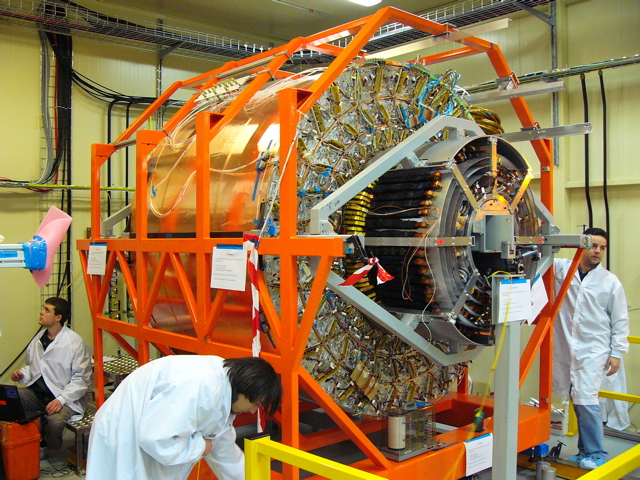
These days, it's not a trip to CERN without a tour in the ATLAS pit. My colleague Pavel snapped this photo of me standing on the scaffolding next to a tiny fraction of the ATLAS detector, which is currently under feverish construction in advance of the LHC start-up, still planned for end-2007.

Needless to say, this thing is big. BIG. But what I still find fascinating is that while the muon system is enormous, and the calorimeters are huge, the "inner detector" which tracks particles in a profoundly complicated silicon and straw-tube detector is much more human-sized. My old colleague Heinz took me to their assembly room where they were surveying the recently-assembled "barrel". Much smaller, but a sublime piece of work with the millions of channels we will be using to study nucleus-nucleus collisions at the LHC.

Mont Blanc, Revealed


This time I have a good excuse: I'm on another trip to CERN for an ATLAS week. It's been non-stop action since hitting the ground (ok, barring an 8 hour collapse after landing on sunday morning). But as I was finishing a videoconference in my colleague's office, we noticed that the clouds had parted, leaving the French Alps exposed to the sunset. Nothing else to do but run outside to capture it on film, or a memory chip. Whatever.

I should mention, however, that I have not seen Mont Blanc from the CERN site since my student days in the mid 90's. It's usually been cloudy during my short visits here. The only way to really guarantee a good view is to head southeast by car. Give me a few days...

Friday, February 17, 2006

Who's the Scientist?

This is the greatest thing I've seen in a while. A group of 7th graders visited Fermilab and made before-and-after descriptions and drawings of their image of scientists.

This is real progress, folks.

(Thanks, Betsy!)

Wednesday, February 15, 2006

Richard and Me

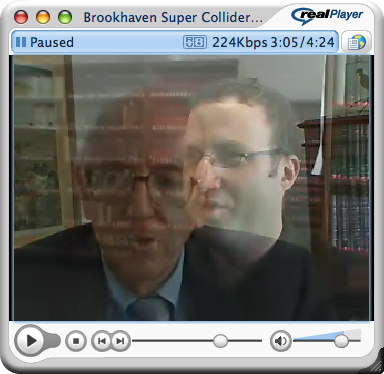
This has been in the works quite a while, but is only now reaching the web. In October, I did an interview with Carolyn Weaver of Voice of America TV about RHIC, it's science, and the controversies surrounding the various "doomsday" scenarios proposed in the 80's and 90's. It's now posted on the VOA website.

What I hadn't realized when I agreed to give this interview was that Weaver had already spoken to Richard Posner, the eminent federal judge. Posner wrote a book in 2004, "Catastrophe: Risk and Response", which discusses the risks of RHIC, among other disasters, and how we are currently not dealing with various eventualities. And here in the final product (shown to the right), I find myself superimposed on Posner, if only for a brief instant. How many of my lawyer friends can say that?

I've discussed Posner and other critics various times in my previous blog, and I maintain that I find their arguments still less than compelling in their particulars. But I never imagined I'd get a chance to say so in public. I still believe that while we should take risks seriously, and in general scientists should be held accountable for the risks they take, and discuss them openly. However, we must constantly be updating the level of risk based on incoming information. Posner (and Rees, for that matter) are basing everything on several papers written in 1999 and before, well before the RHIC data came in. Since that time, we have found that the matter we create at RHIC essentially blows apart as soon as it is made. And more importantly, this matter is not baryon rich, as it was at the AGS. This suggests to me that we're even less likely to make stable strange matter than ever before. That said, I should not be construed to be a real expert on this subject. But that said, no expert I know has suggested that the risk level has increased. There have even been searches for strangelets at RHIC (in the baryon-rich forward region) which have (as always) come up empty!

So until my colleagues A) actually isolate even a hint of a strangelet signal, and B) start to believe (based on experimental data) that RHIC is really a better enviroment for their production than previous facilities (which have established stringent upper limits), I think it's premature to start any serious discussions of the risk of RHIC to humanity as a whole. But I'm sure someone out there already disagrees with me.

Friday, February 10, 2006

Budget Watch, contd., and the Future

Wow, there's a lot of action on science budgets these days. From Bush's State of the Union address, which announced the "American Competitiveness Initiative" (which proposes to double the science budget over the next 10 years) to its manifestation in the 2007 President's budget, which has manifest itself as huge increases to projects near-and-dear to Brookhaven.

The AAAS released an analysis of the budget here, with a choice quote:
The Department of Energy (DOE) would enjoy substantial increases for its energy and science R&D portfolios in 2007, an unusual turn of events for a department that has mostly seen flat budgets in recent years (see Figure 6). The DOE Office of Science (OS) would emerge as the clear winner in the 2007 budget with a 14 percent increase to $3.8 billion for its R&D portfolio centered around the physical sciences. The largest OS programs would all receive increases of 8 percent or more, including a dramatic 24 percent boost for Nuclear Physics after a decade of stagnant funding, a 36 percent increase for computing research, a 25 percent increase for Basic Energy Sciences centered around several large-scale facilities, and a 31 percent increase for the core life sciences research portfolio. Although these increases would help BES, computing research, and nuclear physics reach new highs, high-energy physics, fusion, and biological and environmental research would remain below previous years’ funding levels because of years of eroding budgets.
What a rollercoaster, from the World Year of Physics presenting us with the worst budget in a while, with many gloom-and-doom predictions for the future, to an enormous "bounce" (hope not a "dead-cat" bounce...) and a rosy outlook. But people should keep in mind that a 24% increase relative to 2006 doesn't translate into a huge increase if one averages over the last few years: it's only 15% above the 2005 budget, and inflation depreciates all funding by 3-4% a year, so it's really equivalent to a real 8% increase -- not peanuts to be sure, but it certainly does not sound as whopping as 24%!

This was echoed today by a short presentation by Directory Chaudhari presenting how the budget will directly affect BNL. He reported the robust RHIC budget, promising a 34 week run (not 30 as I mentioned previously), funding for RHIC II-related work (i.e. EBIS, the new ion source), R&D funding for NSLS II (which will be another major facility here, with QCDLab, if it gets sited here) and full funding of the Center for Functional Nanomaterials. All good news, but not nearly as striking as the projections for the lab's future, predicated on these increases. If all goes well, the general shrinking of personnel and near-constant funding levels over the last 5 years will reverse over the next 4-5 years, with the lab's funding increasing by 40% and employment increasing by over 10% over the next five years. Amazing prospects.

Wednesday, February 08, 2006

Justice for RHIC

So after all of the struggles last year (remember the 65% solution?), things are certainly looking up this year. Newsday (and never the New York Times, it seems!) has a piece (and a photo of STAR, with my colleague Gene Van Buren in front!) which seems to have run twice in the last couple of days: "Proposal lets collider run a full schedule".
The relativistic heavy ion collider received $121.5 million for 32 weeks of operation in fiscal 2005, but this year had its budget cut to $110 million. After a $13 million private donation, the collider is scheduled for 20 weeks of operation this year. The proposed 2007 budget includes $138 million for a full schedule of 30 weeks of operation.
This sounds a little awkward, getting more money for less running, but people should realize that we have massive R&D needs, and major upgrades are underway, both for the big detectors (STAR and PHENIX) and for the accelerator (Uranium, anyone?)

But while I appreciate Newsday's interest quite a bit, I wish they would just stop saying this:
The collider is a superconductor that accelerates ions to nearly the speed of light, allowing scientists to explore the smallest known pieces of matter
It's an accelerator, not a superconductor! Yes, there are superconducting magnets everywhere, but ultimately the particles are accelerated in vacuum and just guided by the magnets. Yes it sounds niggly, but I don't think our material science friends would appreciate the confusion either.

Friday, February 03, 2006

Freedom from Justice?

Just a short follow-up to that last post. I arrived for day 2 of Jury Duty at 10am, and essentially did nothing for the rest of the day, only to be fully discharged by 3:30pm, after a two hour lunch break. I was happy to do my duty, in principle, but it still makes me a bit sad that having an overly-developed sense of the objective, and thus a high standard for evidence, makes me a liability to the legal system as it is.

So I guess the scales of justice aren't for me, despite the obvious point that they borrow their defining trope from the scientific method. Clearly, the whole concept of showing the scales of justice is to indicate an objective "measuring" the guilt of the defendant by recourse to brute facts. Go figure: maybe that's why lady justice is portrayed as blind?

Wednesday, February 01, 2006

Law and Physics

After the mayhem of last week, spending 8+ hours a day with ATLAS software, this week has taken on a whole new character: Jury Duty. After holding off the New York Supreme Court for a few months back in the autumn, I was finally compelled to drop by the courthouse this morning. I can't give much in the way of details, but I can report a few things that surprised me.

Jury duty takes a lot less time than it used to: apparently it was two weeks, only a few years ago, but it's certainly never going to end after a day. Minimum is two days, and it's looking like typical cases can take days. Consider that next time you pick your next postponement date. The orientation is cheesy, the time lost from work is a little excessive, but after a while you really start to get into it. While it really looks like a hardship in the abstract, seeing a few details of how the legal system works is pretty neat. Heck, I'm a physicist: I like to know how things work, and the law is supposed to be a machine of sorts, right? Based on laws, just like physics, right?

Well maybe, but they certainly don't seem to value the scientific outlook. While I really can't say much about what went on the courtroom, I can say that I was in the first (large) group of people to be brought down to be considered for a jury. I can also say that I was in the first group of 12 to be considered out of the larger group. So for a few minutes I felt kind of proud of myself, that I could serve my civic duty. Then the questions began, as we cycled through our renditions of the "Voir Dire", a set of questions related to our ability to serve impartially on the jury. Have you ever been a victim of a crime? Do you know anyone in law enforcement? And so on. Most of us didn't set off any alarms in this way, as few people are so scarred by their experiences with courts or law enforcement that they can't consider a situation objectively.

Then they asked us what we did for a living and where we went to school. At first I didn't understand why, although it was fascinating to see the wide cross section of people they had selected, from a wide range of backgrounds and occupations. But a funny thing happened as soon as I said: "Physicist, PhD, MIT". "So you want to be an astronaut?" asked the New York Supreme Court Judge. That started to make me suspicious. Then the prosecuting DA asked: "Mr. Steinberg, scientists typically want objective means to verify facts. Do you think you will be able to believe testimony given by witnesses in the case?" I had to think about this one: "I would feel responsible to my duty to the court, but I really prefer to have some objective verification of facts I am given." I thought this seemed reasonable, to express a high standard for evidence. But the judge lit into me: "You scientists want all the answers! One has to be able to find a defendant guilty on the testimony of a single witness. It's not about the quantity, but the quality!" I realize that this has to be the case, for the system to convict anyone, but I've always been taught to verify everything, since even the smartest, most reliable, people can make mistakes in their perceptions or interpretations.

The defense attorney picked up on my response, however, in a way that made me very suspicious. After he asked me a few questions of what kind of physics I do ("nuclear physics? that's my favorite!" said the judge), he extended this issue of questioning testimony: "I hope all of you will be able to consider that a story given by a witness could be a lie." Always a possibility, but at that point I started to wonder if I was a goner. And after a short recess I was a goner, along with six others in my group, sent back to the pool of potential jurors. Although it wasn't the only reason to cut someone from a jury, the very training I was so proud of, the one that made me so sensitive to various issues in how we know what we know, made me essentially unqualified to serve in one of our most important civic institutions.

So while there are clearly laws of physics, there doesn't seem to be much room for physics in the law. Hasn't anyone seen Minority Report? Better luck tomorrow!

Monday, January 30, 2006

Time of Transition

As usual, blogging slows down as life speeds up. And things have been quite intense recently, as attention shifts almost completely to my new projects. I'm finally making headway with my longer-term project for the PHENIX experiment (a little database, that should grow pretty big over time...) and we just finished an extensive week-long software workshop for ATLAS. This was really the big one for me, when I finally felt "over the hump" in terms of being able to actually use the ATLAS software, which is apparently quite powerful: but with great power comes great...complexity? Anyway, more later as I get my thoughts together (and finish a 15 page writeup of my lectures from Erice last summer, by Wednesday [gulp]).

Sunday, January 22, 2006

Global Fest

No physics connection here (but I've surprised myself before) but this was a pretty neat experience. A friend and I went down to GlobalFest, a smorgasbord of world music at the Public Theater last night. While there were more than a few things to complain about (too many tickets sold, forcing many of us to wait in various lines *after* buying our not-cheap tickets!), it was a good reminder of the worlds beyond our borders, both political and mental. Naturally, there's a flickr set of a few choice photos.

Friday, January 20, 2006

Return of RHIC Round-up

While this story hasn't seemed to reach the national news, via the New York Times (why not, folks?), Newsday has been all over our story recently:
Newsday also has a story about a talk at the lab yesterday that I missed: "BNL's Economic Impact Goes Beyond LI", January 20, 2006. The talk was given by Long Island Association chief economist Pearl Kamer. I can only quote the article since I can't seem to find the report at the moment:
When Brookhaven National Laboratory managed to save one of its key nuclear physics experiments last week by using private financing to fill in federal budget gaps, the effect wasn't limited to the lab itself.

In broader terms, the lab's economic impact statewide is far more significant. Between 1993 and 2003, it added up to 79,000 jobs, $9.2 billion and a host of new technologies that cannot be entirely quantified, according to a report released Thursday by Long Island Association chief economist Pearl Kamer.

The report, which has been two years in the making, shows that the lab is one of the top five high-technology employers on the Island, with 2,750 employees. But what with visiting scientists, the development and marketing of new inventions, and the ripple effect of new technology created in the lab, it's really responsible for tens of thousands of additional, secondary jobs for the state, in industries such as construction, retail and business services, the report said.

And in the future the lab's economic effects could be even greater, with another $5.6 billion and 91,000 jobs statewide by 2014, Kamer's report predicts. Much of the trickle-down effect occurs on the Island, she said, as workers spend money and the economy grows.

Thursday, January 19, 2006

The New World

Sorry to have been silent these last 6 days. A bunch of us went skiing in Vermont for the long weekend (and most of us returned OK...) and since then it's been chaos for me getting retooled for my post-PHOBOS life. We had an internal review of the heavy ion efforts for ATLAS, and since then I've been down with a minor cold, which gave me my only chance to work on my long-overdue PHENIX tasks. That's three acronyms in two sentences, folks. No wonder I'm having trouble keeping up.

And there's a lot to keep up with, especially after last week's blockbuster news of private funding for RHIC. Just as I was returning from lunch today, I overheard a snippet of conversation: "So...we're going back to how science funding used to be...before World War II". It's really true that one just doesn't think about private citizens, or even large foundations, funding science that doesn't offer clear returns on the investment. One is used to thinking of private funding for AIDS, or even for telescopes, but rarely for accelerators (maybe unless they are purposed for radiation therapy...).

Still, this situation asks more questions than it answers: could the emergence of private money inspire the government to make more investments, on the argument that there is clearly interest in the science, or will it just make them cut us further, assuming that we will always find benefactors year-to-year? These are just the first issues that pop to mind, but even this is a brave new world for all of us.

Friday, January 13, 2006

Once a Scientist

There's a lot of ground to cover in the issues surrounding the recent announcement of private funding for RHIC. But as a nice way to start these discussions, it seems apropos to start with a telling quote (at least in retrospect) from the New York Times Business section on November 19, 2005, from an interview by Joseph Nocera with Simons in his Manhattan office:
What interested me most of all was: why? At an age when most men are contemplating retirement, with more money than he can count, why was Mr. Simons still at it? "I enjoy the challenge," he replied.

He then began describing a demonstration he saw recently of a new nuclear accelerator at the Brookhaven National Laboratory, where he is on the board. Two atoms hurtled toward each other, colliding with great force. "A huge number of particles are thrown out," he said, "and the job is to analyze everything that results from the collision."

"Watching the spray of particles on the screen made me think of the stock market," he continued. Every trade, even of a hundred shares of a company, affects every other trade. And every day there are thousands upon thousands of such trades, all of them affecting the rest of the market. His work, as he sees it, is to analyze that incredibly complex mosaic and try to figure out how it all fits together.

"The subject may not be the most important in the world," he concluded, "but the dynamics of the market are really interesting. It's a serious question."

I suddenly understood the motivation behind Mr. Simons's new fund. He's doing it because he wants to see if it can be done. Once a scientist, always a scientist.
Hear, hear. I've reposted the STAR image just to show what Simon was referring to.

The News

That was fast: Director Chaudhari just announced that James Simons, along with partners, has committed to raising $13M for the RHIC run. This is great. I know that I and all of my colleagues are really excited about this. More later.
OK, more now. Here is the statement by the Director.

Information about James Simons can be found here, via Wikipedia. Of course, we all trust Wikipedia as much as we trust...bloggers. Right?

Buzz

To those of you who remember, the 6th RHIC run was saved by an infusion of mysterious funding. I've restrained myself from posting the various rumors I've heard as to its source, but my silence is about to be lifted. In just a few minutes, the lab director is scheduled to give an update about the budget, presumably informing us about where the money came from and the effects it will have on the lab (reducing involuntary layoffs, especially!). Stay tuned.

Wednesday, January 11, 2006

Inna Gadda da Vida, Baby

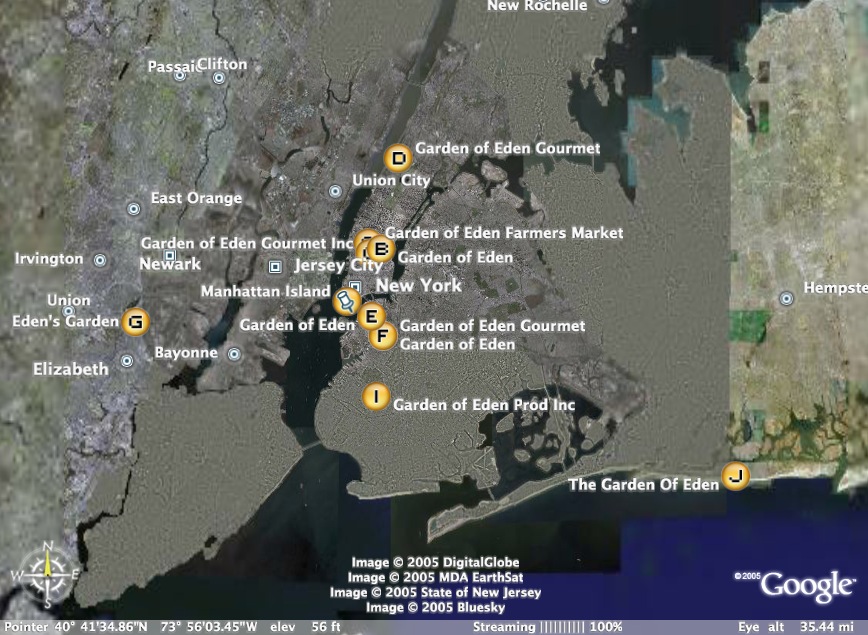
Lots of stuff going on at work: little of it amenable to the blog. That said, it has been fairly exciting to be Apple-watching of late. New CPUs, Tiger upgrade, the MacBook (everyone seems to want one... including me) and... Google Earth. Google Earth. So now I can look for my very own apple (or MacBook) in the Garden of Eden. But given the choices Google Earth gives me, even just in the NYC area, I don't even know where to start...

Monday, January 09, 2006

A Random Walk Down 22nd Street


I'm still catching up with the weekend activities. This is an opportunistic shot of a wall-sized piece by Matthew Weinstein I took at an opening we went to on Saturday at the Sonnabend Gallery on 22nd St. in NYC. Hard to tell from the low-res cameraphone shot, but these are 100 metal cocktail tiki umbrellas arranged on the wall. What could be more obvious?

What you might not have perceived right away is the pattern, or possible lack of the same, in the arrangement. Turns out that my friend's father is a frequent collaborator with Weinstein and wrote the code for a series of models to arrange the umbrellas according to a scheme oddly familiar to me (see below):
  1. Choose a random position in the box (and only in the box)
  2. If the umbrella is less than a minimum distance (d) from any other umbrella, try again.
Turns out that a too-large value of d makes it harder and harder to even find a configuration of umbrellas that fits on the wall. It also turned out that given a choice between a relatively large and relatively small value of d (this was a value near the largest tested), the artists preferred the larger values, since it looked more "random" and reduced the tendency to appear "clumpy" (which turns out to be natural for truly random distributions!)

This kind of model is all-too familiar for me in two scenarios:
  1. Particles emitted by nucleus-nucleus collisions always seemed to "clump" on our event displays. We argued for hours (turning into years) about the dynamical reasons for this kind of thing, but eventually realized the obvious: that Poisson statistics (which characterize truly random choices) always seem to show "clumpy" behavior!

  2. Nuclei are modelled by throwing nucleons into a roughly spherical distribution. Of course, experiments tell us that there is a "hard core" in the interaction between nucleons, making a minimum distance between them (at least in stable configurations) required for "physical" nuclei. My colleagues and I have been exploring the consequences of this "hard core" distance, and found that while some of our colleagues don't "like" the d=0 version (on the left: too many clumps!), you can only make it so big before it becomes unphysical again (on the right). In the latter case, it becomes larger than the known size (shown as a large sphere).


(These excellent images were made by Pete Walters, a PHOBOS colleague and one of Steve Manly's students at the University of Rochester -- I'll have a link when his full study for PHOBOS is made public!)

I'm still trying to figure out exactly why we think that "uniform" (i.e. unclumpy) distributions are more "random", or sometimes even more "physical", than truly random ones. My walk down 22nd street hasn't helped, but it's certainly got me thinking.

Saturday, January 07, 2006

Spiral Scratch (Diplo @ Guggenheim)


Sometimes chance throws you a bone. During the dinner after PAC meeting in November (existential nihilism, anyone?), one of my colleague's wives was raving about the RUSSIA! exhibit at the Guggenheim museum this season. A few days later, slightly hungover (did I just admit that?), I found myself watching the NY Marathon, ambling over to the Gugg, and becoming a member in the hopes of forcing myself back there later.

Little did I know that I was just in time for one of the more fun events I've ever attended in NYC: the First Fridays event celebrating the close of RUSSIA! with Diplo running DJ set until 1am. The line ran around the block even at 10pm, but membership has its privileges (totally kidding, folks, but this was my good luck for the evening having become a member for a totally unrelated reason...) Really neat seeing all of the art (amazing) with a huge crowd on the ground floor, and lots of others hanging over the walls of the ascending spiral. And the DJ set was excellent, especially seen from directly above (see the photos...)

Naturally, I took a lot of photos. Have a look at my Flickr set!

Friday, January 06, 2006

Lego(s) and the Scientific Outlook

Fun season so far, but pretty busy overall. That said, an amusing issue popped up at lunch, yesterday. Chatting with a friend of mine, a plant biologist at BNL, we both realized that we both were Lego-obsessed kids. Then it turns out that he was part of a group of three friends growing up in England on the same street, who were all obsessed with those multicolored plastic blocks, and they all became scientists. Adding me to the sample, that's 4 for 4: anyone else out there? It's always amused me that high-energy physicist have been using "Lego plots" for years, but it never occurred to me that it could be part of a larger trend.

I also learned that one doesn't play with "Legos" across the Atlantic. One plays "with Lego". Go figure.

Wednesday, January 04, 2006

artifact: relativator

At last the loop is closed. It began as a mild-mannered post on Quantum Diaries last March, made a pit stop during a photo-shoot at BNL in late August, and has finally culminated in a bona-fide article in Symmetry Magazine (which I somehow didn't get in my mailbox!). Check out the PDF version with the full-page photo!

Monday, January 02, 2006

Preservation Hall Jazz Band


Preservation Hall Jazz Band
Originally uploaded by entropybound.
As the year ended, it was quite staggering to reflect on the insane menagerie of biblical-scale disasters which took place. It was thus quite moving to take in one of the performances by the Preservation Hall Jazz Band at the Jazz Standard in NYC. Amazing to consider that these guys have seen their home city (and homes, presumably) washed away but still maintain such a level of good humor, professionalism and sheer fun. We even got to see Allen Toussaint (a New Orleans legend, and a longtime fave of mine) amble out the door after the early show while we waited to descend down for the late one.

Sunday, January 01, 2006

Waiting For Einstein

OK, this has made me mad. John Horgan, author of the much-debated (and unread-by-me) "The End of Science", has managed to secure himself the last page of this week's New York Times Book Review on which to tell us that "Einstein Has Left the Building."

"End of Science" was notorious when it came out in the mid-90's, since it claimed that most of the major discoveries had already been made (shades of the pre-Quantum era!) and that there was little left to do in fundamental physics but fill in a few details. The obvious point it seemed he missed was that science always looks this way, until it doesn't. In 1996 we had no accelerating universe, no WMAP, no RHIC (I must get my plugs in where I can!). In 2005 we simply know more than we did 10 years ago, but if science policy makers would have taken Horgan seriously (at least at the book-review level) we wouldn't have learned nearly as much, since they would have been under the impression there was nothing left to do.

The new article leaves a bad taste in my mouth as the World Year comes to a close. Horgan muses on how nothing important happened in 2005 despite all of the WYOP hype. Moreover, he seems to be implying that all of the attention paid to Einstein just makes us more cognizant of the possibility that there will never be another of his ilk. Rather than grapple with the big questions of the limits of time, space, and even technology, he argues that physics is far too involved with questions beyond the realm of testability, trotting out the usual complaints from him and others about the inaccessibility of string theory, extra dimensions, etc.

I have no interest in taking him on point-by-point, but I think he misses several obvious points. Firstly, even Einstein was "no Einstein" in 1905. The papers came out, and took years for the importance of all of them to be fully recognized by the scientific community. Thus, 2005 may well be a watershed year in science, but we just won't know that for at least a few years.

Of course, that comment could and does apply to any year. What really frustrates me is that he has missed the point of the world year of physics altogether. While the hype may have been over-the-top at times, it really revealed that people -- normal people, everywhere -- really like to hear about, and talk about, science. Moreover, while we may not get too many Einstein's, both in terms of depth and breadth of intellect, as well as moral commitment, we've at least reawakened a general sense that 1) science is important (take that, Dover), and 2) it's made by individuals (and not just institutions and governments, but that's another rant), and 3) no-one knows when a major discovery will happen. I can't imagine that the world experts in 1904 would have seen 1905 coming around the corner -- and I have trouble believing that science writers, or anyone, can predict the shape of the science to come. That said, nor should they preclude that science from happening by fomenting radical skepticism about the whole project.

OK, I'm not mad anymore. Back to work!

Saturday, December 31, 2005

The Old Blog is the New Blog

Sad, but true, Quantum Diaries is now over. You can still have a look at the archive of posts at http://qd.typepad.com/5 (but let me know ASAP if you can't!) but now I'm on my own again. Amazing how a year flies by, but Happy New Year everyone and see you again in 2006!

Monday, June 27, 2005

On Hiatus


Releasing a new paper...
Originally uploaded by entropybound.
For those of you making it here by accident, my *real* blog is at http://qd.typepad.com/5 for the rest of 2005. That's a "Quantum Diary", along with 32 of my best colleagues (a few of whom I've even met)...