
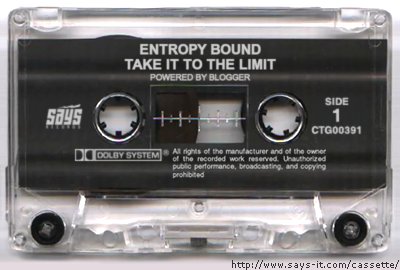
 Look what I dug up. I didn't realize that I was audio blogging back in the early 90's. Ok ok, I found this here, via Gizmodo via Boing Boing.
Thursday, September 28, 2006
Artifact
Look what I dug up. I didn't realize that I was audio blogging back in the early 90's. Ok ok, I found this here, via Gizmodo via Boing Boing.


Saturday, September 23, 2006
Quarks Swim Free
 Not sure how I missed this, but Elliot Sharp has a piece floating around town these days that I really should check out: "Quarks Swim Free":
Quarks Swim Free is E#'s latest algorithmic piece for Orchestra Carbon. For 11 or more musicians and based on prime numbers, Quarks Swim Free creates a dense primordial soup filled with high-energy collisions, gnashing grooves, and warped melodies. Quarks Swim Free premiered at the Venice Biennale in 2003. This performance will be captured by noted documentarian Bert Shapiro for his film on E#'s work.Sounds neat, but I was intrigued where the title came from. Best I could come up with was Kenneth Chang's NYT piece (archived by Brookhaven here):
For this concert the ensemble includes Kinan Azmeh, Curtis Fowlkes, Rachel Golub, Brad Jones, Ron Lawrence, Jenny Lin, Chris McIntyre, Rudresh Mahanthappa, Kevin Ray, Danny Tunick, Alex Waterman and more
An atomic nucleus consists of protons and neutrons, which, in turn, consist of smaller particles, quarks. Quarks are held together by still another type of particle, gluons. In ordinary matter, it is impossible to pull out an individual quark or gluon.I saw Sharp play at a benefit last year, accompanying a Jenn Reeves film (thanx Jen!), and I definitely would have swung by last night (if one can swing by Carroll Gardens from the Upper West Side...), but it's Rosh Hashanah folks and Kate and I had a service to attend. Happy new years everyone!
But with hot temperatures and high pressures, physicists theorize, the gluon bindings loosen, and the quarks can swim free, melting protons and neutrons into a new state of matter, a quark-gluon plasma.
Thursday, September 21, 2006
Blow-Up
 Uh-oh, trouble in cosmologyland: Type Ia supernovae, the objects responsible for the post-1998 consensus that the universe is not just expanding, but accelerating, aren't such standard candles after all:
Now, astronomers led by Andrew Howell of the University of Toronto in Canada have found a type Ia supernova that is 2.2 times as bright as others of its class. Called SNLS-03D3bb, it lies about 3 billion light years away, a distance that was independently verified by studying the light spectrum of its host galaxy.As a student, I found it amazing that you could use brightness to measure distance. One always suspects that it's harder than it looks, but it's quite impressive that they have sufficient precision to detect outliers. Unfortunately, once everyone trying to image the dynamics of a younger universe gets on board, they're probably going to have a fun time agreeing on just who the "rogues" really are.
That brightness, along with other clues from the supernova's spectrum, suggests the white dwarf exploded with 2.1 solar masses of material – significantly above the Chandrasekhar mass. "It wasn't a little bit over – it was way over," Howell told New Scientist. "We're forced to say it's not a measurement error."
These young galaxies are found more often in the early universe, which corresponds to greater distances from Earth. "This might actually improve our precision in future studies if we identify this little subset of supernovae," says Howell.In my kind of physics, we sometimes call such things "pentaquarks". Ouch.
(Thanks to slashdot, apologies to Brian de Palma for post title...)
Monday, September 11, 2006
The Rising
Hard to believe it's been 5 years, isn't it? Long story, but I spent most of yesterday in Valhalla, NY, out in Westchester County, watching the dedication of "The Rising". This 80-foot high steel structure, designed by architect Frederick Schwartz, commemorates the 109 Westchester residents who died in the 9/11 attacks. A beautiful work, poignant and soaring -- and not absurdly expensive.
The dam itself is a beautiful object in itself, massive beyond words. All of this, plus candids of Hillary Clinton, Chuck Schumer, and a Bruce Springsteen tribute band, here in my Flickr set.

The dam itself is a beautiful object in itself, massive beyond words. All of this, plus candids of Hillary Clinton, Chuck Schumer, and a Bruce Springsteen tribute band, here in my Flickr set.
Friday, September 08, 2006
The Chelsea Particle Zoo
 As one of the seemingly-few unofficial nuclear physicists about town, I can't resist chiming in when the culture industry starts to wander into scientific territory. Kate and I cut out of work a little early yesterday to check out the endless array of Chelsea art openings. I wasn't expecting much (not following the art scene too closely, I admit) but I wasn't expecting The Particle Zoo at the Mike Weiss Gallery.
Don't get me wrong, there is enormous potential in mining scientific concepts and images. Nature throws us many things we could never have imagined until we actually look (with eyes or detectors or telescopes or models, etc.). That said, rainbows and glassy shapes don't really do it for me.
Monday, September 04, 2006
Follow the Bouncing Ball
Summer's over, folks, as is my recent vacation (to the North Fork of Long Island, Southwest Florida, and finally back to NYC). But what better way to acknowledge this fact than to sit my ass down for 6 hours to watch a lot of great tennis at the US Open. Some friends were already going and it didn't take much to get Kate and me on board. Have a look at my Flickr set!
Clearly I didn't get to see Agassi's final game, but given the sold-out General Admission tickets I'm glad I got to see anything at all. Then again, who can complain about seeing greats such as Safin and Davenport without too much fuss? I even learned how to run my camera (Panasonic FZ10 -- beautiful machine, that) in "sports mode" and capture wild serve poses that I would never notice with just my eyes. There's a lot more richness to the game than just the elastics and ballistics of balls hitting rackets.

Clearly I didn't get to see Agassi's final game, but given the sold-out General Admission tickets I'm glad I got to see anything at all. Then again, who can complain about seeing greats such as Safin and Davenport without too much fuss? I even learned how to run my camera (Panasonic FZ10 -- beautiful machine, that) in "sports mode" and capture wild serve poses that I would never notice with just my eyes. There's a lot more richness to the game than just the elastics and ballistics of balls hitting rackets.
Wednesday, August 30, 2006
Melvin Schwartz Dies at 73
 Terrible day, the world losing both Naguib Mahfouz and Melvin Schwartz. Schwartz was many things, a professor at Columbia, Nobel-prize winner in 1988 for the discovery of the muon neutrino, and a major figure in the history of Brookhaven. He was both a scientist there (i.e. the neutrino work) as well as an administrator (overseeing the RHIC project in its early stages!).
 Just a point left out of the obituaries: I never met him (he had left the field again by the time I got my PhD), but I always enjoyed his book on electrodynamics. It was one of the more elegant descriptions of the physics and mathematics that I had seen up to that time (1991). And it was cheap -- god bless Dover.
Tuesday, August 29, 2006
Wired, Tired
 When did Wired magazine become merely glib?
Despite the demagoguery (and apparent laziness) of those who keep making these kind of claims (i.e. they haven't read anything about the subject since 1999 *before* the machine turned on, or they only read people who have written about it since, who themselves have been asleep since last century...), RHIC has produced hundreds of interesting papers, many new scientists, and several really fascinating results about high density matter. And no black holes.
(Thanks Rick!)
But if you check the next page, then things are more like it. In the "Wired, Tired, Expired" list for the week: "Wired: scientist blogs". Still can't say Wired is, well, required, but my vanity can't keep from giving it a few points.
Tuesday, August 22, 2006
Who's Gonna Live Forever?


Not to overdo NYTimes mining, but I'm still trying to figure this one out. Do the best of us truly become fame-obsessed, or run for the hills when the pressure gets too great?
Einstein, Mao,and Me
 How can someone resist procrastinating when stumbling on an article like this? Dennis Overbye's profile of Xu Liangying, the foremost translator of Einstein's works in China, and a communist revolutionary turned dissident. From humble beginnings:
The love affair between Dr. Xu, who was born in Linhai, Zhejiang, in 1920, and Einstein began when Dr. Xu was in secondary school and read a collection of Einstein’s essays called “The World as I See It.” The book had as much politics as science. In one passage that the young Xu underlined, Einstein wrote: “The state is made for man, not man for the state. I regard the chief duty of the state to protect the individual and give him the opportunity to develop into a creative personality.”
Dr. Xu said, “I wanted to be such a person.”
Einstein's outlook on intellectual freedom developed into a source of political philosophy that got Xu into more trouble than not. Definitely worth a few wasted minutes at work.
Monday, August 21, 2006
A Matter Darkly
 Go freaking figure, just a day after ranting on about RHIC physics to a whole group of friends who trekked out to BNL from NYC, those damn astronomers have got to get some cheap media attention by doing something easy: like finding dark matter. What I find somehow pleasing, though, is how conceptually familiar it all feels. Hereby begins a novice's description
The image shows a collision of two galaxy clusters, but imaged in three different ways. The optical image shows flashes of white galaxies, something we are used to seeing through telescopes. The pink shows an image of the distribution of hot gas surrounding the cluster, imaged by X-ray astronomy (i.e. by looking at the photons emitted by the gas), which seems to have taken on an oddly "Mach Cone" shape, if I may add. Finally the bluish clumps are the distribution of mass, as imaged by the distorted views of the galaxies behind (i.e. gravitational lensing).
The rub lies in the way the pink and the blue have separated. The general view is that the gas has slowed down as the clusters passed through each other, while the dark matter has continued moving on. But if the gas was somehow the more massive part of the system, one would have also found the mass there as well.
The familiar part is that my colleagues and I have been pondering what happens when clumps of things we like, strongly-interacting nucleons (i.e. nuclei), pass through each other at high speed. We also try and "image" the space time story, but of course using different tools. We can't see spatial distributions directly, but we can infer them from the final velocities. Of course, they can't repeat their collisions, while we do so thousands of times per second. And we're all using theories, like hydrodynamics, which are amazingly applicable at extremely microscopic and extremely macroscopic scales.
Friday, August 18, 2006
School of Rock, Gnarls-style
Hi everyone - I swear I'm getting back to blogging one of these days. But it's been a busy summer, both professionally and non. I shouldn't admit this, but we managed to actually see Gnarls Barkley last night at Summerstage (i.e. I had to duck out of an all-day meeting a little early, driving by a car whose wheel fell off in front of me...). Check out the photos!

Tuesday, May 23, 2006
Remain in Light
 It's spring, and I use almost any excuse to post songs I like (which I only seem to do when I have too much time on my hands, as was the case this weekend with my girlfriend out of town). This one seems to have arisen out of a recent Talking Heads re-obsession, mixed with working to Fela Kuti albums (on iTunes, cheap) as background music. Have a listen.
Sunday, May 21, 2006
Spinning Round (or Square or Hexagonal...)
 From Slashdot, here's this unreal article in Nature.
Tomas Bohr and colleagues made plexiglass buckets, 13 and 20 centimetres across, with metal bottoms that could be rotated at high speed by a motor. They filled the bucket with water and spun the bottom to whip up the liquid into a whirlpool that rose up the sides of the container.I mean, symmetry breaking is one thing, but where do pentagons come from? Why do things "quantize" in this way, when there's nothing obvoiusly "quantal"about the problem?
This set-up is very similar to the rotating bucket that Isaac Newton used in the seventeenth century to investigate centrifugal forces.
The researchers found that once the plate was spinning so fast that the water span out to the sides, creating a hole of air in the middle, the dry patch wasn't circular as might be expected. Instead it evolved, as the bucket's spin sped up, from an ellipse to a three-sided star, to a square, a pentagon, and, at the highest speeds investigated, a hexagon.
Saturday, May 20, 2006
No, Steve, *you* the man

That said, something about this opening felt important (and not just to justify two hours waiting in line just to see a store.) This is a computer store, opening up (and staying open 24/7/365) at the gateway to the shopping on 5th Avenue, but right on Central Park. But it's also an architectural gem, a focal point for technology and content, California and New York, young and old, and so on. And it's a far cry from the tiny shop in Lincoln Park in Chicago in 1979 where I saw my first Apple ][, but it feels just as special. There are reasons people (like me) are so impressed by Jobs and his good works, and this is an important one for me.
Thursday, May 18, 2006
Boulder Workshop 2006

Monday, May 15, 2006
Big Bang of the Day
Speaking of Big Bangs, anyone realize there was a musical about it? Well there is: it's playing tonight at the CUNY Graduate center in Manhattan. Not sure I can make it, but sounds amusing.
Big (Glass and Chrome) Bang
 Damn, 3quarksdaily beat me to this one, but I just wanted to show a photo and say a few words about Josiah McElheny's show at the Andrea Rosen Gallery in Chelsea, which I saw on Saturday. My friend Ofer pointed me to an article about this in the NY Times last weekend (now hidden behind the walls of Times Select), but nothing in there prepared me for how amazing this was. "An End To Modernity" is an homage to both the chandeliers at the Met Opera house in Lincoln Center and the introduction of the Big Bang theory, both in 1965. One sees the emanation of "lines" from an occluded "core" (indicating the moment of recombination, when the universe became opaque), and the development of those "lines" into clusters of galaxies of different shapes. Really excellent, and moving in its size, scope, and attention to detail (both of craftsmanship, and scientific).
 Of course, I see RHIC collisions everywhere, and this is no exception. I see hadron emission from an "initial state" which we have trouble understanding due to "hadronization" and the decay of those hadrons isotropically in their own rest frame. But maybe I see dead people too? If anyone is interested, I can explain more -- i think the analogy works pretty well (except RHIC collisions are definitely not globally isotropic, as many think the universe is and should be...). There are even points of light -- photons! -- in between the clusters of glass. Nice to have a model to simultaneously compare one's thinking on Big and Little Bangs.
Tuesday, May 02, 2006
Rock the Casbah
With gas prices spiking (you notice these things if you make at least one trip between Brookhaven and Manhattan on a given weekday), chaos in the middle east (you notice these things if you have a pulse), and a bunch of great recent videos of the Clash being mentioned on the usual major blogs (you notice these things if you sit in a lot of meetings...did I just admit that?), I thought I'd give YouTube a go and keep those memes jumping. This is only a test, but given this outrageously simple (in concept, not in execution) but profound (emailing and blogging video) technology, isn't it a great world we live in?
Monday, May 01, 2006
Springtime @ BNL
You know it's here when the trees by Berkner hall burst into bloom. And springtime in NY and NYC is really excellent.

Subscribe to:
Posts (Atom)
