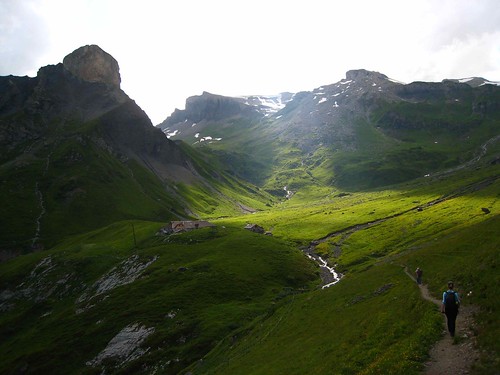
And yes, I saw the movie last night, but didn't see any alpine sunsets anywhere -- just that crazy Joker everywhere.
Saturday, July 26, 2008
Bernese Bat Signal
And yes, I saw the movie last night, but didn't see any alpine sunsets anywhere -- just that crazy Joker everywhere.
Wednesday, July 23, 2008
Bernese Oberland
Taking PHOBOS Apart
One of my BNL colleagues wanted to see these again, so I decided just to go ahead and post them online. These are the most recent photos of PHOBOS in its final incarnation, as it was when we had to take it apart in 2005 and put it in "cold storage" for a few years. You can finally see all of the various pieces of the system we usually show as a CAD drawing in our scientific talks -- the magnet, the silicon, the beampipe, etc. Frankly, while at first glance it looks quite chaotic, I find the silicon detectors themselves alarmingly symmetric and beautiful looking. And incredibly clean, which is unsurprising considering they were safely protected in a light-tight enclosure for 6 years! Enjoy.
Saturday, July 19, 2008
View from Fort L'Ecluse
Still catching up from my long trip. Here are a few photos from an afternoon playing hookey from meetings. An ALICE friend of mine had stumbled onto Fort L'Ecluse years ago, on another hookey trip, and wanted to check it out again. However, this time they'd completely revamped the fort, made it into a museum, and given access to the upper fort (Fort Superieur) 1000 steps in the air. While I hadn't expected a Washington Monument level climb, it was totally worth it for the views (of Mont Blanc, the Rhone, and the Vuache) which happened to be on the most perfect day I'd seen in Geneva for quite a while. Anyway, enjoy.
For those curious, the fort is a drive about 20 minutes southwest of CERN (just between Meyrin and Saint-Genis-Pouilly, straddling the border), at a "notch" in the Jura just below Collonges, which looks like this (thanks, Google):
So it gives fantastic views towards the Alps to the east, especially Mont Blanc, which features prominently in a few of the photos.
For those curious, the fort is a drive about 20 minutes southwest of CERN (just between Meyrin and Saint-Genis-Pouilly, straddling the border), at a "notch" in the Jura just below Collonges, which looks like this (thanks, Google):
So it gives fantastic views towards the Alps to the east, especially Mont Blanc, which features prominently in a few of the photos.
Friday, July 11, 2008
CERN Rainbow
I know things have been silent on this blog since before I left for Switzerland, but it's been flat out for me since that Wall-E post. First I had to get ready for my trip, which involved a week in the Bernese Oberland, a week in Bern for an ATLAS meeting, and now a partial week here at CERN getting my head around ATLAS itself. Then I had to hike up and down mountains for a week, breathing the cleanest air, drinking the cleanest water, and eating lots of swiss hiking food. I've just finished the week in Bern, which is an unbelievably nice place, especially with the weather. And now I'm holed up in a hostel room at CERN (the CERN hostel being better than many hotels I've seen) waiting out the intermittent rainstorms. Of course with crazy weather comes some crazy luck, like this circular rainbow hovering over Geneva: auspicious, no?
Sunday, June 22, 2008
The BNL of the Future
I totally missed this, but the marketing for the upcoming Pixar film Wall-E has a fake website for a company called "Buy-N-Large", whose acryonym is kind of familiar to me:
I wonder if anyone at the lab is going to make the connection? Of course, this new BNL has to compete with Banco Nazionale del Lavoro in Italy, and Bare Naked Ladies, and, um, B&L Associates. But the movie seems to suggest that BnL will be all right, especially from the perspective of the far future.
Needless to say, that despite a major work trip coming up the next day, my wife and I will be lining up to catch Wall-E when it opens this week. The NYTimes article yesterday (today?) made sure that resistance would be futile, at least for us.
Tuesday, June 10, 2008
Physics and Politics
I actually spent time on Capitol Hill when I was in college, working for a Congressman. Fascinating time, but that was a major inflection point in my life story, when I decided to do science instead -- hoping to avoid some of the messiness of politics in my real life. Of course, do science for a few years and the messiness of it comes roaring back at you: so I really respect these guys trying to roll up their sleeves and interject fact-based reasoning into the policy-making process.
Friday, June 06, 2008
The Four Phases of PHOBOS
Of course I'm still catching up with last week, partly due to distractions this week, and partly since it took a few days for the organizers to post all of the talks from the RHIC Users Meeting. One talk which was particularly significant to me was "The Four Phases of PHOBOS" by Wit Busza from MIT, who has been spokesman of the PHOBOS experiment at RHIC since its inception in the early 1990s. He was even spokesman before PHOBOS was even a proposal, back when it was a conceptual design called "MARS", shown here to the right, which eventually became the PHOBOS experiment (side note: while MARS was actually an acronym, PHOBOS never was, even if it was presented like one). And he was there all the way through it's first incarnation as a working experiment, even in pieces
(see left), through its "golden age" from 2000-2005 as a working active experiment (below), and even now as the collaboration is still analyzing the data and writing papers despite the experiment being completely disassembled.In fact, it was also notable that last week was when PHOBOS was finally taken from BNL and brought to MIT by van (see loading photos below), where various sections will be shipped to the participating institutions -- the physics equivalent of a hunting trophy. Of course this is kind of like a hunter mounting a gun on the wall instead of the deer. Too bad you can't put a "perfect fluid" (or whatever) on the wall -- since, although small, we were an active participant in that hunt since the very beginning.

Monday, June 02, 2008
Bo Diddley
Sunday, June 01, 2008
The Gospel According to Oliver
It was hard to know what exactly to expect from this event, where Oliver Sacks was guest speaker at the Abyssinian Baptist Church up on 138th Street in Harlem as part of the World Science Festival. But pairing a short, but substantial talk by Sacks about "Music and the Brain", with a full-on gospel concert by the Abyssinian Gospel Choir, and introductions by Calvin O Butts III, an impressive speaker in his own right, made for a stellar evening. Brian Greene even gave a star turn doing his best impression of a Baptist preacher, and then took off for his Guggenheim gig downtown (anyone see that?). Even better, I had a Quantum Diarist sighting -- that's Stephon Alexander standing in the front with Jim Gates (who also was part of the Gugg event), as they were acknowledged by Butts during his introduction.
UPDATE: The TED blog has asked if they could use my photo for their report on the same event.
Saturday, May 31, 2008
Dept. of Shamelessness, Part II
And before things accelerate again, just wanted to pass along a couple more pieces of good news. On Thursday, during the RHIC/AGS Users Meeting (yes it ran all week), two things happen that don't normally Happen To Me: a certificate of appreciation for helping bring the BNL Cafe in reality (I'm still blushing -- all I wanted was a cup of coffee), and I survived the election to win a seat (one of several) to the Users Executive Committee. Growing up, I never really thought of myself as community-minded, but something seems to have changed in the last few years. Brookhaven is a lovely place, and RHIC a great place to work, and it's been fun to take a more active role in keeping it that way.
Moscow on the Moskva
Friday, May 30, 2008
Entropy Bound in Physics World
Thursday, May 29, 2008
Thank You (Faputtinme on the NYTimes Website)
Sly Stone is one of my favorites, and this is my favorite period of his career. And his 1973 expression, surrounded by the ephemera of the modern web, is priceless.
The PHOBOS Glauber Monte Carlo
As a follow up to this post, several colleagues and I just posted a paper to the arxiv today: "The PHOBOS Glauber Monte Carlo." This is one of those technical-sounding things, but which has had a surprising relevance to understanding actual RHIC data. Many people treat nuclear collisions by considering the nuclei to be overlapping smooth distribution of protons and neutrons. However, it is also reasonable to treat nuclei as clumps of protons and neutrons as individual particles, especially since that's, um, what they are. The interesting part is that the positions jiggle around collision to collision, and those fluctuations seem to have real manifestations in physical phenomena (see, e.g., this paper). Anyway, there is an amusing back story here: when we were writing one of the early PHOBOS papers back in 2000, we discovered that we needed our own implementation this kind of thing. I was on a trip to South Africa at the time, so I cobbled something together on the plane -- and this is the core of what we've now put out for public release almost 8 years later. That said, it's not rocket science (i.e. every experiment has their own version), but despite a ream of papers and Glauber reviews, there have been relatively few codes available until now. Enjoy.
Wednesday, May 28, 2008
The Physics of Privacy
Fantastic -- an anonymous donor has recently stepped up to contribute $5 million to Fermilab (via the University of Chicago) to help end its furloughs.
It's incredible that Congress as a whole still does not appreciate the intrinsic interest high energy and nuclear physics generate outside the field. RHIC already showed that private funding actually makes both sides look good: the donor for supporting something which promotes science and technology, and participating in the process of discovery, and the scientists for attracting the attention of powerful people outside the government. While it clearly will never be enough to rely on private donors, it bodes well for the future of the field.
RHIC Users Meeting
Thursday, May 08, 2008
Bait and Switch
I've been thinking a bit about Kelly McMaster's book about Shirley, her hometown just a few miles south of BNL, and the air of mystery she tries to generate about the lab where I work, a sense which she passes on to those who listen to and interview her (and who often have never been out there).
The main disconnect I sense with her argument (and full disclosure: I haven't read the book yet, but have only heard interviews and read some of her writing online) is between her sense of wonder about the lab as a child, with her fear and loathing of it as an adult.
The wonder, from her Mother Jones piece:
I gravitated toward a scientific life with fantasies of sci-fi movies running through my head, with large machines emitting lightning at the flip of a huge Frankenstein-type switch, or several people poring over softly-glowing computer screens as an experiment produces fantastic data in real-time, and great discoveries are made. I thought this kind of thing actually happened even as I started grad school (even if I had never seen it in my various research summers...)
Unfortunately, the gap between fantasy and reality is as large as the gap between a scientific experiment and comprehending its implications. Things always take a long time to get started, a long time to happen, and a long time to understand, and often involve false starts, misundertandings, mistakes, retries, etc. This is because we have to constantly test our hypotheses against what we observe in the world around us, either through our own experiments or by scouring the literature (which also takes forever) for similar results. Kind of like a journalist, come to think of it. Bottom line is that the daily work of the scientific life just isn't as colorful -- or ever as sinister -- as McMasters seems to imagine (the conferences and talks etc are another matter -- fun as can be).
That said, maybe I speak as someone who is officially allowed to enter my lab on a daily basis (a privilege I share with 2500 other employees, less than 1000 being scientists, I should add). I suppose if you are put off by the fact that someone at the gate asks who you are, then you might wonder if the lab is hiding something, and develop a sense of mystery to justify one's feeling as an outsider. Then again, you might not have noticed that they have public lectures and musical recitals (always open to the public) almost every week. But it's possible that I only perceive the friendly-and-open side of things -- some bias of this sort is unavoidable, it seems.
So the child in me always wishes someone would take me to the secret parts of the lab --where the lights are flashing, and lightning strikes, and green goo runs out of a vat into the ground, i.e. where the wild things are. But maybe no-one seems to know where they are anymore -- or maybe they aren't there, and were never there. Or maybe I've just grown up a bit and actually taken a look around.
But when you get down to it, it's a bait-and-switch: when you are growing up, no-one ever tells you that things aren't so colorful and mysterious, so by the time you finally realize that it's not, you've found a much more interesting -- albeit prosaic --real world to ponder.
The main disconnect I sense with her argument (and full disclosure: I haven't read the book yet, but have only heard interviews and read some of her writing online) is between her sense of wonder about the lab as a child, with her fear and loathing of it as an adult.
The wonder, from her Mother Jones piece:
As a child, I imagined the lab’s buildings were made of an igloo-like substance, and the rooms inside were full of metallic file cabinets, clinking glass test tubes, and notebooks full of secret codes. Men and women in crisp white lab coats and plastic goggles coaxed new species of frogs and lizards out of mottled purple eggs. Others hovered over milky glass globes of light whose kinked antennas sparked blue shots of electricity into the dim, silent air.And the loathing, in the same paragraph:
My neighbor worked as a maintenance man at the lab, and he often teased that he glowed in the dark. After he died of brain and lung cancer, my imaginary lab became a much darker place—a small, sinister pocket hiding in the pines.The strange part for me is that I can identify with the disconnect between the childhood fantasy and the adult reality, but mine is a different trajectory than hers (and don't assume I'm unaware of the emotional trauma of a close loved one with cancer).
I gravitated toward a scientific life with fantasies of sci-fi movies running through my head, with large machines emitting lightning at the flip of a huge Frankenstein-type switch, or several people poring over softly-glowing computer screens as an experiment produces fantastic data in real-time, and great discoveries are made. I thought this kind of thing actually happened even as I started grad school (even if I had never seen it in my various research summers...)
Unfortunately, the gap between fantasy and reality is as large as the gap between a scientific experiment and comprehending its implications. Things always take a long time to get started, a long time to happen, and a long time to understand, and often involve false starts, misundertandings, mistakes, retries, etc. This is because we have to constantly test our hypotheses against what we observe in the world around us, either through our own experiments or by scouring the literature (which also takes forever) for similar results. Kind of like a journalist, come to think of it. Bottom line is that the daily work of the scientific life just isn't as colorful -- or ever as sinister -- as McMasters seems to imagine (the conferences and talks etc are another matter -- fun as can be).
That said, maybe I speak as someone who is officially allowed to enter my lab on a daily basis (a privilege I share with 2500 other employees, less than 1000 being scientists, I should add). I suppose if you are put off by the fact that someone at the gate asks who you are, then you might wonder if the lab is hiding something, and develop a sense of mystery to justify one's feeling as an outsider. Then again, you might not have noticed that they have public lectures and musical recitals (always open to the public) almost every week. But it's possible that I only perceive the friendly-and-open side of things -- some bias of this sort is unavoidable, it seems.
So the child in me always wishes someone would take me to the secret parts of the lab --where the lights are flashing, and lightning strikes, and green goo runs out of a vat into the ground, i.e. where the wild things are. But maybe no-one seems to know where they are anymore -- or maybe they aren't there, and were never there. Or maybe I've just grown up a bit and actually taken a look around.
But when you get down to it, it's a bait-and-switch: when you are growing up, no-one ever tells you that things aren't so colorful and mysterious, so by the time you finally realize that it's not, you've found a much more interesting -- albeit prosaic --real world to ponder.
Tuesday, April 29, 2008
The Raw and the Cooked
Hm, my brain is shutting down now, since I just finished giving a long workshop talk here at BNL. The talk is linked above and is not a new topic for me (whether or not the initial state of a RHIC collision is smooth or lumpy, kind of like the green stuff in the image above). Still, it was a nice chance to highlight a relatively new paper we just had published in Physical Review C, and a great chance to catch up with colleagues who really like this stuff. I know it sounds very academic, but it's not (I know I doth protest too much). When you try and "run the movie backwards", starting from this,
Why Black Holes are Good For You
While I wouldn't want to eat one, they clearly make you think about many issues -- some scientific, and these days even moral. But some think more clearly and explain things more generously than others.
The only involvement I can claim with this excellent post by Sabine on Backreaction is finally pushing her over the edge (with this) to blog in public about her take on the non-dangers of black holes, micro or not. It's a great read -- with something to say to many people, including the folks in the media who have really been milking the doomsday story dry.
But who the heck made this crazy video of the earth being swallowed by a fictional black hole Beyond a certain point this goes beyond speculation, and becomes manipulative demagoguery.
The only involvement I can claim with this excellent post by Sabine on Backreaction is finally pushing her over the edge (with this) to blog in public about her take on the non-dangers of black holes, micro or not. It's a great read -- with something to say to many people, including the folks in the media who have really been milking the doomsday story dry.
But who the heck made this crazy video of the earth being swallowed by a fictional black hole Beyond a certain point this goes beyond speculation, and becomes manipulative demagoguery.
Subscribe to:
Posts (Atom)