UPDATE: The TED blog has asked if they could use my photo for their report on the same event.
Sunday, June 01, 2008
The Gospel According to Oliver
It was hard to know what exactly to expect from this event, where Oliver Sacks was guest speaker at the Abyssinian Baptist Church up on 138th Street in Harlem as part of the World Science Festival. But pairing a short, but substantial talk by Sacks about "Music and the Brain", with a full-on gospel concert by the Abyssinian Gospel Choir, and introductions by Calvin O Butts III, an impressive speaker in his own right, made for a stellar evening. Brian Greene even gave a star turn doing his best impression of a Baptist preacher, and then took off for his Guggenheim gig downtown (anyone see that?). Even better, I had a Quantum Diarist sighting -- that's Stephon Alexander standing in the front with Jim Gates (who also was part of the Gugg event), as they were acknowledged by Butts during his introduction.
Saturday, May 31, 2008
Dept. of Shamelessness, Part II
And before things accelerate again, just wanted to pass along a couple more pieces of good news. On Thursday, during the RHIC/AGS Users Meeting (yes it ran all week), two things happen that don't normally Happen To Me: a certificate of appreciation for helping bring the BNL Cafe in reality (I'm still blushing -- all I wanted was a cup of coffee), and I survived the election to win a seat (one of several) to the Users Executive Committee. Growing up, I never really thought of myself as community-minded, but something seems to have changed in the last few years. Brookhaven is a lovely place, and RHIC a great place to work, and it's been fun to take a more active role in keeping it that way.
Moscow on the Moskva

Friday, May 30, 2008
Entropy Bound in Physics World
Thursday, May 29, 2008
Thank You (Faputtinme on the NYTimes Website)
Sly Stone is one of my favorites, and this is my favorite period of his career. And his 1973 expression, surrounded by the ephemera of the modern web, is priceless.
The PHOBOS Glauber Monte Carlo
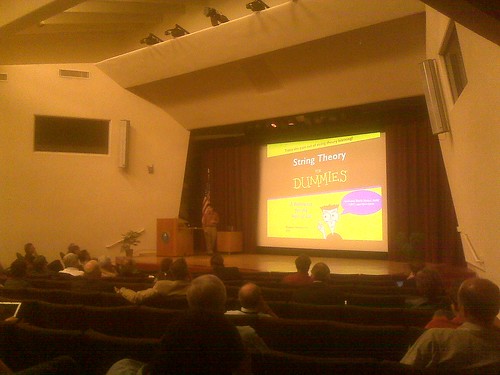
As a follow up to this post, several colleagues and I just posted a paper to the arxiv today: "The PHOBOS Glauber Monte Carlo." This is one of those technical-sounding things, but which has had a surprising relevance to understanding actual RHIC data. Many people treat nuclear collisions by considering the nuclei to be overlapping smooth distribution of protons and neutrons. However, it is also reasonable to treat nuclei as clumps of protons and neutrons as individual particles, especially since that's, um, what they are. The interesting part is that the positions jiggle around collision to collision, and those fluctuations seem to have real manifestations in physical phenomena (see, e.g., this paper). Anyway, there is an amusing back story here: when we were writing one of the early PHOBOS papers back in 2000, we discovered that we needed our own implementation this kind of thing. I was on a trip to South Africa at the time, so I cobbled something together on the plane -- and this is the core of what we've now put out for public release almost 8 years later. That said, it's not rocket science (i.e. every experiment has their own version), but despite a ream of papers and Glauber reviews, there have been relatively few codes available until now. Enjoy.
Wednesday, May 28, 2008
The Physics of Privacy
Fantastic -- an anonymous donor has recently stepped up to contribute $5 million to Fermilab (via the University of Chicago) to help end its furloughs.
It's incredible that Congress as a whole still does not appreciate the intrinsic interest high energy and nuclear physics generate outside the field. RHIC already showed that private funding actually makes both sides look good: the donor for supporting something which promotes science and technology, and participating in the process of discovery, and the scientists for attracting the attention of powerful people outside the government. While it clearly will never be enough to rely on private donors, it bodes well for the future of the field.
RHIC Users Meeting
Gee it's been a longer hiatus than expected. First was that trip to Russia. Then it's been madness finishing a proposal (more on that soon). Then it was memorial day weekend and a trip down to the Chesapeake bay. And now it's the RHIC Users Meeting at Brookhaven. We've already had a full day of workshops (I attended one on various correlation measurements used to characterize jets in heavy ion collisions) and now it's an all day symposium on RHIC and its impact on Nuclear Physics. So far nothing brand new to report, but the day has just begun.
Thursday, May 08, 2008
Bait and Switch
I've been thinking a bit about Kelly McMaster's book about Shirley, her hometown just a few miles south of BNL, and the air of mystery she tries to generate about the lab where I work, a sense which she passes on to those who listen to and interview her (and who often have never been out there).
The main disconnect I sense with her argument (and full disclosure: I haven't read the book yet, but have only heard interviews and read some of her writing online) is between her sense of wonder about the lab as a child, with her fear and loathing of it as an adult.
The wonder, from her Mother Jones piece:
I gravitated toward a scientific life with fantasies of sci-fi movies running through my head, with large machines emitting lightning at the flip of a huge Frankenstein-type switch, or several people poring over softly-glowing computer screens as an experiment produces fantastic data in real-time, and great discoveries are made. I thought this kind of thing actually happened even as I started grad school (even if I had never seen it in my various research summers...)
Unfortunately, the gap between fantasy and reality is as large as the gap between a scientific experiment and comprehending its implications. Things always take a long time to get started, a long time to happen, and a long time to understand, and often involve false starts, misundertandings, mistakes, retries, etc. This is because we have to constantly test our hypotheses against what we observe in the world around us, either through our own experiments or by scouring the literature (which also takes forever) for similar results. Kind of like a journalist, come to think of it. Bottom line is that the daily work of the scientific life just isn't as colorful -- or ever as sinister -- as McMasters seems to imagine (the conferences and talks etc are another matter -- fun as can be).
That said, maybe I speak as someone who is officially allowed to enter my lab on a daily basis (a privilege I share with 2500 other employees, less than 1000 being scientists, I should add). I suppose if you are put off by the fact that someone at the gate asks who you are, then you might wonder if the lab is hiding something, and develop a sense of mystery to justify one's feeling as an outsider. Then again, you might not have noticed that they have public lectures and musical recitals (always open to the public) almost every week. But it's possible that I only perceive the friendly-and-open side of things -- some bias of this sort is unavoidable, it seems.
So the child in me always wishes someone would take me to the secret parts of the lab --where the lights are flashing, and lightning strikes, and green goo runs out of a vat into the ground, i.e. where the wild things are. But maybe no-one seems to know where they are anymore -- or maybe they aren't there, and were never there. Or maybe I've just grown up a bit and actually taken a look around.
But when you get down to it, it's a bait-and-switch: when you are growing up, no-one ever tells you that things aren't so colorful and mysterious, so by the time you finally realize that it's not, you've found a much more interesting -- albeit prosaic --real world to ponder.
The main disconnect I sense with her argument (and full disclosure: I haven't read the book yet, but have only heard interviews and read some of her writing online) is between her sense of wonder about the lab as a child, with her fear and loathing of it as an adult.
The wonder, from her Mother Jones piece:
As a child, I imagined the lab’s buildings were made of an igloo-like substance, and the rooms inside were full of metallic file cabinets, clinking glass test tubes, and notebooks full of secret codes. Men and women in crisp white lab coats and plastic goggles coaxed new species of frogs and lizards out of mottled purple eggs. Others hovered over milky glass globes of light whose kinked antennas sparked blue shots of electricity into the dim, silent air.And the loathing, in the same paragraph:
My neighbor worked as a maintenance man at the lab, and he often teased that he glowed in the dark. After he died of brain and lung cancer, my imaginary lab became a much darker place—a small, sinister pocket hiding in the pines.The strange part for me is that I can identify with the disconnect between the childhood fantasy and the adult reality, but mine is a different trajectory than hers (and don't assume I'm unaware of the emotional trauma of a close loved one with cancer).
I gravitated toward a scientific life with fantasies of sci-fi movies running through my head, with large machines emitting lightning at the flip of a huge Frankenstein-type switch, or several people poring over softly-glowing computer screens as an experiment produces fantastic data in real-time, and great discoveries are made. I thought this kind of thing actually happened even as I started grad school (even if I had never seen it in my various research summers...)
Unfortunately, the gap between fantasy and reality is as large as the gap between a scientific experiment and comprehending its implications. Things always take a long time to get started, a long time to happen, and a long time to understand, and often involve false starts, misundertandings, mistakes, retries, etc. This is because we have to constantly test our hypotheses against what we observe in the world around us, either through our own experiments or by scouring the literature (which also takes forever) for similar results. Kind of like a journalist, come to think of it. Bottom line is that the daily work of the scientific life just isn't as colorful -- or ever as sinister -- as McMasters seems to imagine (the conferences and talks etc are another matter -- fun as can be).
That said, maybe I speak as someone who is officially allowed to enter my lab on a daily basis (a privilege I share with 2500 other employees, less than 1000 being scientists, I should add). I suppose if you are put off by the fact that someone at the gate asks who you are, then you might wonder if the lab is hiding something, and develop a sense of mystery to justify one's feeling as an outsider. Then again, you might not have noticed that they have public lectures and musical recitals (always open to the public) almost every week. But it's possible that I only perceive the friendly-and-open side of things -- some bias of this sort is unavoidable, it seems.
So the child in me always wishes someone would take me to the secret parts of the lab --where the lights are flashing, and lightning strikes, and green goo runs out of a vat into the ground, i.e. where the wild things are. But maybe no-one seems to know where they are anymore -- or maybe they aren't there, and were never there. Or maybe I've just grown up a bit and actually taken a look around.
But when you get down to it, it's a bait-and-switch: when you are growing up, no-one ever tells you that things aren't so colorful and mysterious, so by the time you finally realize that it's not, you've found a much more interesting -- albeit prosaic --real world to ponder.
Tuesday, April 29, 2008
The Raw and the Cooked
Hm, my brain is shutting down now, since I just finished giving a long workshop talk here at BNL. The talk is linked above and is not a new topic for me (whether or not the initial state of a RHIC collision is smooth or lumpy, kind of like the green stuff in the image above). Still, it was a nice chance to highlight a relatively new paper we just had published in Physical Review C, and a great chance to catch up with colleagues who really like this stuff. I know it sounds very academic, but it's not (I know I doth protest too much). When you try and "run the movie backwards", starting from this,
it's important to consider various scenarios of how things looked just as the collision occurred, and not just at the end of the day, when the particles arrived for your perusal.
Why Black Holes are Good For You
While I wouldn't want to eat one, they clearly make you think about many issues -- some scientific, and these days even moral. But some think more clearly and explain things more generously than others.
The only involvement I can claim with this excellent post by Sabine on Backreaction is finally pushing her over the edge (with this) to blog in public about her take on the non-dangers of black holes, micro or not. It's a great read -- with something to say to many people, including the folks in the media who have really been milking the doomsday story dry.
But who the heck made this crazy video of the earth being swallowed by a fictional black hole Beyond a certain point this goes beyond speculation, and becomes manipulative demagoguery.
Friday, April 25, 2008
Half

Hm. Maybe MC knows something Stephen Hawking missed, as suggested by his (relatively famous) quote:
Although equations are a concise and accurate way of describing mathematical ideas, they frighten most people. When I wrote a popular book recently, I was advised that each equation I included would half the sales. I include on equation, Einstein's famous equation, E=mc2. Maybe, I would have twice as many copies without it.Maybe someone can construct an empirical test of this phenomenon?
And #1 hit record or not, shouldn't this have come out in 2005?
Thursday, April 24, 2008
From a Racetrack to The Cold War Near Home
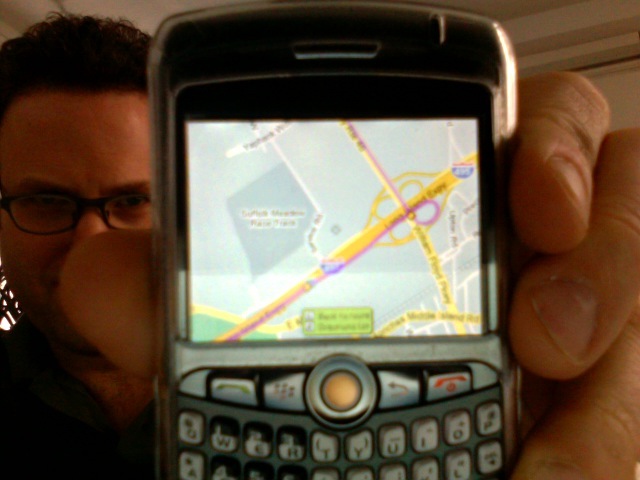
Funny how there are often amazing things around you, and you never notice until you trip over them. I was chatting with a colleague today about how one could improve the commute to Brookhaven from NYC, and I started looking at Google maps to see how close the LIRR tracks came to the lab (a man can dream about a new train station just where he wants it, right?). Then my network connection at home collapsed briefly (my mom is in town so I am telecommuting today), and I resorted to my ever-lovin' Google Maps Mobile on my Blackberry Curve (no iPhone for me, yet). And lo, what did I see there -- and not on the normal version -- but "Suffolk Meadow Race Track", just southwest of the lab. A little Googling got me to the interesting "Long Island Oddities" site, which has this neat article about the honest-to-god horserace track, which was open from 1977 to 1988. 
But then I saw "NIKE Missile Base", which led to this piece about an honest-to-god anti-aircraft missle base in Rocky Point, about 7 miles North of the lab. From there, the research is straightforward, given all of the cold war buffs out there who seem to be keeping the Wiki pages complete. It seems the program ended in 1974, with the SALT I treaty, and now it's a ball field and low-income housing. That said, I'm still not absolutely sure the Nike missiles housed here were actually nuclear (although it was certainly an option for the Hercules), but I'm really staggered to hear about a missile site so close to home.
Monday, April 21, 2008
A Passover Talk
Happy holidays, everyone. Hectic weekend, with two seders to attend -- one of them even assigning homework, to present to the other guests. Unable to resist the assignment, and unable to do anything without visuals, I found myself analyzing a passage from Exodus -- one about the covenant with Abraham, and how it is "remembered" by God just before the Exodus story gets rolling -- by means of a fairly ornate Keynote presentation. Most interestingly, I found a connection to a neat etching I saw recently by Roman Opalka, a French-Polish artist who seems to have a real thing for recursion. Anyway, have a look and let me know if you have any questions.
Thursday, April 17, 2008
The Higgs @ RHIC?

Now I know there are lots of connections between RHIC and the LHC, but finding the Higgs is not one of them. Maybe someone should mention this to the photo editor for this Canada.com story on the LHC?
Friday, April 11, 2008
Spiderwebs, Everywhere
I've been writing all day, so the blogging is heavily on the visual side.
And I know I'm just seeing what I want here in a totally unrelated (but interesting looking) show, at a frustrating but interesting place, but weren't we just talking about spiderwebs?
Is This What Physicists Do on Wall Street?
This looks more like a New Yorker cartoon contest than a New York Times editorial illustration.
Wednesday, April 09, 2008
Galaxies Forming Along Filaments, Like Droplets Along the Strands of a Spider's Web
I swear I didn't make this up, and it's really a room-size set of connecting elastic rope segments by Tomas Saraceno at Tanya Bonakdar (way West 21st St), which are honestly meant to be imaginings of the early universe.
I have to admit that it does a pretty good job evoking the images coming from dark matter simulations, where dark matter clumps up into filaments that sketch out a "spongy" structure. What I find neat is that these filaments, seen in galaxy surveys, are thought to reflect inhomogeneities from the very early universe, propagated over billions of years.

Investigating how the gossamer thin filaments of these intricate webs are able to suspend life by way of intricate geometry, Saraceno suggests at a conceptual architectural proposal that relies on this most delicate and prehistoric system of life to take us into our future. Of particular interest is the application of this phenomenon throughout the history of time. A keystone to Saraceno’s fascination with these web constructions was the recent discovery that suggests the early universe was a sponge-like form, with galaxies forming along filaments, like droplets on a spider's web.
I have to admit that it does a pretty good job evoking the images coming from dark matter simulations, where dark matter clumps up into filaments that sketch out a "spongy" structure. What I find neat is that these filaments, seen in galaxy surveys, are thought to reflect inhomogeneities from the very early universe, propagated over billions of years.I also wonder how the sponge soaked up all the perfect fluid we've been studying these last few years. Ironically, one of these "sponge" images was also used in this 2005 article on RHIC.

But speaking of art, I also recently managed to catch a half an hour of the Poussin exhibit at the Met. Awesome. Poussin was a famously astute observer of nature, which clearly dominates these enormous tableaux. But beyond the obvious emphasis on the detailed imaginings of forests and mountains and lakes, out of which manmade cities seem to sprout, and little people frolic in the margins, he was apparently a real stickler for optics, as evinced by the precise rendering of the reflections in the water.
Monday, April 07, 2008
Examining Life
Phew, a bruising weekend. But how great is this, for a Monday? Philosophy everywhere:- A NYtimes article about the resurgence in philosophy programs in US universities. I started out a philosophy major before mutating into a physicist, and I have never regretted it. To be somewhat glib, the experience with struggling with "big questions," even apparently unanswerable ones (e.g. life and death, soul vs. body, Sein und Zeit, the role of Geist in history, etc.), makes dealing with somewhat-answerable ones (the existence, and definition of the Quark Gluon Plasma) that much more satisfying.
- Stanley Fish, remembering the rise of "French Theory in America" and the Culture Wars they inspired. I went to college in the 80's and lit theory was a temporary, but fascinating, stage in that aforementioned mutation. There's certainly a tension between the deconstructionist worldview (and its antecedents) and the "naive" (oy) scientific realist view most of us working scientist have to adopt (with some hardship, in my case) to stay sane -- as well as to write plausible accounts of our research. But when you notice that data never speaks for itself (even if we've all heard our colleagues claim that "the data say..." something or another, usually in support of their view of things), and that two different people can make equally consistent stories for data sets (until the decisive experiment arrives!) it's nice to know that you're not alone:
...[The] program of drawing closer and closer to a truth independent of our discursive practices, a truth that, if we are slow and patient in the Baconian manner, will reveal itself and come out from behind the representational curtain — is not, according to [the deconstructionist way of] thinking, realizable...That’s a loss, but it’s not a loss of anything in particular. It doesn’t take anything away from us. We can still do all the things we have always done; we can still say that some things are true and others false, and believe it; we can still use words like better and worse and offer justifications for doing so. All we lose (if we have been persuaded by the deconstructive critique, that is) is a certain rationalist faith that there will someday be a final word, a last description that takes the accurate measure of everything. All that will have happened is that one account of what we know and how we know it — one epistemology — has been replaced by another, which means only that in the unlikely event you are asked “What’s your epistemology?” you’ll give a different answer than you would have given before. The world, and you, will go on pretty much in the same old way.
- And a statue of Aristotle has just arrived in Queens.
Barry Loewer, the [Rutgers philosophy] department chairman, said that Rutgers started building its philosophy program in the late 1980s, when the field was branching into new research areas like cognitive science and becoming more interdisciplinary. He said that many students have double-majored in philosophy and, say, psychology or economics, in recent years, and go on to become doctors, lawyers, writers, investment bankers and even commodities traders.OK, philosophy as a means rather than an end. At least it's a start.
As the approach has changed, philosophy has attracted students with little interest in contemplating the classical texts, or what is known as armchair philosophy. Some, like Ms. Onejeme, the pre-med-student-turned-philosopher, who is double majoring in political science, see it as a pre-law track because it emphasizes the verbal and logic skills prized by law schools — something the Rutgers department encourages by pointing out that their majors score high on the LSAT.
Other students said that studying philosophy, with its emphasis on the big questions and alternative points of view, provided good training for looking at larger societal questions, like globalization and technology.
Monday, March 31, 2008
Wagner's Bona Fides [UPDATED]
What really bothers me about this recent flap with the lawsuit to delay the start of the LHC is the way Walter Wagner claims to be a "nuclear physicist", and how some journalists feel compelled to take that claim seriously, at least in part (e.g. the Register, who otherwise goes to town on him, calls him a "sometime physicist", although the Times is more careful and avoids it).
And for the record, the "Cosmic rays" Wikipedia entry was started in 2002, but Wagner's "discovery" was only posted on January 13, 2008 by an unnamed author (which turns out to be a dialup connection in Honolulu - just 'nslookup 4.248.7.153'!), just in time for his re-entry into the blogosphere.
Let's be blunt: if you want to even start to call yourself a nuclear physicist -- and by this I mean someone who actually understands what is known fundamental forces well enough to make meaningful predictions as to what they might do in unfortunate circumstances -- you might want to actually have authored a paper in the subject.
In his brief submitted to the Hawaiian court, Wagner claims to be "credited with discovery of a novel particle only previously theorized to exist, namely a magnetic monopole." But Stefan, from Backreaction, had a look at the original paper and pointed out that Wagner is only thanked "for assistance", and is manifestly not an author. The Time magazine piece about this putative discovery (thanks again, Stefan!) calls him a technical assistant, albeit one who got "credit for first spotting the monopole's track), along with another assistant, Julie Teague.
So let's continue to be blunt: being a technical assistant on an experiment where someone else tells you to look through a stack of emulsions, when you luck out and find something, does not make you 1) a nuclear physicist, or 2) even necessarily an author. While one could argue that doing work for an experiment would normally get you on the paper these days, clearly Wagner was below threshold even in his particle-discovering heyday.
In general, a paper's authors are not just the guys who "did the work", but those who take responsibility not just for being right about the results (which can happen by dumb luck) but for being wrong as well -- which can be fatal, unless you understand why you were wrong and make into something productive down the road. And being wrong is something Wagner doesn't seem ready for yet, about anything. I contrast his unwavering belief in his own bona fides with William Unruh, who made real contributions to the theoretical explorations of Hawking radiation (and whom I discussed in a recent post) that Wagner is so quick to dismiss (from the NYT piece):
According to a paper by the cosmologist Stephen Hawking in 1974, they would rapidly evaporate in a poof of radiation and elementary particles, and thus pose no threat. No one, though, has seen a black hole evaporate.So here is a person who is considered to be an expert on the subject, but who is comfortable enough with how the process works to consider that his theories might be wrong, although everything he knows about the known (i.e. experimental) facts of gravity, quantum mechanics, particle physics, astrophysics, etc. reassure him that he is most likely not. Ultimately, it's Wagner's self-generated certainty, based on purely negative evidence (e.g. "I might be right because you might be wrong"), that makes him the weaker party in this argument.
As a result, Mr. Wagner and Mr. Sancho contend in their complaint, black holes could really be stable, and a micro black hole created by the collider could grow, eventually swallowing the Earth.
But William Unruh, of the University of British Columbia, whose paper exploring the limits of Dr. Hawking’s radiation process was referenced on Mr. Wagner’s Web site, said they had missed his point. “Maybe physics really is so weird as to not have black holes evaporate,” he said. “But it would really, really have to be weird.”
And for the record, the "Cosmic rays" Wikipedia entry was started in 2002, but Wagner's "discovery" was only posted on January 13, 2008 by an unnamed author (which turns out to be a dialup connection in Honolulu - just 'nslookup 4.248.7.153'!), just in time for his re-entry into the blogosphere.
And next up, I'll try and deal with the substance of the issue, which is tricky when there's not much information supporting or rejecting a hypothesis...
(UPDATE: Wagner replies to my assessment, which is based only my reading of the publication record.)
Subscribe to:
Posts (Atom)


