Thursday, October 14, 2010

Milestone


It's very exciting to hear that the LHC has exceeded the "1032" milestone already. While this is an important step on the way to the luminosity goals for the first two years at the LHC, it's particularly important as a step on the way to...heavy ions (collisions of fully-stripped lead ions) at the LHC.

This is not exactly for technical reasons, per se. Instead, the LHC heavy ion program was scheduled to happen only if the LHC reached 1032 this year. If they didn't then it was always possible that the program would be shortened, or even cancelled (chilling as that seemed). Fortunately this did not happen, so onward we go into November! See you all at CERN.

Thursday, June 10, 2010

90-50-10 (Evolution of a design)

I'm at the "90-50-10" celebration at BNL now, honoring the 90th birthday of Ernest Courant, 50 years of the AGS, and 10 years of RHIC. Quite an impressive lineup, with 5 Nobel Prize winners in the audience and several speaking as well. It's hard to overstate the importance of Courant's work in the 1950's, which allowed the develop of modern accelerators, both fixed target and colliders.

I had an amusing role in helping design the logo for the event, when I proposed a poster idea (OK, this was the second draft..):

which ended up looking like this in the end:

I still like the original idea, but it's flattering that it survived as much as it did. Anyway, I'll report a bit more on the talks later (maybe much later, but I promise!)

RHIC AGS Users Meeting 2010


Wednesday, June 09, 2010

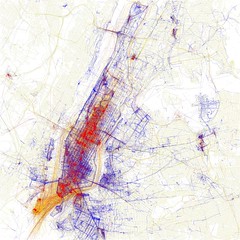
Hot v. Cool spots in NYC

Very neat: a heat map of NYC, extracted from Flickr geotagging information. Red indicates photos taken by "locals" (people who stick around) and blue indicates "tourists" (people who don't). The yellow ones can't be easily put in ether category (still thinking through this one). But amazing how a simple criterion like that can basically get it right.

Wednesday, February 17, 2010

Just in case anyone forgot...

For an article I'm working on, I thought I'd redo my old illustrations.

1. A gas of hadrons, with mesons (quark and antiquark) and baryons (three quarks or three antiquarks). Each cluster is contained by its own "bag":


2. A quark-gluon plasma, with the same quarks, but with "bags" disappeared and gluons flying around in their place.


All the rest is commentary. Any questions? And yes, I really did try and get the gluons right (sigh).

Tuesday, February 16, 2010

When gold collides!

Real time event displays from the STAR experiment at RHIC. This is what their raw data looks like, folks. Pretty neat, even 10 years after the early displays that you see everywhere. And I mean everywhere, even shoes...(thanx, Paul!)

Wednesday, February 03, 2010

And i was!

drat.

I might be wrong, but...

One of my least-well-kept secrets is that I'm mildly obsessed with the old hydrodynamical model invented by Landau and Fermi in the early 50's, which predicts (surprisingly well, IMHO) the total number of particles produced in collisions of nuclei, and even collisions of protons (and angular distributions, and some novel features of the same etc.). The physics is simple (pack all the energy into a tiny volume and let it explode along the beampipe) but the justification is downright bizarre (that all of these microscopic systems form a droplet of fluid as soon as they overlap each other). Of course, RHIC has told us that nuclei seem to form a fluid, and pretty damn quickly -- I'm still looking for a good reason why protons couldn't in principle do the same thing. Of course, making a snappy prediction would help my case.

So the points are nucleus-nucleus data (top trend) and proton-proton data (bottom-trend), and I've tried my hand at extrapolating with a few favorite functions. Unfortunately for me, but congratulations to CMS, the top one (my favorite) is pretty clearly ruled out by the low multiplicity measured by CMS today (4.5 instead of 5.5).

Of course, there are two more experiments to go, and a few more energies to be filled in in the next few years. A man can still dream -- especially since the CMS paper measures the number of particles at 90 degrees relative to the colliding beams, which is *not* the same thing as the total number. Of course, the calculations nominally allow one to predict things at 90 degrees but lots of things can get in the way. No-one said this would be easy!

Tuesday, September 29, 2009

Meet Clea

This is the main reason why it's hard to write these days. Bear with me.


Monday, September 14, 2009

Science is Real


Pardon my going on and on about this , but "Science is Real" is one of my favorite things recently, and not just out of anticipation of watching it over and over again with my daughter in a couple of years (yes, I just said daughter).

From the Carnap quote, to the "kid" bursting with curiosity (but one who still likes good stories -- who shouldn't?), to the frog in the 'fro, to the description of the scientific method ("when a theory emerges" nails it): fantastic back to front.

Saturday, August 29, 2009

STAR in the Prince's Eye?


Voici "Le Petit Prince": A plant-bearing robot for encouraging plant life on, um, Mars:


But is there a certain STAR in this robot's single eye? If we look at 0:32 we see something like this:
Don't know about you, but I see this (from the RHIC images page):

I think someone needs to make a phone call to someone, although nothing I love better than the science we do getting to places I'd never imagine (e.g. Mars). Or am I just, um, seeing things?

Friday, August 21, 2009

Rabbit & lucite blocks


The rabbit is something one might use in a child's room. The lucite blocks with embedded geometric solids are something else entirely: they've been in my family since I was a small child and I know literally nothing about them. Anyone?

Monday, August 17, 2009

A piece of the strong-correlations puzzle?

Which one of these things is not like the other? None of them, it may turn out.

Editing a colleague's article over the weekend tipped me off to this piece, by Jorge Quintanilla and Chris Hooley, which ran a few months ago in Physics World. It seems to be concerned with similar issues as our AAAS symposium last winter, the quest to understand strongly-coupled systems, but from the perspective of condensed matter physics:

"Quantum matter is everywhere, from the interiors of neutron stars to the electrons in everyday metals. Like ordinary, classical matter, it is made up of many interacting particles. In classical matter, however, it is possible to think of each particle as an individual entity, whereas in quantum matter Heisenberg’s uncertainty principle forbids us from telling individual particles apart: their behaviour can only be described collectively. In spite of this, many types of quantum matter are quite well understood from a theoretical point of view. For example, the “electron liquid” that is responsible for the flow of electricity through ordinary metals, the magnetic properties of many insulating materials and the normal and superfluid phases of helium at very low temperatures have all succumbed to the probing of theorists.

But the behaviour of some forms of quantum matter has proved a much harder nut to crack. High-temperature superconductors, for example, are not really understood despite more than two decades of research since they were first discovered. Also mysterious are various exotic types of magnet; while the electrical resistance of most metals increases with the square of their temperature, T, for some magnetic metals like manganese silicon the resistance is proportional to T1.5. And then there is the quark—gluon plasma, which occurs when neutrons are pressed together so tightly that their quarks lose their identity and form a single homogenous liquid. Such a plasma is believed to have formed during the first few microseconds after the Big Bang, but has also recently been recreated in the Relativistic Heavy Ion Collider (RHIC) at the Brookhaven National Laboratory in the US, with further experiments planned at CERN’s Large Hadron Collider.

All these forms of quantum matter have one thing in common: very strong — rather than weak — correlations between the particles from which they are composed. Materials with weak correlations are relatively easy to understand: as the component particles barely interact with each other, one can extrapolate the behaviour of non-interacting particles (like those in an ideal gas) to get a good insight into how they behave en masse. Strong correlations, however, lead to qualitatively new behaviour. High-temperature superconductors, for example, display not only an unconventional superconducting phase but also mysterious “bad metal” and “pseudogap” behaviours."

While I complained on Twitter about the PW firewall, I did manage to find a PDF of the article posted by the authors -- but don't tell anyone (but with my "select", read "low", number of readers, I'm not too worried at the moment!).


Saturday, August 15, 2009

“Nobody got hurt, and I’m not in jail.”

Of course I could see it coming for the last week or so on Twitter, and we had good reasons, but I'm sad we missed Duke Riley's naumachia in Corona Park. Besides being one of the Best Places in the world (particularly since it has the Unisphere), these kind of things happen all too rarely anywhere, much less NYC.

Wednesday, July 29, 2009

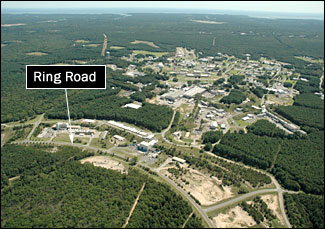
The (Rail) Road to the Renaissance of RHIC on the Ring Road

How things change. In 2005, James Simons and Renaissance Partners made an astute investment in science, by funding the last 10% of the RHIC budget for 2006 -- one that literally made 100% of the science possible (remember that most of the budget is taken up in fixed costs). The lab thanked him for his generosity several years ago in a major ceremony, but tomorrow will take the appreciation one step further. The RHIC Ring Road, running along the inside of the collider ring (i.e. it's official, but mainly descriptive -- I don't think I've ever seen a green sign on the road itself) will now be called Renaissance Circle. And the road joining it to the lab will be transformed from the prosaic, but obsolete "Railroad Ave" (also descriptive of the truth, as a track runs alongside it, but this time with green signs) becomes Renaissance Road. So you take Renaissance Road to Renaissance Circle for the new era of RHIC experiments. A lot catchier -- and modern -- than taking Railroad to Ring Road. But it's not in our job description to be catchy: we're scientists, folks, not poets (at least not most of us!)

The only nitpick I can make with the new naming is that a "renaissance" indicates a revival of something lost along the way. Last I checked, RHIC has been incredibly productive, without missing a beat, for almost 10 years now. That said, an undeniable renaissance in science has certainly taken place with the arrival of the Obama administration, which is redoubling efforts to support science nationwide -- and the presence of the Department of Energy tomorrow (William Brinkman, from the Office of Science) makes that clear to all of us.

See you there (esp. at the Autism walk around the RHIC ring at Noon)

I must start writing again

Some of my favorite tweets from the last few days, translated into English.
  • "The Rorschach debate almost seems like a Rorschach test itselfhttp://bit.ly/ZiAfv (so download 'em while you can! http://bit.ly/5gNgD )": in other words, the very reaction to the "exposure" of the Rorschach blots raises many of the ambiguities (i.e. issues) people have about the efficacy of the method. There's clearly as much interpretation in the handling of the responses, as the subject has in giving them in the first place.
  • "unreal - RT @Naunihal: Please make it stop! RT @SlateBoston cop suspended for calling Skip Gates racial slur in email http://tr.im/uEEe": My friend Naunihal forwarded me this link to a Boston Globe article, originally posted by Slate this afternoon. Can this really be happening? Yes, it can.
  • "Hertzberg recommending movies? @newyorkerdotcom-mers using blogs to expand purview, i guess. http://bit.ly/41IuLT worked on me, anyway": In my naive understanding of the New Yorker hierarchy, it's Lane and Denby who make us want to watch movies, and Hertzberg who leads off the Talk of the Town, typically with astute commentary on our leading political figures. But through those pesky blogs, it's Hertzberg who's recommending movies (Apatow's Funny People), and I'll be damned if he doesn't make me want to see it even more than I did before.
I will start writing again, I promise -- but tweeting is. so. easy...


Saturday, June 06, 2009

Still Twittering

Still twittering like crazy - lots of links and short bursts of commentary - but it takes mindshare away from the blog. Not sure how to solve this yet, until I have complete essay-length thoughts to share, which will be difficult while we are dealing with some of the more intense rites of adulthood, all at the same time. More later!

Tuesday, May 12, 2009

S.O.S. (Save Austrian Science)

Just in case you missed it: Austria is planning on pulling out of CERN after 50 years involvement. The claim is that they can use the money (about $21M) elsewhere in the EU.

Anyway, don't think that the Austrian scientific community is taking the news well. They are getting organized and already have a petition online. Please take a minute and sign it:

http://sos.teilchen.at/petition/

It came as a surprise when Federal Minister Hahn announced that he wanted to discontinue Austria's membership in CERN.

This "wrong historic decision" (quoting Prof. Dr. Herbert Pietschmann) must be stopped before Austria's reputation as a nation of high-tech and modern research suffers irreparable damage and our country excludes itself from future developments.

CERN - this is research in elementary particle physics and comology. CERN is a brilliant example of excellence by European cooperation. CERN is the vision of our young scientists.

By signing this petition I urge the Austrian parliament not to agree to this proposition of minister Hahn.

(And I hope no-one missed that ATLAS slide in the AP article!)

(Thanks, Heinz and Paul!)

Tuesday, May 05, 2009

Redesign

Not like I have time to fiddle around and redesign things just for the heck of it but, well, I fiddled around and made the design a little cleaner, and even cleaner still with some help from my wife.

So just in case people are reading this via an RSS reader, have a look at the new version and let me know what you think. But if you're from the Kazimir Malevich estate, I'm not home right now -- of course, if you leave your name and number, I'll be sure get back to you right away.

Monday, May 04, 2009

Tesla in Shoreham

Tesla's lab was located in Shoreham, New York (yes, that Shoreham - but a lovely place I used to live in when I first moved to BNL) in Long Island, just north of Brookhaven. The Times reports on the battle brewing over what to do with the site, which locals and Tesla enthusiasts want landmarked, and which Agfa, the current owner, just wants to jettison. Neat article, and a reminder of how big a presence Tesla was in his time, and how hard he fell.