Monday, March 02, 2009

David Paterson @ BNL


Just a few photos from the Paterson event at Brookhaven last Friday. Very impressive on all fronts, particularly the solar project at BNL.

And here are more details on:

Saturday, February 28, 2009

David Byrne @ Radio City

Wow that was fun. All of the good stuff ('78-'80 Talking Heads w/ Eno, the new album) played with fire and good feelings. Too bad my camera was too puny to give a good sense of the show.

This Vanity Fair piece gets most of it right: keeping up keeps you young. True for many scientists I know as well.

And for the record, Radio City Music Hall is a wonder.

Friday, February 27, 2009

50 Megawatts from the Sun (Paterson @ BNL)


NY Governor David Paterson is at BNL today, in part to announce this:
Gov. David A. Paterson is expected at Brookhaven National Laboratory today to tout approval of a LIPA project to add 50 megawatts of solar power to the local power grid - among the largest in the country.

Long Island Power Authority trustees yesterday approved the selection of four solar power firms to erect photovoltaic stations at locations across the region. In addition to Brookhaven Lab, they will be placed on rooftops and parking lots of the Plainview- Old Bethpage Central School District, at landfills in Oyster Bay and Islip, and atop a real estate business.

LIPA hasn't released the cost of the project. Acting LIPA chairman Howard Steinberg said residents should expect the power to cost from two to three times that of conventional fossil-fuel plants.

Paul DeCotis, Paterson's energy chief, said LIPA can expect funds from the recently approved federal stimulus package to help defray part of the "green premium," as well as money from state renewable programs. He said the solar power project will be the first major leg of Paterson's push for 45 percent of the state's electricity to come from efficiency and renewables by 2015.
I've got my seat -- and my laptop, so I'll post anything else I hear (besides the Billy Joel muzak being played as we wait). I suppose we still call that live-blogging, but just saying that sounds so old fashioned. Maybe I should twitter it?

But now that I poke around a bit, I'm a little confused: the Times reported on this issue on Feb 13 and mentioned that LIPA is raising electricity rates by 3.2%. RHIC research is quite dependent on power costs, so will this be a net gain for the lab, after all, despite being a major source of renewable energy for the region? Or will this eventually make the lab's power cheaper, as it would be if you installed it on your own home? Stay tuned.

Update: pushing 2:10 and no Paterson -- someone next to me commented about 200 wasted man-hours.

Forgets Byron Foley -- "you know how they say 'you always forget the one you love'" and apologizes. He's hilarious.

2:19pm DOE has awarded $913M in capital money for the new light source (NSLS II). Wow.

"If I know any more than that I will actually come help with the research."

1000 jobs in construction -- mostly from people who live in Long Island.

BNL has estimates 63M hours of labor needed for NSLS II.

Big announcement: 50MW of hydro power for BNL from LIPA. Lower cost for operations of lab activities, just for NSLS II or for RHIC?

Triple threat: DOE funding, BNL expertise, NY will supply the power. Colleges and universities will be great beneficiaries.

"But there's more"

Feb 11, 2008 was charged for developing recommendation for renewable power. proposal for 50MW of photovoltaic power. Got back opportunties for 400MW, and looking for a venue.

Today: announcing private investor will lease property at BNL, central station solar power plant here at lab!

BNL, along with LIPA and NYSERDA will collaborate to put this in place. Part of getting 45% of energy from renewable sources by 2015 -- BNL solar plant will be a major contribution. "45 by 15" will yield 50000 jobs in NYS.

All of these can also heat hydrogen ("not nitrogen -- I get letters about this stuff") to help store power.

Called BNL a major leader in scientific research and fuel cell research. Benefit to NYS and Long Island, and will transform the US power to produce energy and clean up the atmosphere.

Paterson is done!

Sunday, February 22, 2009

Making Connections

(An edited version of this is going to run in the BNL Monday Memo tomorrow. I just wanted to post it here because...well, because I had written it already! And I post the book cover on the right because...well, because I loved that show as a young PBS viewer and because...well, because this is why I got into the science biz to begin with -- to find unexpected connections! And here's the press rundown -- thanks Clifford!)
At the annual meeting of the American Association for the Advancement of Science last week in Chicago, the sessions covered a wide range of scientific fields, from climate change to the intersections of mathematics with origami. Of course for me, the highlight was the symposium that I organized with Bill Zajc, professor at Columbia University and former spokesperson for the PHENIX experiment at RHIC.

Titled “Quest for the Perfect Liquid: Connections Between Heavy Ions, String Theory, and Cold Atoms,” the session covered the emerging relevance of the physics done at RHIC to other subfields of physics, ones that were never thought to be related.

It included speakers both from within the RHIC community, as well as from fields who turn out to have a closer connection to RHIC physics than had been realized. It turns out that physicists from three separate fields are all intensely interested in the physics of strongly-coupled liquids, which flow so easily that they are called “perfect” liquids.

PHENIX spokesperson Barbara Jacak of Story Brook University presented the major results from RHIC, which has been providing collisions since 2000. She paid particular attention to the main features of the medium formed in heavy ion collisions at RHIC: that it flows like a near-perfect liquid, a property intimately connected to its ability to stop the motion of fast-moving quarks (both light and heavy). Using these data, RHIC scientists are able to determine a particular ratio -- that of viscosity to entropy density -- to be quite small.

John Thomas, an atomic physicist from Duke University, presented his experimental results on ultracold atomic gases. In these experiments, clouds of atoms are released from optical traps, and their expansion is visualized by laser flash-imaging techniques. An external magnetic field affects the coupling of the atoms and can be tuned to put the system in a strongly-coupled “universal” regime. Here, the system acts in a way similar to RHIC collisions, expanding asymmetrically according to the laws of fluid flow. The viscosity to entropy density ratio has also been measured here and is as low (or maybe lower!) than that found at RHIC.

Rounding out the presenters was (notable blogger) Clifford Johnson of the University of Southern California. He described how the mathematical techniques of string theory are elucidating the properties of these strongly interacting near-perfect liquids, based on the ideas of string theory. These techniques are used to draw a connection between a strongly-coupled quark-gluon liquid in our world of three spatial dimensions and a gravity theory living in four spatial dimensions with a black hole sitting deep in the fifth dimension! While this scenario sounds strange, it provides one of the few concrete predictions arising from string theory calculations -- that the ratio of viscosity to entropy density has a lower limit, a value which seems to be observed by both RHIC and the ultracold atomic physics experiments.

The serendipitous convergence of these three separate fields has been very exciting -- and useful -- for everyone involved, giving all of us the strong sense that we are only starting to grasp its implications. And it is quite striking that the tools of string theory have provided a sharp, testable prediction for the first time -- one that seems to be borne out by experiments from completely different fields.

Our symposium was attended by over 120 people, ranging from high-school students to scientists in a variety of physics subdisciplines, showing the wide interest this emerging field of science has attracted. It was subsequently covered by several physics blogs.

Symmetry magazine’s assistant editor Glenda Chui served as a discussant along with Bill, and they both addressed questions to the speakers following the talks.

Chui herself posted a blog (http://www.symmetrymagazine.org/breaking/2009/02/16/a-first-string-theory-predicts-an-experimental-result/) a few days later, which was picked up by digg.com. The interest in Chui’s blog was so great that it overloaded Symmetry's server, necessitating a major upgrade. The comments to the piece show that connecting experimental data to string theory is controversial, especially if this is used to argue for the “reality” of string theory. But such debate is fitting for the kind of forefront science we do here at Brookhaven with RHIC.

Friday, February 20, 2009

The Invisible Tower

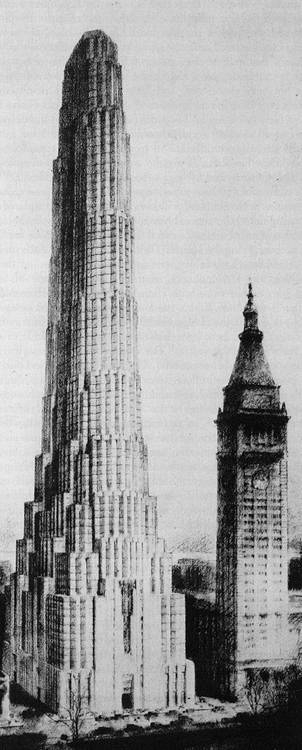
Our apartment is just a few blocks from Madison Square park and can even see the Met Life Tower from the window. I also happen to drive down 23rd St whenever I head to the Midtown Tunnel to get the Brookhaven (a rare event these days, now that I take the LIRR more often). I find the tower a magical structure, particularly when I try and imagine just how huge the clock face must be.

And, something I stumbled on a few months ago completely blew me away. This one is about the Met Life North Building, something not as noticable in the shadow of the gorgeous 770 foot tower. Turns out that it was the base for a planned 100 story skyscraper, but the crash of 1929, um, "descoped" the project a bit. Who knew? But now every time I drive by, I find myself wanting to see the real tower, and not just this beast.

When Water Droplets Collide


So not exactly world-shattering, but certainly droplet-shattering. I was curious about people who had done this kind of thing -- and Google was kind, yielding up Robert Park's interesting web page. Image after image (and movies) of water droplets colliding: slow and fast, symmetric and asymmetric, head on and glancing. Interestingly, a colleague of mine looked at these yesterday and saw very low-energy nuclear physics (neutron necking, and the like). I looked at these and tried to imagine them relativistically.

Wednesday, February 18, 2009

Blinking Lights and Other Revelations


Who can resist these BNL blinking buttons? Clearly no child under the age of 10, judging by how quickly they disappeared once laid out on the table. And no one realized that the tech would let us track their whereabouts forever.

Tuesday, February 17, 2009

Scenes from the AAAS

It has been quite a crazy few days since I left for the AAAS meeting in Chicago:
  • Thursday, reaffirmed my faith (shared by the family Obama) that Avec is one of my favorite restaurants in the country, but I can't figure out how to describe it
  • Friday, grappling with the almost-unmanageable AAAS sprawl, learning a bit about scientists in Hollywood, and huge events by Sean B. Carroll, Al Gore, and the Ig Nobel folks
  • Saturday, skipping the science of kissing for the arts of getting scientific insight to Congress (with the impressive Bill Foster), learning about the human propensity for blinkenlights at the BNL booth, the joys of neo-Origami, Chicago evening fireworks on the river, and the fun of science journalist parties (and congrats to the AAAS award winners!)
  • Sunday, the wonders of Houlihan's breakfast, surviving our symposium (audience shown above!), missing the Higgs discussion at the FNAL/CERN symposium, and bumping into a few physioblogospheric luminaries (yes, that's two Sean Carrolls in three days...)
A few attempts at documentary photography can be found in the usual place.

And more to come on the symposium itself.  I'm still processing things -- e.g. our crashing symmetry magazine's site with thousands of hits, apparently thanks to Digg.

Friday, February 06, 2009

Physics of Splashes

A nice piece from NPR on jets from dropping a ball into sand or water. It's not new, but the video is quite clear about laying out the problem and showing how the scientists understand the problem.

Some of this research is also featured on the APS Focus page who posted one of the videos of jets in liquid.

(X-msvideo 1.98MB)

Senate Cuts to Science Stimulus


Zeroing out all of the increases for NSF and the office of science (in the DOE part)? Who are these people?

This is ghastly -- and does the opposite stimulating innovation in the US.

Thursday, January 29, 2009

Upcoming: AAAS Symposium (2/15/09)

This is a shameless plug for something I am organizing at the upcoming AAAS 2009 meeting in Chicago, in just a couple of weeks. I and several colleagues, in collaboration with the BNL Public Affairs folks (who are promoting this as well), are putting together a short symposium about the physics we do at RHIC, and how it relates to other, wide-ranging fields of science. In particular, we have people discussing both string theory, connected through the famous "AdS/CFT Correspondence", and cold atomic physics.

What relates all of these three topics (as I attempted to illustrate in the triangle diagram above) is the idea of the "perfect liquid". Both RHIC physicists and cold atomic physicists have discovered liquid-like behavior in their respective systems, despite a factor of 10^20 (1 with 20 zeros after it) difference in temperature (i.e. RHIC makes liquid at 2 trillion degrees, while the atomic guys make them at billionths of a degree above absolute zero!). And the most interesting predictions made about the properties of both systems have come from string theory, using calculations where gravitons scatter off of a black hole sitting in the 5th dimension. No kidding.

Seriously, how often do people in such disparate subjects discover that they are working on similar problems? Anyway, if this piques your interest, please stop by the symposium at the AAAS 2009 in Chicago on Sunday, Feb 15, 10:30am (yes, yes, registration required...)

Tuesday, January 27, 2009

John Updike, RIP (The Gall!)

Sad news, hearing of the death of John Updike. I've only read a Rabbit or two and kept up with him in the New Yorker, but no physicist can avoid "Cosmic Gall": one of the only poems I can think of dedicated to an elementary particle.

Oddly, I just came across this poem this last sunday, while literally racing through Murray Gell-Mann's The Quark and the Jaguar (excellent stuff, but not a good enough fit to RHIC physics for us to pursue him as a speaker this summer...). But it's not that strange of a coincidence -- the poem is everywhere in the physioliterasphere, i.e. Gell-Mann was certainly not my introduction to it. I've seen it tacked on cubicle walls, reproduced in physics books, pasted into blog posts (July 2005 Cosmic Variance). And now, I repeat it again, in (but certainly not by) memory:
NEUTRINOS, they are very small.
They have no charge and have no mass
And do not interact at all.
The earth is just a silly ball
To them, through which they simply pass,
Like dustmaids down a drafty hall
Or photons through a sheet of glass.
They snub the most exquisite gas,
Ignore the most substantial wall,
Cold shoulder steel and sounding brass,
Insult the stallion in his stall,
And scorning barriers of class,
Infiltrate you and me! Like tall
and painless guillotines, they fall
Down through our heads into the grass.
At night, they enter at Nepal
and pierce the lover and his lass
From underneath the bed-you call
It wonderful; I call it crass.

Tuesday, January 20, 2009

The Story of Hope

A very neat story of where Shepherd Fairey got the image now immortalized on those amazing posters (a B&W version of which I have on my office door, when it's not being taken down mysteriously...). And the show is opening at Danziger Projects tonight.

White House Blog

The new White House Blog should be interesting, but is anyone else not seeing the inaugural address?...

Restoring Science

"Starting today, we must pick ourselves up, dust ourselves off, and begin again the work of remaking America.

For everywhere we look, there is work to be done.

The state of our economy calls for action: bold and swift. And we will act not only to create new jobs but to lay a new foundation for growth.

We will build the roads and bridges, the electric grids and digital lines that feed our commerce and bind us together.

We will restore science to its rightful place and wield technology's wonders to raise health care's quality and lower its costs.

We will harness the sun and the winds and the soil to fuel our cars and run our factories. And we will transform our schools and colleges and universities to meet the demands of a new age.

All this we can do. All this we will do
Right on.

Moving On

Wednesday, December 10, 2008

A Few Days in Stellenbosch

Great workshop so far: fantastic setting and excellent discussions about black holes, QCD, strings, dualities, etc.  All the fun stuff, all in one place.  Anyway here are some photos.  Enjoy.

Monday, December 08, 2008

Where The Black Hole Went

The Economist tells us that "saving seems like pouring money into a black hole." I always wondered what had happened to that black hole we didn't make at the LHC...

Saturday, December 06, 2008

Cape Crusaders

So just as I start to blog a tiny bit, I'm disappearing again for another work trip (and a bit more).  This time it's off to Cape Town (well, Stellenbosch, really) for a workshop on "Applications of Gauge/Gravity Duality".  It'll be me and a lot of string theorists, where naturally I'll be the token experimentalist.  Still, should be a blast in a beautiful place -- and hopefully I'll learn a thing or two, and teach a thing or two.  In any case, it's great to have a chance to spread the RHIC gospel.  More later.

Thursday, December 04, 2008

Chance and the Curies

Yesterday, a friend of mine who works for the Cullman Center for Scholars and Writers asked my wife and me to be her guests to hear Lauren Redniss, an artist and writer (nominated for a Pulitzer for her NYTimes Op-Art pieces).  It felt like something out of a mysterious teen novel to go to the NY Public Library, amble up the stairs gawking at the high ceilings and stone work, and have to knock to gain entry to the conference room (where they nicely served Dominican food for lunch).
 
Redniss, who has written/drawn about dancers and chess and people and their lives in New York, is tackling the lives of Pierre and Marie Curie who did pioneering studies in radioactivity (and Marie even coined the term).  It is an interesting approach, trying to tie various aspects of their lives to the science they devoted themselves to (and devote themselves they did -- sounds like they didn't get out of the lab much!).

Pierre Curie died in a freak accident in a Paris street, where he tripped and had his skull crushed by a heavily-laden horse-drawn carriage.  Redniss related this to the concept of the "normal accident", one which occurs in complex, tightly coupled systems, where one seemly-trivial problem may randomly coincide with another, and their combination may trigger a catastrophe.  Turns out that Three Mile Island is the paradigmatic case, a fact that Redniss interestingly ties back to the Curies -- their work having made nuclear power (eventually) possible.  She also connected it to the randomness of radiation itself.

The thing that struck me about that latter point was that the randomness of life and the randomness of radioactive processes aren't really the same.  The randomness of life is one that emerges out of complex environments, like cities, where many people and things move according to their own agendas and interact (physically, socially, etc).  Getting hit by a car is the result of a long causal chain which brought you to that crosswalk, and a different causal chain which brought the car there at the same exact time, and then perhaps another factor which makes you cross against the light etc.  The point here is that there is a long, confusing, but nominally well-defined set of events that could in-principle be reconstructed to explain why that accident occurred where and when it did.  

But radioactivity (and indeed any quantum mechanical system) is different.  As far as we know, quantum mechanical processes like nuclear decay just happen when they happen, and completely at random.  The life or death of Schrodinger's cat, and the mystery of the thought experiment relies on this truly random nature of quantum processes.  All attempts to reduce quantum probabilities to the deterministic activity of hidden degrees of freedom have failed (see e.g. Bell's Theorem).  Thus for all practical purposes, radioactivity is one of the purest examples of irreducibly random behavior existing in nature, and this is no small thing: generating random numbers with computers (e.g. pick a number between one and ten) is a non-trivial thing, and most only make "pseudorandom" numbers at best.

Anyway, I did manage to ask if she had considered this difference in her thinking-through of the story she was trying to tell.  Of course I also managed to say that radioactivity was the "only" way that such randomness was manifest in nature, which is obviously wrong.  Luckily the roomful of writers, historians, and graphic designers didn't catch me right off.  Too bad that a well-known historian of science was also in the room, who did!