Friday, March 23, 2007

Oh, Lordi (I'm in Finland)

Another quiescent period, but I've been at CERN all week (ATLAS trigger/physics week) and now in the land of Lordi (Finland for those who don't pay attention to Eurovision winners, or read articles in the Times about them...). Actually, I'm at a workshop in Jyvaskyla, a few hundred kilometers north of Helsinki, staying in a gleaming, white hotel on an frozen lake. And there's a suspension bridge just in front that leads to the gleaming, white Physics Department here at the University of Jyvaskyla.

It's looking like a rough week, with a student lecture to deliver on Monday ("Introduction to Hydrodynamics" - and I don't even do hydro) and a talk to give on Tuesday morning ("Consequences of Early Thermalization" etc., so once again, with feeling -- and more details). But no pain, no gain, I suppose.

Friday, March 16, 2007

Extra Extra

If you have a fixin' for RHIC news, and find yourself scouring the arxiv after Quark Matter conferences, you need look no further than the just released "RHIC News". It's planning to be a bi-weekly release, with new content from RHIC scientists and updates from the machine and experiments. For more on the philosophy, and even how to contribute (that means you, RHIC scientist!), you can read John and Susan's introduction.

Wednesday, March 14, 2007

String Debate '07

The String Wars of 2006 continue, but are kicking it up a notch in 2007 with the first (that I've heard) String Debate. And not just debate as in "let's argue in journals or magazines or newspapers" but debate as in:
String Theory: Brian Greene and Lawrence Krauss Debate Co-sponsored with the Department of Energy’s Office of Science
It comes down to this: Are all things in nature actually super-tiny bits of strings that are vibrating strands of energy? If so, string theory would merge general relativity and quantum mechanics, and would explain the origin of space, time, and the universe itself. Or is the theory, as some critics claim, just extraordinarily complex mathematics which may have nothing to do with physics and a theory of nothing, not everything? If so, physicists are back to the drawing board in their quest for the Holy Grail of physics—an ultimate theory of everything.
For those of you in DC in a couple of weeks, this will be happening at the National Museum of Natural History at the Smithsonian, moderated by Michael Turner.

But seriously folks, who benefits from these kinds of debates, besides the obvious rock-star experience seeing two charismatic speaker/performer/scientists argue in real life? Then again, who wants to imagine Greene and Krauss snapping fingers at each other, going "Bring it!"? In sum, I'm not sure (as it's mildly fun to watch smart people argue, despite the inevitable vacuousness of any result from this particular debate...kind of like the WWE, right?). All I know is
Greene is a professor of physics and professor of mathematics at Columbia University; Krauss is Ambrose Swasey professor of physics and a professor of astronomy at Case Western Reserve University; and Turner is the Rauner Distinguished Service professor in the Kavli Institute for Cosmological Physics at the University of Chicago.
so Greene, lacking a titled chair, which even the moderator has, is already racing to catch up.

(Thanks, Burt!)

Tuesday, March 13, 2007

Mistakes Were Made

I generally try and avoid politics in my blogging, but the political firing of federal prosecutors really irks me, reeking of the anti-democratic odors one has picked up emanating from this administration for years. That said, how often does a national figure (i.e. AG Gonzales) quote Matt Groening's Life in Hell: "I accept that mistakes were made"? OK, seriously, Groening was was quoting Reagan but was Gonzales (who gets mixed style points for combining active and passive voice in the same sentence)?

In trying to remember where that phrase came from, I found a blog post by Caterina "Flickr" Fake on the subject, and she found a great excerpt from Charles Baxter on the subject. Totally relevant now, and totally excellent.
What difference does it make to writers of stories if public figures are denying their responsibility for their own actions? So what if they are, in effect, refusing to tell their own stories accurately? ... Well, to make an obvious point, they create a climate in which social narratives are designed to be deliberately incoherent and misleading. Such narratives humiliate the act of storytelling. You can argue that only a coherent narrative can manage to explain public events, and you can reconstruct a story if someone says, "I made a mistake," or "We did that." You can't reconstruct a story — you can't even know what the story is— if everyone is saying, "Mistakes were made." Who made them? Everybody made them and no one did, and it's history anyway, so let's forget about it. Every story is a history, however, and when there is no comprehensible story, there is no history. The past, under these circumstances, becomes an unreadable mess.
(Please don't ask me where I got a copy of LiH, since more people should be allowed to see them online! Google will reveal all.)

UPDATE: Gee those New York Times reporters know lots of stuff about mistakes.

Tuesday, March 06, 2007

Freeman (Dyson) in New York

Why do I ever leave the apartment without a camera? K and I left the house on Sunday afternoon with a few errands and some work to do, but knew that our final destination was the Guggenheim Museum. The goal was to see "El Greco to Picasso" (at least for 15-20 minutes after bumping into one of my oldest college friends who lives in Turkey, etc. -- can anyone reading this quantify the effective area of the entire planet, once network effects are taken into account?), find somewhere to eat on the Upper East Side (Cafe Alsace, found by accident given Saigon Grill's unexpected renovations, was pretty great), and then to see Freeman Dyson talk about "How We Might Have Gone To Mars in 1965."

Freeman Dyson. I nearly jumped when I got the email announcing this late last week. Here's a guy who has made a mark in real science (QED, Schwinger-Dyson equations etc.), real science & military policy (JASON, test-ban treaties), and even science "fiction" (Dyson spheres, Dyson trees -- on comets no less) and written more than a few books for general consumption. And he's 84, so no time to waste. Then again, K and I saw him being guided through the main exhibition and he looked pretty spry, regardless of age.

Anyway, no time today to go into how great his talk was, or to explain the context in detail. Bottom line: Project Orion - a spaceship to explore the solar system (carrying real scientists in addition to astronauts, even, a la the Beagle) powered by several thousand 1-kiloton nuclear bombs, deployed via what was planned to be essentially a Coke-bottle dispenser (General Atomic even consulted with Coca-Cola about this!). The powerpoint (prepared by his son George, one famous child among six, who wrote the definitive history about Orion several years ago) was incredible, simple and full of 1) archival images, many declassified for George Dyson's book, and 2) honest-to-God information, which he would let us read. And finally, he answered questions, lots of them, and even the ones which were completely off topic. After we left the theater (downstairs at the Guggenheim and clearly unaltered Frank Lloyd Wright -- itself worth the price of admission) and the post-talk reception (an extremely gracious touch, but where K noticed that no-one seemed to be getting Dyson a glass of water -- so she brought him one!) we basically flew home. It was a really well-executed Sunday event by Dyson and the Guggenheim, and we'll be back.

So back to that camera. I normally post my own images from these kind of things (e.g. the theater, Dyson, his slides, etc) But no luck this time, having left said camera at home. But frustratingly, I can't find any images online of Orion as it was shown in Dyson's talk. All one finds are images from the NASA-influenced "final" design, which was ultimately cut. Dyson didn't have many nice things to say about it, so I will just show something based on Jules Verne's "From the Earth to the Moon", which was, according to Dyson, literally how they imagined the Orion spaceship for most of its project lifetime.


Friday, March 02, 2007

Two Minutes or Less

In a group meeting yesterday, my colleagues pointed me to this interesting, um, contest, from Discover Magazine.
The Challenge
Just over a century ago, Albert Einstein published three groundbreaking scientific papers in one year, any one of which could have won him the Nobel Prize.

Taking a cue from The Great One, Discover.com is now challenging armchair theorists to produce a similar feat of inspired - and speedy - brilliance.

Your goal is to create a video that quickly and clearly explains perhaps the most baffling idea in the history of the world: string theory.

And the best part is that you have just two minutes.

The Opportunity
The winning video will be selected by Columbia University physicist Brian Greene, best-selling author of The Elegant Universe and The Fabric of the Cosmos, and broadcast via a prominent spot on the homepage of Discover.com.

The individual or team who submits the best video will be featured in an upcoming issue of Discover Magazine.

The Rules
The video should present an accurate, basic understanding of string theory that will stick in the brains of relatively intelligent non-scientists.

You can use any teaching aides you like (props, animation, etc.)

Submissions will be accepted from individuals and teams (subject to the terms and conditions).

Don't go over the time limit.
I wish I could explain anything in two minutes. My only question is why you wouldn't just go straight to YouTube...

Tuesday, February 27, 2007

Going and Coming Home

Sorry for the unintended break. It's not that I have a maximum number of words per week, but I had to finish up a few things before a 5 day trip to Ireland for a wedding. My first time, and highly recommended (for me to go back, that is -- I don't normally try and give travel advice).

Anyway here's the first thing I come back to, in the new issue of Physics News Update (It's a broken link for now -- I get this via email):
STRING THEORY EXPLAINS RHIC JET SUPPRESSION. String theory argues that all matter is composed of string-like shreds in a 10-dimensional hyperspace assembled in various forms. It has won acclaim from many who appreciate the theory’s elegant mathematics and ambition to unite quantum mechanics and general relativity, and skepticism from others who cite the theory’s lack of a practical track record. String theory, the doubters say, makes no testable predictions. But this isn’t exactly true. Indeed, the theory has not yet been experimentally vindicated in the realm of quantum gravity, but has been put into play in the realm of high-energy ion collisions, the kind carried out at Brookhaven’s Relativistic Heavy Ion Collider (RHIC). A few years ago string practitioners attempted to establish a relationship between the 10-dimensional string world and the 4-dimensional (3 spatial dimensions plus time) world in which we observe interactions among quark-filled particles like protons (for background, see Physics Today, May 2005). This duality between string theory and the theory of the strong nuclear force, quantum chromodynamics (QCD), was recently used to interpret puzzling early results from RHIC, namely the suppression of energetic quark jets that should have emerged from the fireball formed when two heavy nuclei (such as gold) collide head on. The thinking was thatperhaps the plasma of quarks and gluons (quarks bursting free from their customary proton and meson groupings) wasn’t a gas of weakly interacting particles (as was originally thought) but a gas of strongly interacting particles, so strong that any energetic quarks that might have escaped the fireball (initiating a secondary avalanche, or jet, or quarks) would quickly be slowed and stripped of energy on its way through the tumultuous quark-gluon plasma (QGP) environment. Two new papers by Hong Liu and Krishna Rajagopal of (MIT) and Urs Wiedemann (CERN) address this problem. The first paper calculates a specific quark-suppression parameter (namely, how much the quarks, each attached to a string dangling "downward" into a fifth dimension, are pushed around as they traverse the quark-gluon plasma) that agrees closely with the experimentally observed value. Rajagopal (krishna@ctp.mit.edu, 617-253-6202) says that in the second paper, the same authors make a specific testable prediction using string theory that bears not just on missing jets of energetic light quarks (up, down, and strange quarks), but on the melting or dissociation temperatures of bound states of heavy quarks (charm-anticharm or bottom-antibottom pairs) moving through the quark-gluon plasma with sufficiently high velocity, as will be produced in future experiments at RHIC and the Large Hadron Collider (LHC) under construction at CERN. (Physical Review Letters: first paper in the 3 November 2006 issue; second paper, upcoming article)
Wow that's a long "blurb". No wonder we have such trouble explaining how this all fits together. You have to explain most of modern physics in the same paragraph. Anyway, so we're done (i.e. String Theory Explains RHIC Physics)? I can go home now?

OK, seriously: Nothing brand new (i.e. I heard all of this in China in November) but interesting to see it bubble up to the level of news. While it is nascent phenomenology for now (at least to my eyes/ears), it bodes well for a fascinating future ahead of us. Follow the references and citations of these papers and you'll find a rapidly-growing community of theorists getting in on the action. What do they usually say about exponential growth?...

Sunday, February 18, 2007

Why I Am A Physicist

Once in a while you get the chance to bare your physicist's soul in the harsh light of the physioblogophere, and today is my chance. Sabine Hossenfelder co-writes a great, funny blog called Backreaction (which I've posted to several times, and which I've seen mentioned in various realms of said ogosphere), and as part of an email thread starting with me asking her to put in a good word for me at the Perimeter Institute (where I'm still interested to give a RHIC seminar someday), she ended up asking me to contribute a few words on "Why I became a physicist". I have to admit that I didn't expect to get into high memoir mode, but I did (and in a bit more than a few words, I now notice), partially inspired by a very moving piece about Ron Mallett I heard on This American Life a few weeks ago. So here it is, bigger hair and all (and thanks to K for taking the photo at Storm King Art Center back in October)

Wednesday, February 14, 2007

Starlings

Speaking of excellent, I'm totally smitten by this photograph: "Migration of starlings, Algeria", a 2nd place prizewinner in the Nature category of the World Press Photo 2007 Winners Gallery.

2001: Central Park

K and I stumbled on this, if one can think it possible to "stumble" on anything sitting on the southeast corner of Central Park, kitty-corner to the Apple Store. It's Liz Larner's "2001", a 12'x12'x12' mashup of a huge sphere and a huge cube, coated with essentially resilient automobile paint that reflects different colors from different angles. Excellent.

Science Creative Quarterly

My god, a McSweeney's for creative science types. With knots and badges for Science Scouts, no less. I guess I qualify for Badge #6 ("The 'I blog about science' badge") and Badge #32 ("The 'I've done science with no concievable practical application' badge") and maybe #23 ("The 'I work with way too much radioactivity, and yet still no discernable superpowers yet' badge"). Do I qualify for Eagle Science Scout yet? Heck, I never even made it to cub scout meetings when I was a kiddo in the 70's. Too bad, as I'd surely invalidate SCQ's recent Valentine's Day Hypothesis #1 "All we need is love".

The project looks neat. Thanks to the intermittently-posting Collision Detection for pointing to it. Clive also points to this outrageous video of a glowing giant squid. Glowing. Giant. Squid. Egads.

Tuesday, February 13, 2007

Forever Blowing Bubbles

Catching up on ATLAS work today, but while waiting for my Athena (software) to compile I'm catching up on some physics blogs. Bee, from Backreaction (whom I'll be guest-blogging for in the next week or so!) has linked to an older post of hers on "Water in Zero Gravity". Most people who've spoken to me in the last few years know that I've become mildly obsessed with fluid behaviors of all sorts, in the vain hope that I'll collect enough insight to better understand the "near perfect fluid" we think we're making at RHIC.

This one will haunt my dreams for a while. And this one (1930 animation, totally off-topic, downloadable here) will haunt yours (i.e. it's old, weird, fascinating -- and nominally children's entertainment. Go figure!)

Friday, February 09, 2007

Penrose's Universe (@ BNL 2/6/07)

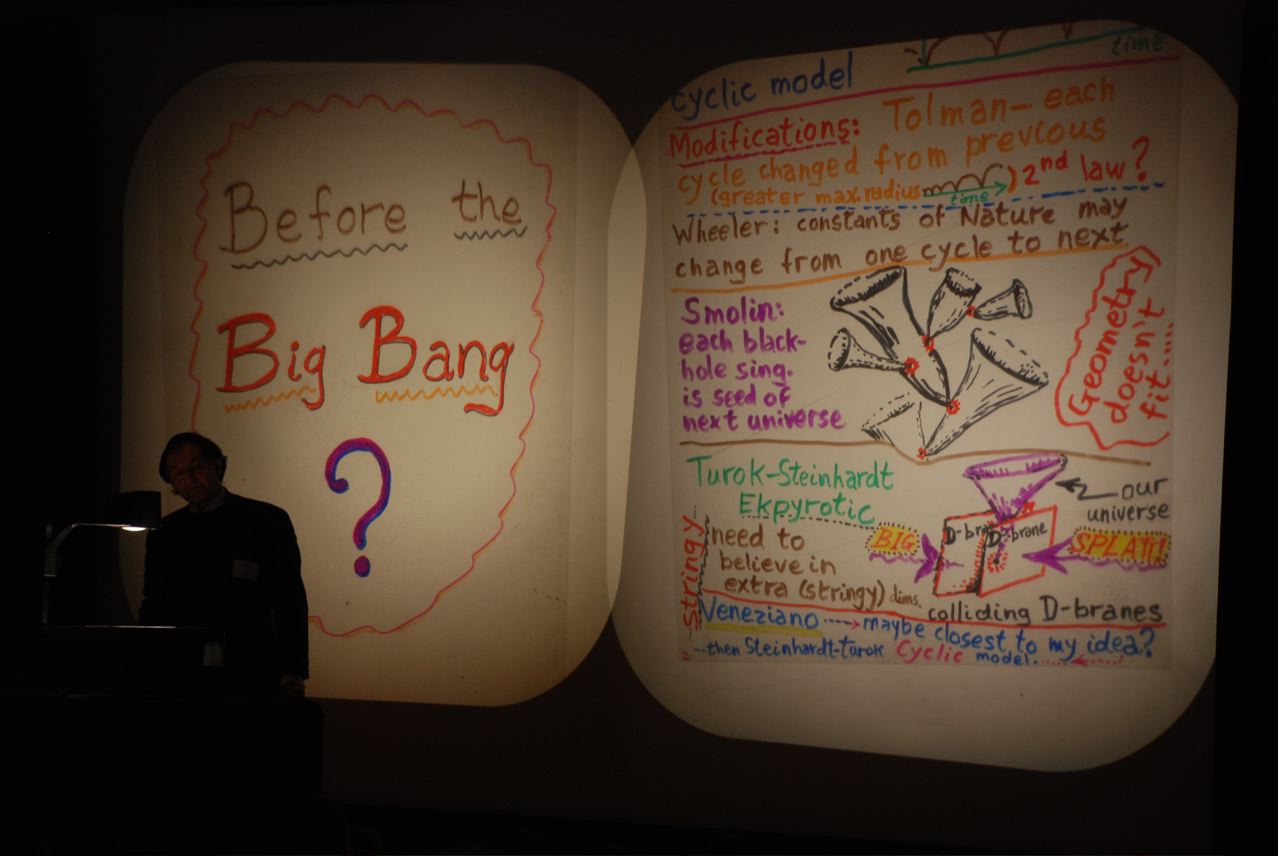
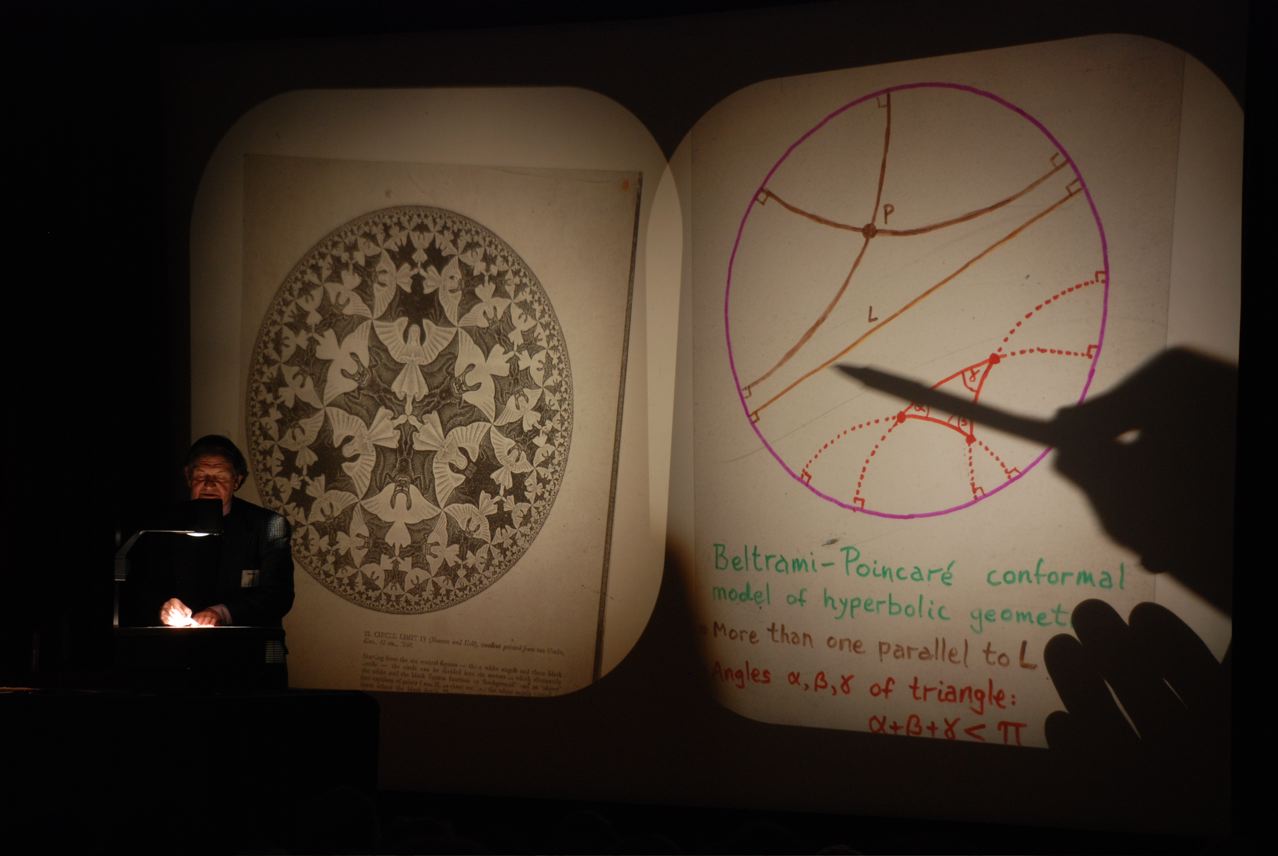
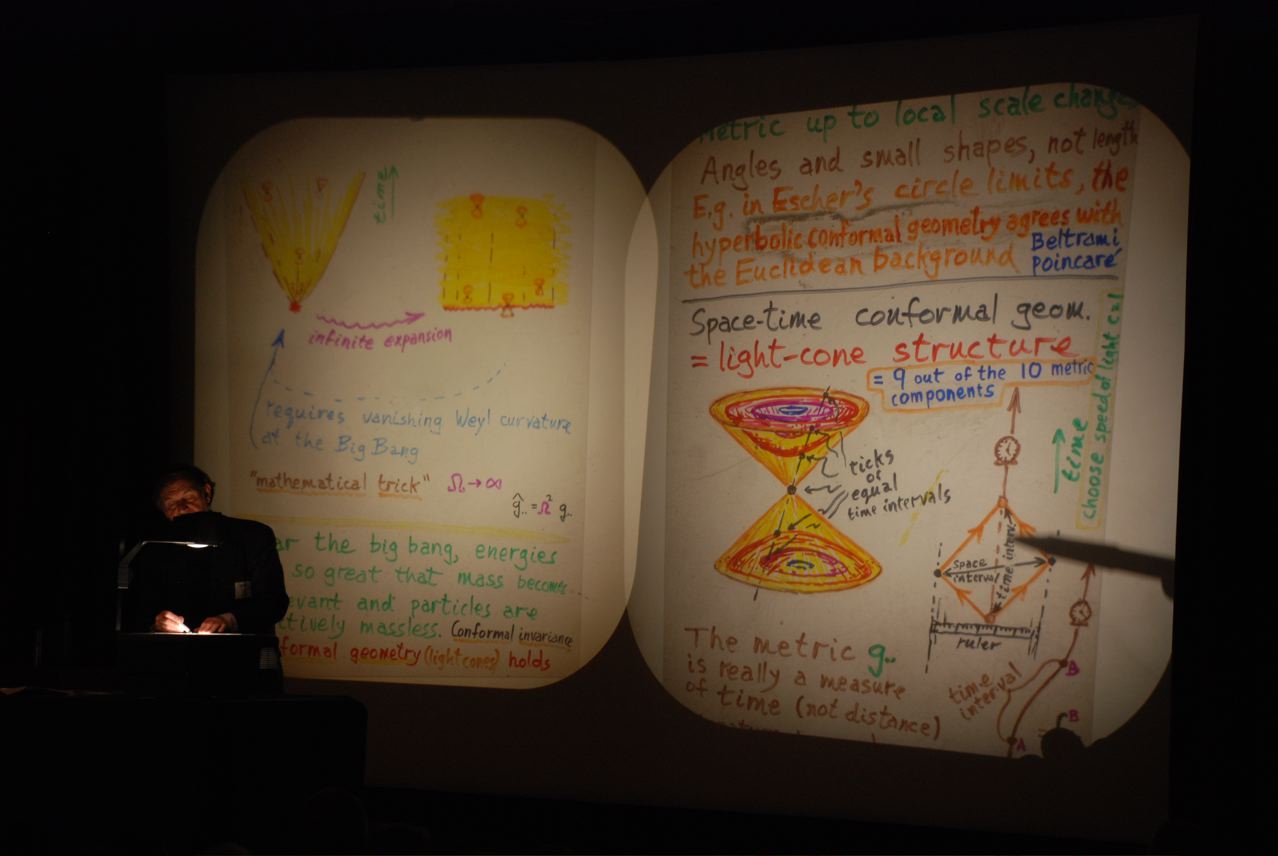
Roger Penrose stopped by Brookhaven early this week, to discuss his views on the Big Bang...and before. While I'm still working through what he seems to be saying (that the universe somehow serves as the "inflationary" period for the universe which succeeds it...) I found his slides particularly evocative and managed to get a few photographs. Enjoy!

Quantum Computer History

Not sure how or why I missed this yesterday, but I was really busy. Really. But really, quantum computing is now technology that can be demonstrated? Last I checked, it was still a messy tech on the bench, and thought to be incredibly fragile. Now D-Wave is "ready to make computer history" (but shouldn't that be "computing history"?) with it's Orion system:
The Orion system is a hardware accelerator designed to solve a particular NP-complete problem called the two dimensional Ising model in a magnetic field. It is built around a 16-qubit superconducting adiabatic quantum computer processor. The system is designed to be used in concert with a conventional front end for any application that requires the solution of an NP-complete problem.
Of course, the skepticism level is still high:
"This is somewhat like claims of cold fusion," said Professor Andrew Steane of Oxford University's Centre for Quantum Computing. "I doubt that this computing method is substantially easier to achieve than any other."
But wait a minute, that D-wave blog post says that:
At the demo, what we’re going to do is run two different applications, live, on an Orion system residing in Burnaby, BC. Orion is designed such that it can be used remotely, and this is the mode we’ll be using for the demos.
They're going to run a hardware demo in California on brand-new, highly-anticipated, but widely-doubted technology, and the hardware will be a thousand miles away from the demonstration site? Not the greatest marketing concept I've ever heard, and it won't do much to fend off those skeptics no matter how well it seems to work. We'll check back next week.

But in the meantime, D-wave's blog also points to a paper on arxiv.org on the Orion's architecture. Arxiv? Did I mention that I was really busy yesterday? And this news is burning up the gadget blogs, e.g. check out these images posted to Gizmodo...

Thursday, February 08, 2007

Nuke You Less

Stumbled on this NYT blog piece by...Dick Cavett?...on a subject near and dear to my heart, and a mainstay of my cocktail party banter: just why W refuses to say "nuclear" correctly. Everyone knows it's "new clear", but even now, more than six years after "winning" the 2000 election, he insistently, deliberately says "nuke you lur" over, and over, and over again. Really, I've learned to accept it as the usual follow-up joke people make when I tell them my profession for the first time. While it instinctively drives me nuts, it's not a matter of personal and professional pride. I certainly agree with Cavett that it's a slight to the English language. But I have also thought that it's his way of being stubborn in the face of criticism from "intellectuals", whom he probably ultimately as effete ineffectuals, worrying about pronunciation when there are more important things to deal with in the post-9/11 world. But of course this is the same stubborn disregard that has gotten him and his colleagues and our country into such trouble in the past -- and which continues unchecked to this day.

Anyway, I heard Andy Rooney riff on this on 60 minutes when I surfed by CBS at the gym last week. And I like Cavett's transliterations, especially "nuke-you-luss". I'll have to sneak that into a talk one of these days. And I'm not going to reflect on "nuke you less" in the light of Seymour Hersh's reporting on the Administration's plans for Iran.

(And an interesting footnote: surfing around Google images to find a nice image of a nukeyouless, there are a lot more cells than subatomic clusters of nucleons... A sign of the times?)

Tuesday, February 06, 2007

Steve Jobs vs. DRM


I know this isn't in my official purview, but I've hated DRM on my iPod just like everyone else. But, Lo and behold, Steve Jobs doesn't like DRM either and is willing to speak out against it on the Apple website:
Though the big four music companies require that all their music sold online be protected with DRMs, these same music companies continue to sell billions of CDs a year which contain completely unprotected music. That’s right! No DRM system was ever developed for the CD, so all the music distributed on CDs can be easily uploaded to the Internet, then (illegally) downloaded and played on any computer or player.

In 2006, under 2 billion DRM-protected songs were sold worldwide by online stores, while over 20 billion songs were sold completely DRM-free and unprotected on CDs by the music companies themselves. The music companies sell the vast majority of their music DRM-free, and show no signs of changing this behavior, since the overwhelming majority of their revenues depend on selling CDs which must play in CD players that support no DRM system.

So if the music companies are selling over 90 percent of their music DRM-free, what benefits do they get from selling the remaining small percentage of their music encumbered with a DRM system? There appear to be none. If anything, the technical expertise and overhead required to create, operate and update a DRM system has limited the number of participants selling DRM protected music. If such requirements were removed, the music industry might experience an influx of new companies willing to invest in innovative new stores and players. This can only be seen as a positive by the music companies.

Much of the concern over DRM systems has arisen in European countries. Perhaps those unhappy with the current situation should redirect their energies towards persuading the music companies to sell their music DRM-free. For Europeans, two and a half of the big four music companies are located right in their backyard. The largest, Universal, is 100% owned by Vivendi, a French company. EMI is a British company, and Sony BMG is 50% owned by Bertelsmann, a German company. Convincing them to license their music to Apple and others DRM-free will create a truly interoperable music marketplace. Apple will embrace this wholeheartedly.
It's way too fun to imagine Steve actually reading this outloud, in his inimitable (well, highly imitable, but you know what I mean) style. Right on, Brother. Next, Bill Gates has to make Windows free, or at least cheap, to keep those Russian schoolteachers out of Siberian prison.

Entertaining Science vs. the Super Bowl

Yes, despite being a longtime Chicagoan, I missed more than half of the Superbowl by attending Roald Hoffman's "Entertaining Science" series on Sunday evening at the Cornelia Street Cafe down in Greenwich Village. And while I felt more than a little twinge of traitorious guilt, I really enjoyed the talk (on organic chemistry, no less) by Karl Anker Jørgensen of Aarhus. The theme of the last couple of programs has been the role of "mirror molecules", and I never cease to be surprised by the wildly different functions of chiral molecules (e.g. peppermint vs. caraway) and their benign and malign effects on biological processes (e.g. sugar substitutes vs. thalodomide). Next program is Sunday, March 4 -- see you there.

Monday, February 05, 2007

What is the, ahem, LHC?

Just stumbled on this, in the "Big Questions" piece in the recent Wired magazine. John Hodgman (full disclosure: whom I went to school with years ago...) reports:
What is the Large Hadron Collider?
The Large Hardon Collider is a giant particle accelerator: a 17-mile-long tunnel beneath Switzerland and France. With it, scientists hope to isolate the Higgs boson, the particle that could explain mass. Some worry that the Hardon Collider is too big and could create a black hole that, while awesome, would destroy Earth. Is such a huge Hardon Collider worth it? Why are you laughing? Oh. Oh. I see. My mistake. I meant to say “Large Erection Collider.”
I've never heard this joke before. I swear.

Friday, February 02, 2007

Not Exactly a Hollywood Ending, 2007 Edition (i.e. RHIC funded in 2007)

Sometimes we get incredible surprises, like the Renaissance Technology intervention at the end of 2005, but this time we get, well, surprises...like the 2007 budget as it was promised to us last year. No small thing, given the huge transitions in the Congress. Anyway, In the email box this morning (Thanks, Susan!):
"Energy Dept. Assures Delegation It Will Fully Fund Brookhaven's RHIC Program, Significantly Fund NSLS-II
...
Editor's Note: The following is a joint statement released from the offices of Senator Charles Schumer, Senator Hillary Clinton and Congressman Tim Bishop.
...
Following this week’s announcement that the Department of Energy’s Office of Science will receive a $200 million increase for the FY 2007 from its FY 2006 funding level, yesterday, DOE Office of Science Director Raymond Orbach assured Senators Schumer and Clinton and Congressman Bishop that the Relativistic Heavy Ion Collider (RHIC) program will be fully funded for FY 2007 and the National Synchotron Light Source II (NSLS II) program will be significantly funded for FY 2007. Orbach’s assurance is a huge victory for Brookhaven National Labs which was girding itself for devastating budget cuts.

On Tuesday, Senator Schumer sent a letter to the Office of Science urging it to use its increased budget to fully fund RHIC and NSLS II. Yesterday, Schumer followed-up with a phone call to Director Orbach and secured assurances that RHIC would be fully funded and NSLS II would be significantly funded for FY 2007.

“I’m thrilled that Director Orbach responded so quickly to our request, and that he understands the huge impact Brookhaven’s programs have on our nation’s scientific research and Long Island’s high-tech job market,” said Senator Schumer. “Continued funding for these two cutting-edge programs will help ensure that American science remains a global leader.”
Here's more of the press release hosted by the BNL press office. This is really great news -- and now we can go back to our regular programming. Lots of entropy to bound out there.

Thursday, February 01, 2007

Silence

Sometimes you just gotta go. While I'm totally knuckled under with papers papers papers (catching up from last year's conferences this year...) K's friend was showing a piece in an opening of "[silence]". I somehow managed to survive the mild traffic home (although the LIE is generally quiescent in winter for the most part) by nearly finishing up my listen to David Foster Wallace's excellent (if ridiculously-abridged) audiobook of "Consider the Lobster" and wound my way from the Midtown Tunnel to Franklin Street in Tribeca to Gigantic Artspace. There I walked into a maelstrom of, well, sound. Not exactly silent at all, as one of the pieces consisted of transmitters and various radios. K's friend Michelle Rosenberg had a lovely piece: a necklace made of headphone speakers, delicately connected by wires that conducted the signal being delivered by a pen-size Sony radio. Couldn't hear it above the din (silence, indeed) but it looked great.

In the way back was another fun piece, this one by Douglas Repetto. This one was a room-sized array of wooden blocks (shown on that web page), densely packed, suspended from the ceiling by thin wires. A switch was placed at head-level with "puff" on a slat of plywood. Blowing on it tripped the switch, which activated a small gadget near the ceiling that jostled one of the blocks hard enough to induce some "sound waves" in the "liquid" of blocks. I see physics everywhere, but this one wasn't trying to hide it at all.