Pardon my going on and on about this , but "Science is Real" is one of my favorite things recently, and not just out of anticipation of watching it over and over again with my daughter in a couple of years (yes, I just said daughter).
Monday, September 14, 2009
Science is Real
Pardon my going on and on about this , but "Science is Real" is one of my favorite things recently, and not just out of anticipation of watching it over and over again with my daughter in a couple of years (yes, I just said daughter).
Saturday, August 29, 2009
STAR in the Prince's Eye?

I think someone needs to make a phone call to someone, although nothing I love better than the science we do getting to places I'd never imagine (e.g. Mars). Or am I just, um, seeing things?Friday, August 21, 2009
Rabbit & lucite blocks
Monday, August 17, 2009
A piece of the strong-correlations puzzle?

"Quantum matter is everywhere, from the interiors of neutron stars to the electrons in everyday metals. Like ordinary, classical matter, it is made up of many interacting particles. In classical matter, however, it is possible to think of each particle as an individual entity, whereas in quantum matter Heisenberg’s uncertainty principle forbids us from telling individual particles apart: their behaviour can only be described collectively. In spite of this, many types of quantum matter are quite well understood from a theoretical point of view. For example, the “electron liquid” that is responsible for the flow of electricity through ordinary metals, the magnetic properties of many insulating materials and the normal and superfluid phases of helium at very low temperatures have all succumbed to the probing of theorists.
But the behaviour of some forms of quantum matter has proved a much harder nut to crack. High-temperature superconductors, for example, are not really understood despite more than two decades of research since they were first discovered. Also mysterious are various exotic types of magnet; while the electrical resistance of most metals increases with the square of their temperature, T, for some magnetic metals like manganese silicon the resistance is proportional to T1.5. And then there is the quark—gluon plasma, which occurs when neutrons are pressed together so tightly that their quarks lose their identity and form a single homogenous liquid. Such a plasma is believed to have formed during the first few microseconds after the Big Bang, but has also recently been recreated in the Relativistic Heavy Ion Collider (RHIC) at the Brookhaven National Laboratory in the US, with further experiments planned at CERN’s Large Hadron Collider.
All these forms of quantum matter have one thing in common: very strong — rather than weak — correlations between the particles from which they are composed. Materials with weak correlations are relatively easy to understand: as the component particles barely interact with each other, one can extrapolate the behaviour of non-interacting particles (like those in an ideal gas) to get a good insight into how they behave en masse. Strong correlations, however, lead to qualitatively new behaviour. High-temperature superconductors, for example, display not only an unconventional superconducting phase but also mysterious “bad metal” and “pseudogap” behaviours."
Saturday, August 15, 2009
“Nobody got hurt, and I’m not in jail.”
Of course I could see it coming for the last week or so on Twitter, and we had good reasons, but I'm sad we missed Duke Riley's naumachia in Corona Park. Besides being one of the Best Places in the world (particularly since it has the Unisphere), these kind of things happen all too rarely anywhere, much less NYC.
Wednesday, July 29, 2009
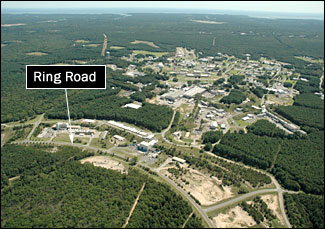
The (Rail) Road to the Renaissance of RHIC on the Ring Road

I must start writing again
- "The Rorschach debate almost seems like a Rorschach test itselfhttp://bit.ly/ZiAfv (so download 'em while you can! http://bit.ly/5gNgD )": in other words, the very reaction to the "exposure" of the Rorschach blots raises many of the ambiguities (i.e. issues) people have about the efficacy of the method. There's clearly as much interpretation in the handling of the responses, as the subject has in giving them in the first place.
- "unreal - RT @Naunihal: Please make it stop! RT @SlateBoston cop suspended for calling Skip Gates racial slur in email http://tr.im/uEEe": My friend Naunihal forwarded me this link to a Boston Globe article, originally posted by Slate this afternoon. Can this really be happening? Yes, it can.
- "Hertzberg recommending movies? @newyorkerdotcom-mers using blogs to expand purview, i guess. http://bit.ly/41IuLT worked on me, anyway": In my naive understanding of the New Yorker hierarchy, it's Lane and Denby who make us want to watch movies, and Hertzberg who leads off the Talk of the Town, typically with astute commentary on our leading political figures. But through those pesky blogs, it's Hertzberg who's recommending movies (Apatow's Funny People), and I'll be damned if he doesn't make me want to see it even more than I did before.
Saturday, June 06, 2009
Still Twittering
Tuesday, May 12, 2009
S.O.S. (Save Austrian Science)
Just in case you missed it: Austria is planning on pulling out of CERN after 50 years involvement. The claim is that they can use the money (about $21M) elsewhere in the EU.
Anyway, don't think that the Austrian scientific community is taking the news well. They are getting organized and already have a petition online. Please take a minute and sign it:
http://sos.teilchen.at/petition/
It came as a surprise when Federal Minister Hahn announced that he wanted to discontinue Austria's membership in CERN.
This "wrong historic decision" (quoting Prof. Dr. Herbert Pietschmann) must be stopped before Austria's reputation as a nation of high-tech and modern research suffers irreparable damage and our country excludes itself from future developments.
CERN - this is research in elementary particle physics and comology. CERN is a brilliant example of excellence by European cooperation. CERN is the vision of our young scientists.
By signing this petition I urge the Austrian parliament not to agree to this proposition of minister Hahn.
(And I hope no-one missed that ATLAS slide in the AP article!)
(Thanks, Heinz and Paul!)
Tuesday, May 05, 2009
Redesign
Not like I have time to fiddle around and redesign things just for the heck of it but, well, I fiddled around and made the design a little cleaner, and even cleaner still with some help from my wife. Monday, May 04, 2009
Tesla in Shoreham
Tesla's lab was located in Shoreham, New York (yes, that Shoreham - but a lovely place I used to live in when I first moved to BNL) in Long Island, just north of Brookhaven. The Times reports on the battle brewing over what to do with the site, which locals and Tesla enthusiasts want landmarked, and which Agfa, the current owner, just wants to jettison. Neat article, and a reminder of how big a presence Tesla was in his time, and how hard he fell.
Tuesday, April 28, 2009
Plot Device of Mass Destruction
Don't be afraid, the likelihood of anyone gathering up even a fraction of a gram of anti-matter (as seen here in this still from the Angels & Demons preview) is pretty unlikely. The ATRAP experiment at CERN managed to trap 170,000 antihydrogen atoms, but that's still 18 orders of magnitude (1 with 18 zeros after it!) away from A&D territory.
My introduction to anti-matter was certainly via "The Counter Clock Incident", in the animated Star Trek series from the early 1970's. While the black stars on the white sky, and the total absence of annihilating anything, clearly miss the mark, they did somehow capture Feynman's insight that anti-particles in the matter universe are, in a sense, travelling backwards in time. Who knows if they were reading Bjorken & Drell, and it's sci-fi as all get-out, but it sort of feels like an inside joke for physicists (in a Saturday morning cartoon, no less)- My reminder that people other than I watched Star Trek as kids came when I was visiting NYC from CERN in the mid-1990's. I was staying with a college friend who had gone into finance, and we ended up hanging out in Washington Square Park on a Sunday afternoon, with a guitar or two in tow. I vividly remember him playing for a bit, looking thoughtful for a second and then asking, "Now that you're a physicist, you can tell me: what is antimatter?" I gave a similar spiel as I wrote in this Discovery Space piece, but somehow he wasn't satisfied. The mystery was too great, and my experienced reality of anti-matter was far too mundane. Hope this try was better!
Thursday, April 23, 2009
Twittering
Yes, I broke down and started twittering. I used to find it quite pointless, compared to "normal" blogging, but then I started getting into updating my facebook status, and realized I actually enjoyed microblogging. Then I discovered how to link twitter and FB, and here I am, updating over and over, over on the right side of this page in the little box.
Tuesday, April 14, 2009
Starry Eyed

Explanation: Intricate, glowing nebulae that shine in planet Earth's night sky are beautiful to look at in deep images made with telescopes and sensitive cameras. But they are faint and otherwise invisible to the naked-eye. That makes their relative location and extent on the sky difficult to appreciate. So, consider this impressive composite image of a wide region of the northern winter sky. With a total exposure time of 40 hours, the painstaking mosaic presents a nebula-rich expanse known as the Orion-Eridanus Superbubble above a house in suburban Boston, USA. Within the wide and deep view are nebulae more often seen in narrower views, including the Great Orion Nebula, the Rosette Nebula, the Seagull Nebula, the California Nebula, and Barnard's Loop. The familiar constellation of Orion itself is just above the foreground house. Brightest star Sirius is left of the roof, and the recognizable Pleiades star cluster is above the tree at the right. A version of the big picture that includes simple constellation guidelines is available here.One can get a sense of this even with the naked eye if you go way out in the desert, e.g. in South Africa. I once saw the large and small Magellanic clouds down there -- with my eyes -- and I was never the same again.
Quark Matter in the News
I'm sitting here and I got some things on my mind,Hear, hear! (Thanks, Mike!)
and we're sitting here at Quark Matter two-thousand-and-nine.
Now I can't really explain what all of it means,
I just hope they don't blow us all to smith-er-eens
Monday, April 13, 2009
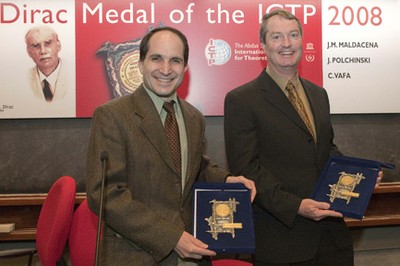
New Application (2008 Dirac Medals)

I missed this, but it's started bubbling up on the PHENIX lists: The Dirac medals were awarded a few weeks ago, and somehow it seems that being interested in the quark gluon plasma is no longer a handicap:
Professors Maldacena, Polchinski and Vafa are being honored for their fundamental contributions to superstring theory. Their studies range from early work on orbifold compactifications, physics and mathematics of mirror symmetry, D-branes and black hole physics, as well as gauge theory-gravity correspondence. Their contributions in uncovering the strong-weak dualities between seemingly different string theories have enabled us to learn about regimes of quantum field theory which are not accessible to perturbative analysis. These profound achievements have helped us to address outstanding questions like confinement of quarks and QCD mass spectrum from a new perspective and have found applications in practical calculations in the fluid dynamics of quark gluon plasma.So quark gluon plasma is now a "practical application" of string theory. While I completely agree with it in principle, imagine telling this to your aunt when she asks what your research is good for. Ironically, I usually argue that "helping string theory" is a practical application of studying the QGP at RHIC -- but it's all a matter of perspective I suppose.
The dualities have also led string theorists to conjecture that the five different superstring theories in ten space-time dimensions are manifestations of one underlying theory, yet undiscovered, which has been named the M-theory.
In any case, a belated congrats to Maldacena, Polchinski, and Vafa. It's been pretty exciting to see all of this develop in the last decade.
Wednesday, April 08, 2009
Know Your Reference (Quark Matter 2009)
So much for those dispatches: I could barely figure out where I wanted to be at any given time, much less come up with reasonable summaries of what I had just seen. Conferences are like that. Anyway, I do have a few photos, but just a few. Above you can see Bill Zajc of Columbia University telling us a few things to keep us focussed, two of them not about heavy ions at all, but about the "control measurements" we do with smaller systems that we assume are "references".Now that I'm home, it's interesting to reflect on how little attention we've questioned our reference systems as such. Generally, the less we worry about them, the better we feel, since they then remain "someone else's" problem (i.e. that of our particle physicist friends). However, the more I hang out in this neck of the scientific woods, the less I believe that nominally "simple" systems are that simple (even protons are made of many quarks and gluons), or are even that different than the bigger systems we create with huge (ok, still subatomic) nuclei. While it can be a little confusing, I find these ambiguities the most compelling aspects of this business.
I'll get to this in the next few posts. In the meantime, if you want to see the official summaries, check out the four rapporteur talks here.
Monday, March 30, 2009
Quark Matter 2009: Dispatches
I particularly like the poster this time out: the Great Smoky Mountains, Helvetica everywhere, and the central cluster of stars from the Tennessee state flag, which iconographically refers to the three quarks in the proton, but really refers to the three regions of Tennessee. It's pretty neat that the flag even has a Sol Lewitt style set of instructions associated with it:
Anyone want to try this without peeking?An oblong flag or banner in length one and two thirds times its width, the large or principal field of same to be of color red, but said flag or banner ending at its free or outer end in a perpendicular bar of blue, of uniform width, running from side to side; that is to say, from top to bottom of said flag or banner, and separated from the red field by a narrow margin or stripe of white of uniform width; the width of the white stripe to be one-fifth that of the blue bar; and the total width of the bar and stripe together to be equal to one-eighth of the width of the flag.
In the center of the red field shall be a smaller circular field of blue, separated from the surrounding red field by a circular margin or stripe of white of uniform width and of the same width as the straight margin or stripe first mentioned. The breadth or diameter of the circular blue field, exclusive of the white margin, shall be equal to one-half of the width of the flag. Inside the circular blue field shall be three five-pointed stars of white distributed at equal intervals around a point, the center of the blue field and of such size and arrangement that one point of each star shall approach as closely as practicable without actually touching one point of each of the other two around the center point of the field; and the two outer points of each star shall approach as nearly as practicable without actually touching the periphery of the blue field. The arrangement of the three stars shall be such that the centers of no two stars shall be in a line parallel to either the side or end of the flag, but intermediate between same; and the highest star shall be the one nearest the upper confined corner of the flag.
Monday, March 23, 2009
Chu @ BNL
(Funny, my photo is similar to the Times one -- maybe because Revkin was standing next to me!)Gee I barely had time to introduce this post. Steven Chu, our new Energy Secretary, chose to come to BNL today to announce a major round of funding for science, particularly for the national laboratories. I popped open the new netbook and didn't stop typing for 45 minutes, throughout what turned out to be a quite substantive talk. Enjoy the notes (as raw as they are!):
OK, the first slide is up: "The American Recovery and Reinvestment Act and America's renewed commitment to scientific research"
Cue Billy Joel muzak again, as with Paterson.
First visit of DOE secretary to a national research lab. Visited facilities and scientists.
He has chosen BNL to make an important funding announcment which will affect science across the US.
Sam acknowledging Kevin Law (NYPA), Schumer (not present), Tim Bishop (BNL's congressman)
Bishop speaking. Honored Secretary has chosen BNL as first lab since being appointed. "Underscores just what a treasure this laboratory is." Announcement will reflect wisdom of recovery act. Puts people back to work, and puts them where the US will lead.
Chu speaking. Grew up in Garden City, Long Island, age 3 to 18. Never made it to Stony Brook (laughter).
Thanking Aronson, BNL staff, Bishop, Dehmer. Struggling to get slides showing on the screen!
"This is an experiment". The secretary cracks wise! It seems the plug was kicked. "Now they're rebooting". "I hope NSLS II works better" (laughter).
There's going to be an announcment, and then "you're going to be subjected to a brief real talk"
Announcement: Obama's budget pledges to double office of science over the next 10 years. Calls for $15B per year into R&D for clean, renewable energy. Extends REsearch and experimentation tax credit for companies.
Slides are up.
Funding for DOE includes $150M for NSLS II.
Funding for 9 labs today. $65M for CEBAF. $277M for energy frontier research centers. $90M for grad students, postdocs and PhD scientists -- via which agency? Directly?
DOE: largest funder of physical scientists. 17 national labs. researchers at 300 universities. 88 nobel universities. LBNL has trained 30+ people who eventually received prizes.
NSLS II will continue scientific legacy that began w/ Cosmotron and AGS -- but in chemistry/biology/materials. What about nuclear/particle?
Photos of SC with TD Lee and Murray Gell-Mann. Story of doing crossword with MGM.
Strong focussing as major contribution of BNL to world. Reflects on early days of betatron oscillations to modern machines like NSLS II with tiny submicron beam spots.
Listing NSLS II properties (10k times brighter than NSLS I, spatial resolution of 1nm). As specs being prepared, LBNL folks were nervous -- major advance beyond known technologies.
Major contributions will be at the "Energy Frontier" (different than usual -- "energy" not "high energy"!)
"The Energy Problem": 1. national security and prospertiy linked to energy, 2. potential for geopolitical conflict from competition for resources, 3. climate change
Reviewing predictions for loss of forests and snowpack and heatwave mortality.
Death of British Columbian pine by 2013 since beetles not killed by frost. 40% already dead by 2006.
Permafrost less permanent.
Issue is preserving vegetation: microbes create lots of CO2 when they don't freeze
Human development index vs Electricity Use. US is highly developed (HDI of 0.95) but no correlation with electricity consumption. Canada and Norway much higher but due to hydro resources.
Showing per capita electricity use: flat in CA since 1973 despite GDP per capita doubling, grew 50%+ nationwide. NYS is 2nd best state in union.
Discussing development of refrigerators since 70's. Energy down by 4, cost by factor of 2-3. Energy saved by better fridges is double than all of renewable energy. One cannot stress how important energy efficiency is.
Buildings are 40% of total US energy. Lighting in commerical buildings is 26% of energy use. Huge opportunities for energy saving.
Experience from time at LBNL on making buildings efficient. Turns out lots of physics problems in helping architects and engineers to design better buildings. Can reduce consumption by 80% -- pays for itself in 10 years.
3 myths: one is that it's just political will. no it requires technology.
what is a transformative technology? electronic amplification and transcontinental telephones. vacuum tube was essential for amplifications (no-one knew exactly how they worked!). required red hot wire and burned out. needed something more reliable -- AT&T started development of transistor. Along the way, Nobel Prizes at Bell Labs (Davisson).
R&D started in late 1930's but wouldn't have started w/o development of Quantum Mechanics. By 1930, a theory for properties of atoms started being applied to condensed matter systems, e.g. Bloch waves. With better understanding of electron transport, maybe we can understand materials well enough that we can make a transistor.
It's unlikely that the transistor could have been invented w/o theoretical underpinning. Same for laser. This is why it's important to invest in basic science.
Batteries! No major change in technology since 1850 (only factor of 2). Big breakthrough by sony with Li-Ion battery - factor of 2 since 2000. Discussion of LBNL technology to improve battery performance. Co block polymer that self-assembles and prevents dendrites from forming and making shorts. 2x energy density of current LiIon. Bad at low temperatures. Instead of trying to fine tune old recipe, a new idea.
New batteries for plug in hybrids, perhaps in 5 years. Lots of smart people now spending time on this.
Moore's law curve of $/MWh vs. Megawatts installed. Factor of 10 between gas turbines and photovoltaics. Need major improvement in PV for it to be viable. DOE predicts parity by 2030. Right now a factor of 5 difference w/o all the subsidies.
"We need transformative solutions to solve the energy problem"
nanotech for producing solar cells.
Population issue? Paul Erlich predicted 100's of millions dying in the 1970's and 1980's. Productivity of land grew while land used stayed constant. 1970 nobel prize on dwarf strains of wheat. Improve food production per acre 3-6x. Also mentioned Haber's invention of artificial fertilizer at turn of century (Nobel prize!). Bosch got another prize for efficient production of ammonia. Another prize for figuring out how it worked. Science coming to the rescue, at least temporarily.
We need science to come to the rescue.
Feedstock grass can produce 1/2 current consumption of gasoline via ethanol. 15x more efficient than corn.
But we may need to invent an artificial plant...
Man first learned to fly by imitating nature. Leonardo invented plane by copying how birds flew. In this respect, Leonardo was a theorist.
Wright brothers had a hybrid solution: replaced muscle power with gasoline engine, but took features from bird wings. Now jets look nothing like birds. Also don't act like birds (e.g. mate and produce new little 747's).
Because you have access to materials not found in nature, can do better than nature (e.g. jet blades are single crystals!)
Can develop more efficient means of photosynthesis (Helios project).
This is part of the challenge.
And finally something else: funding increases for national labs, but how do we best organize assault on energy problem. Mentioning manhattan project and radar -- teams working hard to solve a problem. Bell labs -- strong individuals self-organizing into teams. Nobel prizes at Bell Labs.
There is no equivalent to Xerox PARC or Bell Labs in energy sector. National labs need to develop ideas that will be picked up by private sector.
Mentioning space program (Apollo). Earth - there's nowhere else to go.
Now taking questions.
- What about nuclear technology which can already now solve the problem? SC thinks NE is part of the energy mix. Compared to fossil fuels, no carbon emission. Of course waste & proliferation but they can be overcome. Some stimulus money for nuclear energy in ARRA. Should restart nuclear industry
- Nick Samios: part of Bell Labs was from monopoly power. Can there be regulations or incentives to revive basic research in industrial complex in the US. SC says this was part of BHO's announcement today, the R&E tax credit which needs to be made permanent. US is losing technologies to companies overseas. Need to recapture technologies by exploiting scientific lead and incentives to companies to say that we want these to be home-grown industries.
- How will ARPA-E (energy DARPA to invest in high risk things the private sector won't) being incorporated into DOE structure? Discussing conservatism of academics who need to keep their contracts renewed. So need something to encourage high risk research. He wants a lean organization: 20 people, $200M/year. No constraints. Describing his experience developing atomic fountains into better clocks using air force money (lots of money, but limited duration).
- NY Times reporter (Andrew C. Revkin) applicability of something makes an easy sell. how do you communicate energy/climate problem in a way that gets the same outcome. current R&D is $1B/year where war on cancer etc is 10's of $B/year. Times reporter is videotaping SC's answer! SC makes a comment that people often go to war for energy resources so it makes it crucial to act quickly. Also pace of climate change is worrying. Skeptics say that southern hemiphere is cooling down -- but this was predicted in climate models. Difference between now and ice age is 6 degrees C. 5-6 degrees hotter would make a dramatically different world. He sees people being motivated to go into science for this reason.
Sam has ended session. SC says "Don't clap -- get to work."
Tuesday, March 10, 2009
Making Waves

Now I know we all like Animal Collective, right? What I hadn't realized about their new album was that the cover (difficult to see on web pages etc.) was an eye-popping optical illusion ("based on the works of Japanese psychologist Akiyoshi Kitaoka" whose illusion page is wild). But, oddly enough, I only figured this out after writing a little ROOT macro to reproduce it (don't ask -- I had one of those "*I* could do that" moments...). After a bit of messing about to get it to look just like the original, and expanding its size to fill my laptop screen, it started moving. If you're a ROOT user, give it a try (and it makes things that look like this).