Monday, August 21, 2006

A Matter Darkly

Go freaking figure, just a day after ranting on about RHIC physics to a whole group of friends who trekked out to BNL from NYC, those damn astronomers have got to get some cheap media attention by doing something easy: like finding dark matter. What I find somehow pleasing, though, is how conceptually familiar it all feels. Hereby begins a novice's description

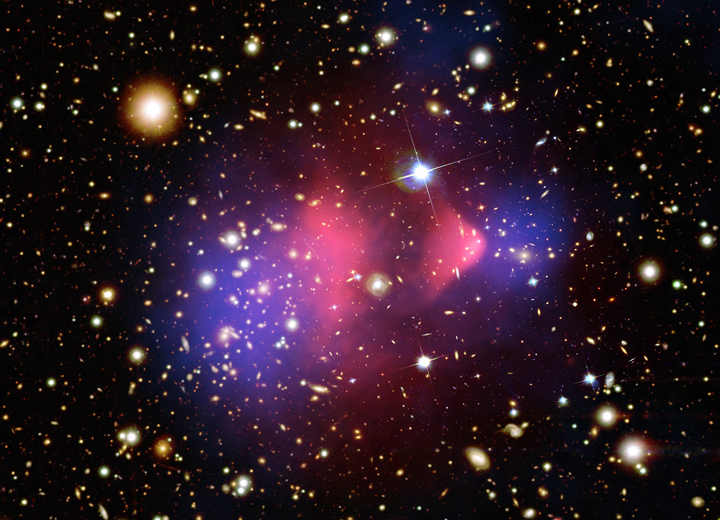
The image shows a collision of two galaxy clusters, but imaged in three different ways. The optical image shows flashes of white galaxies, something we are used to seeing through telescopes. The pink shows an image of the distribution of hot gas surrounding the cluster, imaged by X-ray astronomy (i.e. by looking at the photons emitted by the gas), which seems to have taken on an oddly "Mach Cone" shape, if I may add. Finally the bluish clumps are the distribution of mass, as imaged by the distorted views of the galaxies behind (i.e. gravitational lensing).

The rub lies in the way the pink and the blue have separated. The general view is that the gas has slowed down as the clusters passed through each other, while the dark matter has continued moving on. But if the gas was somehow the more massive part of the system, one would have also found the mass there as well.

The familiar part is that my colleagues and I have been pondering what happens when clumps of things we like, strongly-interacting nucleons (i.e. nuclei), pass through each other at high speed. We also try and "image" the space time story, but of course using different tools. We can't see spatial distributions directly, but we can infer them from the final velocities. Of course, they can't repeat their collisions, while we do so thousands of times per second. And we're all using theories, like hydrodynamics, which are amazingly applicable at extremely microscopic and extremely macroscopic scales.

Friday, August 18, 2006

School of Rock, Gnarls-style


Gnarls Barkley
Originally uploaded by entropybound.
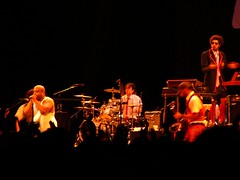
Hi everyone - I swear I'm getting back to blogging one of these days. But it's been a busy summer, both professionally and non. I shouldn't admit this, but we managed to actually see Gnarls Barkley last night at Summerstage (i.e. I had to duck out of an all-day meeting a little early, driving by a car whose wheel fell off in front of me...). Check out the photos!

Tuesday, May 23, 2006

Remain in Light

It's spring, and I use almost any excuse to post songs I like (which I only seem to do when I have too much time on my hands, as was the case this weekend with my girlfriend out of town). This one seems to have arisen out of a recent Talking Heads re-obsession, mixed with working to Fela Kuti albums (on iTunes, cheap) as background music. Have a listen.

Sunday, May 21, 2006

Spinning Round (or Square or Hexagonal...)

From Slashdot, here's this unreal article in Nature.
Tomas Bohr and colleagues made plexiglass buckets, 13 and 20 centimetres across, with metal bottoms that could be rotated at high speed by a motor. They filled the bucket with water and spun the bottom to whip up the liquid into a whirlpool that rose up the sides of the container.

This set-up is very similar to the rotating bucket that Isaac Newton used in the seventeenth century to investigate centrifugal forces.

The researchers found that once the plate was spinning so fast that the water span out to the sides, creating a hole of air in the middle, the dry patch wasn't circular as might be expected. Instead it evolved, as the bucket's spin sped up, from an ellipse to a three-sided star, to a square, a pentagon, and, at the highest speeds investigated, a hexagon.
I mean, symmetry breaking is one thing, but where do pentagons come from? Why do things "quantize" in this way, when there's nothing obvoiusly "quantal"about the problem?

Saturday, May 20, 2006

No, Steve, *you* the man


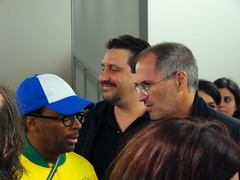
I can't believe I'm admitting this to the world, but yes I had to go down to 59th street in Manhattan to see the opening of the new Apple store. Of course, it made little sense to start with, waiting in line for almost 2 hours just to see...a store. A businessman a few of us were chatting with on the corner of Madison and 58th (yes, the line ran around the block) asked essentially that. "Haven't any of you been to an Apple store before?" Then again, it's not any old Apple store, but one that's entered via a gorgeous glass cube. And it's not any old evening, when you get Steve Jobs and Spike Lee and Fred Armisen (and probably other notables). Did anyone notice that? I just said "Steve Jobs". And he was, like, 5 feet from me. Yes, I'm star-struck. Check out all my photos here.

That said, something about this opening felt important (and not just to justify two hours waiting in line just to see a store.) This is a computer store, opening up (and staying open 24/7/365) at the gateway to the shopping on 5th Avenue, but right on Central Park. But it's also an architectural gem, a focal point for technology and content, California and New York, young and old, and so on. And it's a far cry from the tiny shop in Lincoln Park in Chicago in 1979 where I saw my first Apple ][, but it feels just as special. There are reasons people (like me) are so impressed by Jobs and his good works, and this is an important one for me.

Thursday, May 18, 2006

Boulder Workshop 2006


Catching up on the chaos of the last few months will take, well, probably another few months. Anyway, a couple of weeks ago (May 4-5), Jamie Nagle and I hosted 8 colleagues at CU Boulder for the second "Boulder Workshop" (creative naming wins the day, eh?). It was a good chance (as it was last year) to sit down with a small group of physicists, roll up our proverbial sleeves, and hash out issues and questions that have been bothering us about the physics we do at RHIC (and connections to other fields, like plasma physics and string theory). The talks are now posted online (click names on the left sidebar) and are certainly worth a look. Some photos are posted on my flickr page.

Monday, May 15, 2006

Big Bang of the Day

Speaking of Big Bangs, anyone realize there was a musical about it? Well there is: it's playing tonight at the CUNY Graduate center in Manhattan. Not sure I can make it, but sounds amusing.

Big (Glass and Chrome) Bang

Damn, 3quarksdaily beat me to this one, but I just wanted to show a photo and say a few words about Josiah McElheny's show at the Andrea Rosen Gallery in Chelsea, which I saw on Saturday. My friend Ofer pointed me to an article about this in the NY Times last weekend (now hidden behind the walls of Times Select), but nothing in there prepared me for how amazing this was. "An End To Modernity" is an homage to both the chandeliers at the Met Opera house in Lincoln Center and the introduction of the Big Bang theory, both in 1965. One sees the emanation of "lines" from an occluded "core" (indicating the moment of recombination, when the universe became opaque), and the development of those "lines" into clusters of galaxies of different shapes. Really excellent, and moving in its size, scope, and attention to detail (both of craftsmanship, and scientific).

Of course, I see RHIC collisions everywhere, and this is no exception. I see hadron emission from an "initial state" which we have trouble understanding due to "hadronization" and the decay of those hadrons isotropically in their own rest frame. But maybe I see dead people too? If anyone is interested, I can explain more -- i think the analogy works pretty well (except RHIC collisions are definitely not globally isotropic, as many think the universe is and should be...). There are even points of light -- photons! -- in between the clusters of glass. Nice to have a model to simultaneously compare one's thinking on Big and Little Bangs.

Tuesday, May 02, 2006

Rock the Casbah

With gas prices spiking (you notice these things if you make at least one trip between Brookhaven and Manhattan on a given weekday), chaos in the middle east (you notice these things if you have a pulse), and a bunch of great recent videos of the Clash being mentioned on the usual major blogs (you notice these things if you sit in a lot of meetings...did I just admit that?), I thought I'd give YouTube a go and keep those memes jumping. This is only a test, but given this outrageously simple (in concept, not in execution) but profound (emailing and blogging video) technology, isn't it a great world we live in?

Monday, May 01, 2006

Springtime @ BNL


Springtime @ BNL
Originally uploaded by entropybound.
You know it's here when the trees by Berkner hall burst into bloom. And springtime in NY and NYC is really excellent.

Sunday, April 30, 2006

Visions in Collisions, Hummingbirds, etc.

So last night I finally had my chance to teach "Physics for Filmmakers" and the results kind of look like this. The whole thing was a real 'hail mary', in that I came up with the title in mid-March before I had any idea, but eventually the actual content somehow nucleated around the title. I first tried to show how physicists image the fleeting traces of particles, which are not visible to the human eye, by means of various detector technologies. Lucky for me that even cursory Google searches yield troves of classic particle physics images. Then I tried to sketch out how we take these images of particles and "run the movie" backwards to understand the primordial event that yielded them. I tried to keep the tone breezy and the focus on the visuals (and make wisecracks whenever possible), and I hope it worked. I had a lot of fun giving the talk to this audience of filmmakers and friends and I think they had fun too. I even got a few questions during the wine & cigarette break (all the smokers took an unplanned exit when we had a few video problems at the start of my talk...).


Other highlights for me were:

  • The Thereminvox performance by Anthony Jay Ptak (who turned out to have gone to high school just down the road from Brookhaven...)
  • An unbelievable archival film of Edgerton's high speed stroboscopic films. Smoke, birds, snakes, insects - one always forgets the richness of physical and biological phenomena when one sees them at "human" speeds. 6000 frames a second can show a lot...
  • Liquid crystals filmed by Jean Painleve
  • Void Ratio by Ray Sweeten - the funniest oscilloscope tutorial I've ever seen. Should be a part of every freshman physics course, including the extended visual freakout in the second half.
  • I also liked Jennifer's The Garden Dissolves into Air, a montage of images from the Brooklyn Botanical Garden processed through the "optical printer" (and a Macintosh, of course...)

A fun evening, all in all. You can find my slides here.

Monday, April 24, 2006

Live!

Please don't take my silence as indications that I'm giving up. It's just been insanely busy, with trips to Chicago and Toronto, and various projects at work coming together asynchronously. And I got tenure. Tenure.

Anyway, one of the projects I've been working on has been a short public talk I'll be giving as part of the show "Aerodynamics of the Hovering Hummingbird: Science, Cinema, and Ways of Seeing". It's on Saturday, April 29, 8 pm at Millennium Film Workshop and is curated by Jennifer MacMillan and Bradley Eros. Please come and check it out -- I saw a previous evening Jennifer curated and it was really fun and interesting.

My talk is called "Visions in Collisions", and will be a few reflections on the ways particle and nuclear physicists see both particles, and the underlying dynamics that created them. Think of us as trying to reconstruct a whole movie when we only have access to the last few frames.

Friday, April 07, 2006

Like Steve

Many people who know me professionally know that I have quite a few, um, obsessions which aren't exactly related to physics. One is that I'm a tireless Apple booster, having gone all-Mac all-the-time in the last year and evangelizing where possible. Another is that I'm a serious nut-case perfectionist about the talks I give at meetings and conferences. Although I'm all too aware that it's not necessary to get everything right both in terms of contents and visuals, I've long felt that it never hurts. (I have a clear memory of reading an article about...well...Eddie Van Halen when I was a teenager. I didn't even like Van Halen that much (that has grown with time), but he explained why they rose to rapid fame in the late-70's: they treated every gig, even in tiny bars, as if they were in Madison Square Garden.)

And when it comes to getting presentations (especially the visuals) right, it's hard to beat the instincts of Steve Jobs, co-founder of Apple (especially, as manifest in Keynote, Apple's homegrown presentation software). And now, you too can know the secrets of Steve Jobs, at least as divined Carmine Gallo in BusinessWeek. But here's the thing: while I am not interested in turning scientists into Powerpoint-wielding corporate drones, it surprises me how often scientists ignore common-sense when preparing and delivering talks. I know I'd enjoy conferences so much more if people could just be a bit more like Steve.

(from TUAW)

Wednesday, April 05, 2006

RHIC on the Radio

Now here was a surprise. I was doing my occasional wanderings through that Internets thing trying to see if there was anything on RHIC out there in the media that I had missed. And lo, while I was poking around the WNYC website, I noticed a link to "Radiolab", a show I've heard advertised but never heard (a problem now solved for me with radioSHARK...), clicked on it, and found myself drawn to this quote:
A Simpler Time
Have you ever wished you could time travel, like in the movies? Artist Terry Wilcox asks us to imagine 1,594 years into the future, when his sculptural clock will chime. A particle accelerator jockey at Brookhaven National Laboratory takes us 45 feet away from the beginning of time. And Swedish producer Marcus Lindeen introduces us to David McDermott, an artist who devotes his life to ignoring the present.
"45 feet from the beginning of time"? Holy incompatible units, Batman (but maybe they just suppressed the "c", like pro physicists do?). Anyway, after a bit of fiddling around to find a link to the show which actually worked, I got to hear about RHIC on the radio.

The piece was unfortunately introduced by means of the aforementioned Terry Wilcox, who was worried about those "scientists at Stony Brook making a universe". OK, he missed hitting Brookhaven by about a 45 minute drive, and was attributing a scientific goal I haven't heard much of since Benford's sci-fi novel Cosm. But there we were, with Robert Krulwich interviewing one of my RHIC colleagues, Todd Satogata, about the collider. OK so a few details were botched (like RHIC colliding nuclei to study the properties of the early universe, and not protons), and some of the verbal imagery and sound effects made it sound like we were doing some serious universe creating around these parts. Still, overall I found the piece to have a surprisingly light touch and conveyed a lot of the enthusiasm we feel about our physics. Let's do some more fact-checking next time, Radiolab!

Wednesday, March 15, 2006

Awakening

Gee has it really been 2 weeks since my last post? I suppose it has, but it's not like I had any time to think about it. Since Geneva, I definitely lost a week both to jet lag and talk writing. Then the next week was probably a trifecta for me: a visit to Ohio State University where I gave both a Departmental Colloquium and a Nuclear Physics Seminar, followed a day later by a PHENIX talk at a workshop at BNL on running RHIC at very low energies. Three talks in three days: makes me drowsy just to remind myself.

The visit to OSU was incredibly interesting, as they have quite a group of nuclear physicists, both experimental and theoretical, who kept me busy for two solid work days, leaving me not as much time to prepare for the workshop as I would have preferred! Then again, I didn't prefer to have two planes, on two different airlines, malfunction on the ground in Ohio just as I was trying to board them. While the second one turned out to require only a quick repair, my return to my apartment in NYC was spoiled by a complete absence of water, due to a broken main on Broadway. Fortunately, I had a backup plan, allowing me to attend the low-E workshop with a minimum of unnecessary odor!

Since then, I've been recovering a bit, seeing friends a bit, seeing art a bit (like this dreamy video installation at Scope New York), seeing Garrison Keillor with the NY Philharmonic a bit (thanks Terry and Rachel!), and trying to wake up for a new round of ATLAS work. But speaking of waking up, I was utterly blown away by the reports that Ambien, the enormously popular sleeping pill, seems to trigger sleep-eating in many people, who gorge themselves at night, and wake up remembering nothing, although they have food in their mouths. Doesn't anyone sleep anymore? Turns out that lots of people think they don't, as they lie awake for an hour or so in the middle of the night (I know I do this!), but some people think that this is the most natural sleep pattern of all. Go figure.

Wednesday, March 01, 2006

John Cale in Geneva


Geneva certainly seems like a nicer place to hang out now than I remember it from 10 years ago. There are lots of excellent new restaurants and bars (e.g. Le Gout des Autres in Eaux Vives), and old standby's like L'Usine have gotten very impressive and ambitious in their offerings.

Here's a shot of a John Cale show we caught at L'Usine the night before heading back to the US. Most notable was how excellent the show was, bursting with ideas and energy (incredible especially for a guy the same age as my parents -- I hope I age as gracefully). A close second was the absolute ban on smoking, requested by Cale himself. One of the bouncers mentioned that Cale would flat-out stop if he smelled smoke. That's another serious change from 10 years ago.

Tuesday, February 28, 2006

Robot Wars, Geneva


Robot Wars, Geneva
Originally uploaded by entropybound.
In the midst of an inadvertant pub crawl around Geneva on Friday, we bumped into this little treasure. Apparently, the white robots are winning, at least by the Rhone. Can anyone verify this?

Tuesday, February 21, 2006

ATLAS & Me

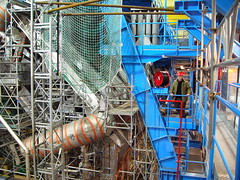
These days, it's not a trip to CERN without a tour in the ATLAS pit. My colleague Pavel snapped this photo of me standing on the scaffolding next to a tiny fraction of the ATLAS detector, which is currently under feverish construction in advance of the LHC start-up, still planned for end-2007.

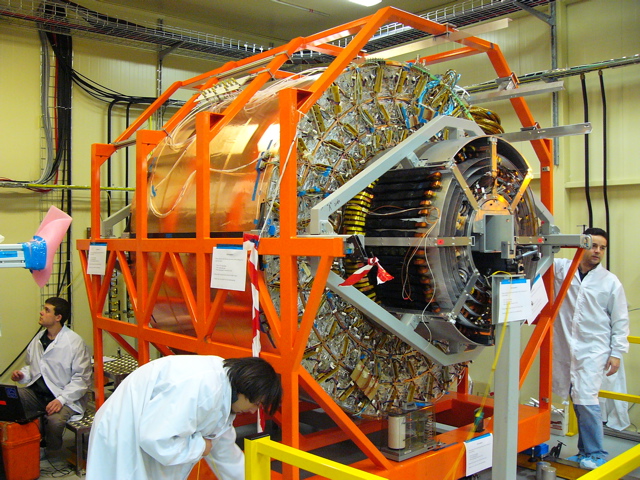
Needless to say, this thing is big. BIG. But what I still find fascinating is that while the muon system is enormous, and the calorimeters are huge, the "inner detector" which tracks particles in a profoundly complicated silicon and straw-tube detector is much more human-sized. My old colleague Heinz took me to their assembly room where they were surveying the recently-assembled "barrel". Much smaller, but a sublime piece of work with the millions of channels we will be using to study nucleus-nucleus collisions at the LHC.

Mont Blanc, Revealed


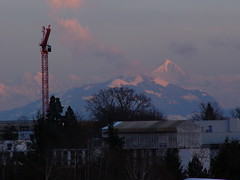
This time I have a good excuse: I'm on another trip to CERN for an ATLAS week. It's been non-stop action since hitting the ground (ok, barring an 8 hour collapse after landing on sunday morning). But as I was finishing a videoconference in my colleague's office, we noticed that the clouds had parted, leaving the French Alps exposed to the sunset. Nothing else to do but run outside to capture it on film, or a memory chip. Whatever.

I should mention, however, that I have not seen Mont Blanc from the CERN site since my student days in the mid 90's. It's usually been cloudy during my short visits here. The only way to really guarantee a good view is to head southeast by car. Give me a few days...

Friday, February 17, 2006

Who's the Scientist?

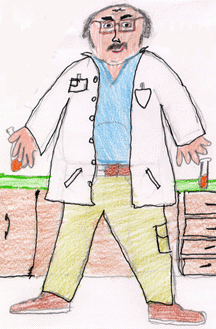
This is the greatest thing I've seen in a while. A group of 7th graders visited Fermilab and made before-and-after descriptions and drawings of their image of scientists.

This is real progress, folks.

(Thanks, Betsy!)