Wednesday, December 12, 2007

The Birth of RHIC

This afternoon, science historian (and SUNYSB philosophy prof) Robert Crease gave the 431st Brookhaven Lecture (he's given quite a few of these, but it's not surprising why) on "Birth of the Relativistic Heavy Ion Collider". Crease is our most notable lab historian and has been an important part of my understanding and appreciation of BNL. Today was no exception, as he covered the improbable chain of events, including some outrageous coincidences that led to the transformation of ISABELLE to RHIC. ISABELLE was a particle physics machine, which was plagued by technical difficulties in producing its accelerator magnets and was rapidly eclipsed by machines at CERN and FNAL even before construction got underway. Fortunately, as the physical infrastructure fell into place, a few visionary folks realized that various facilities of the lab could be yoked together to address the questions arising out of the emerging field of heavy ion physics. But Crease argued persuasively that it was only by the delicate maneuvering and effective leadership on the part of lab management (then lab director Nicholas Samios in particular) which led to a relatively smooth transition from a particle machine to a nuclear machine over the course of 5 days in July 1983.

Entering this story relatively late (only about to enter the 8th grade when all of this went down), it was very moving to understand better just how non-inevitable RHIC was, and how lucky we all are to have it here for us now. It also made me realize just how fragile these projects can be, no matter how big or "logical" they seem at the time. But having lived through the crazy times in 2000 when the machine finally rumbled to life, it makes the memories of the exhiliaration that was in the air that summer that much more meaningful. Also reminds one that the history of science isn't just what you find in Physical Review Letters.

Wednesday, December 05, 2007

L3 Ching

So I'm glancing at upcoming releases in iTunes and I stumble on this:
But then I say to myself: "That spooky octagonal symbol in back looks familiar..." A little perusing the CERN websites yield this event display from the L3 experiment, formerly of LEP (and which now houses ALICE at the LHC):
The octagon in this image is a schematic of the famous L3 muon system. My first thought is: Wu Tang owes Sam Ting some royalty money (could this ever help AMS get airborne, maybe?). My second thought is: I've seen the Wu Tang symbol before. And my third thought is: I Ching:
And I nearly fell out of my chair - even the L3 inner detector is matched with the Yin Yang. To assuage myself that my current reading (Illuminatus! Trilogy -- goofy, but a blast) isn't wrecking my mind, I show a colleague the I Ching diagram. His first response: "L3". So I am still asking myself: is this an accident (likely, but b-o-r-i-n-g), or was the I Ching a design template for the detector, consciously or not (with eight "thunder" trigrams...less likely, but amusing to consider)? Anyone have a good answer?

Anyway, from iTunes to I Ching in two moves. Not bad for an hour's procrastination.

Tackling Easterbroook

Is that fireball all set to destroy humanity (with no practical use except to make sure a few eggheads get fancy dinners at conferences)...or just a fiery football?  Have a look at my reaction to Gregg Easterbrook's recent rantings about physics...on ESPN.com.

Monday, December 03, 2007

A Book, a Real Book


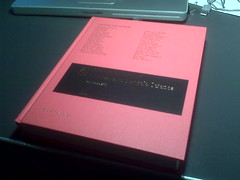
This may seem strange in a world where scientific information is increasingly disseminated electronically (as it should be, and for free, when taxpayer dollars are paying for it!), but I just got the greatest thing in my office mailbox today: a book. A real book. While I've been published in my share of conference and workshop proceedings, and various papers have ended up published on real paper and stashed away in real libraries, this one feels a bit different. 

The book in question is the latest edition of Annual Review  of Nuclear and Particle Science.  I've always seen these on various library bookshelves over the years, and been given photocopies of various articles throughout the years (older issues seem to be online now, which wasn't the case last I checked!)  And somehow the design feels very book-ish, sober red cover, with all of the contributors' names embossed in gold.  Feels snazzy.  Classy, even.

And then you open the thing up and it's all...in color, which is still relatively novel for scientific publishing due to the additional costs incurred by the journal publishers.  So while most of us submit papers with color figures, a perusal through a physical copy of Physical Review C typically doesn't do much for the eyes.  I'm actually surprised at myself that I am responding to some of these articles more for having downright elegant color and design choices - even a very clean, readable font (anyone recognize it?).  That said, I now know that these choices may well come more from the Ann Rev staff than from the authors -- we had quite a few rounds with them during the final stages of our piece.  

So anyway, here's a link to our piece on "Glauber Modeling in High Energy Nuclear Collisions" -- a year in the making, and another year to book form.  And thanks again to my collaborators on this -- Mike, Klaus, and Steve. 

Wednesday, November 14, 2007

Magic

I know that I got into science because it felt like the closest thing to the thrill and mystery of magic, but it was somehow more "real". But after an event I attended Monday night -- an amazing event: magic show, trash-talking puppets, real-time candy-puppet-making, card castles that hold human weight - now I'm not sure who is more in touch with reality. I found out about this event from Mark Mitton, a friend of mine who organized the evening at the National Arts Club. You can read a bit more about the event, get links to their website, and see a few photos (taken by yours truly, like the one above of Mark, Brian and two semi-willing volunteers about to stand on a card structure...) here. The one thing that you won't see anywhere (and I botched the photographs of) was Mark's string theory trick: showing how short and long strings are actually the same size, and closed strings and open strings easily transform into each other, before one's very eyes -- no-one has to teach this guy about duality [rimshot! thankyouthankyou, I'm here Wednesdays and Sundays...]

Thursday, November 08, 2007

We Are the Champions

Who said you can't do physics and rock at the same time? Check out this entry on SPIRES:
Radial Velocities in the Zodiacal Dust Cloud.
Brian May (Imperial Coll., London) . 2007.
Ph.D.Thesis.
Wikipedia fills in some of the story:
May studied astro physics at Imperial College London, graduating with a B.Sc. (Hons) degree, and then proceeded to study for a Ph.D., having written a significant amount of the doctoral thesis, and carried out a majority of the research required, May abandoned his doctoral studies to pursue his music career with Queen.
On a similar tack, but in the opposite order, I saw my old college friend Vijay Iyer play the Jazz Standard the other night with his band Tirtha (guitar, piano, tabla trio, playing jazz strongly inflected by Indian musics). He was a physics major at Yale (like me, sort of -- I graduated with a poli sci degree, but finished a lot of the major), went off to graduate school, and simultaneously started playing pro gigs all over the world, eventually leaving physics after getting his PhD to play full-time. And now he's signed to Savoy Jazz and named top "Rising Star Jazz Artist" and top "Rising Star Composer of the Year" for the second year in a row. Great show, and further proof that sometimes you can do both science and art -- but usually only one at a time.

(Thanks, Corey!)

Friday, November 02, 2007

Granular Liquids vs. RHIC

People often use the word "glass" in relation to RHIC physics (via the Color Glass Condensate), but this is a bit more literal. From the upcoming Physics News Update #845, now RHIC is being used as a "benchmark" for fluid (or even liquid) behavior, even when the fluid is made of glass beads:
GRANULAR LIQUIDS WITH ZERO SURFACE TENSION. New experiments with spherical glass beads show that liquid behavior can arise simply from rapid collisions among a sufficiently dense stream of particles. The experiment was undertaken by Xiang Cheng, Heinrich Jaeger and Sidney Nagel and their colleagues at the University of Chicago, experts on discovering novel effects with granular materials (see http://www.aip.org/pnu/2005/split/725-3.html and http://www.aip.org/pnu/2005/split/759-2.html). If one or two beads are dropped from above on a horizontal surface, they will bounce back in the direction from which they came. If, however, many beads are dropped all at once---constituting a dense granular stream hitting a target---then something else happens: the grains deflect out laterally in the form of a very thin, symmetrical sheet or cone as if they were a liquid. Indeed, the experiments using granular matter quantitatively reproduce results obtained with streams of water. However, with beads, the *liquid* is one in the limit of vanishing surface tension. (To ensure there was no cohesiveness between the beads, which range in size between 50 microns and 2 millimeter, they were baked in a vacuum oven beforehand, evaporating any lurking moisture.) During the short interval the beads inside the stream collide with each other in front of the target, liquid-like conditions are established whose observable consequence are the thin sheets. This novel, zero-surface-tension liquid state, the experimenters believe, might be of interest to physicists at the Relativistic Heavy Ion Collider (RHIC), where heavy nuclei colliding at high energies (see http://www.aip.org/pnu/2005/split/728-1.html) form a plasma of quarks and gluons that also resembles a liquid. Intriguingly, the collision pattern produced by the completely classical, macroscopic granular liquid can match that produced by the quark-gluon plasma. (Cheng et al., Physical Review Letters, 2 November 2007)

Tuesday, October 30, 2007

Who Put the Manhattan in the Manhattan Project?

Speaking of Columbia, check out this article in the Times on the Manhattan history of the Manhattan Project. Quite a bit of it was in fact done downstairs from where the string theory workshop was held, in the basement of Pupin Hall. To be honest, I still don't know if those lower floors are open again; when I was a postdoc there in the late 90's everyone told me they were still "hot" (i.e. activated) and sealed off from normal access. Want. To. Know. More.

First off: that's a huge room and cyclotron. Is that really in Pupin? I'd be surprised...in fact this looks nothing like this photo I found on the Columbia website of I.I. Rabi frying hotdogs on the Pupin cyclotron. Time to write the NY Times another email...

Cosmic Rays in ATLAS

From Monica Dunford's recent post on the US-LHC blogs: a cosmic ray muon read out by the ATLAS muon system and Tile calorimeter in the pit. Reality check, indeed. And a brief meditation on the joys of data, especially poignant in the "LHC generation", which has been living its physics life looking at physics event generators for far too long (spoiler: In my experience they are all wrong, always, to some extent -- even when they're "right" in many respects. But the way they are wrong is almost always more interesting than one expects...)

But let's not forget the bottom line: holy crap, ATLAS is rumbling to life.

Sunday, October 28, 2007

Strings@Columbia

Sorry to be non-posting on this blog, but my guilt lies heavy where an editor watches -- i.e. I just posted a long piece about a workshop last friday on the US-LHC page.

Saturday, October 20, 2007

How I Spent My Month, Part II

Eleven days in Morocco (Marrakech, Skoura, Fes)

Thursday, October 18, 2007

How I Spent My Month

Couldn't imagine a better way.

Tuesday, September 18, 2007

Alan & Joan

Did anybody notice, in all the hubbub around Alan Greenspan's new book, that his connection to Ayn Rand was through the painter Joan Mitchell, whom he married for 10 months in the early 1950's? His biographies often mention her, and Rand, but Mitchell's online bios make no mention of him. Even the Times article linked above doesn't mention her by name, even though you can figure this out using Wikipedia and Google. Why the asymmetry? I mean, we just saw four huge Mitchell canvases hanging in the MoMA lobby the other day, so it's not like she's a big secret. I know -- nothing to do with physics -- but this is the wildest thing I've heard in a while.

Six Physicists in a Room, Talking About TV

I know I'm way too late on this one, but I was dumbfounded by this piece in New York magazine's Fall Preview a couple of weeks ago. It's a TV show about physics graduate students ending up on prime time TV (Big Bang Theory, on CBS, premiering Monday). And I bet they're all theorists.

OK, grumbling aside, how great is this interview with six real graduate students? It includes our own (heavy ion theorist) Azfar Adil, who gets both first -- and last -- word.
Was the physics on the show accurate?
Azfar Adil (age 27, high-energy particle physics): Not at all.
David Kagan (27, theoretical physics): Some of it was loosely accurate.
AA: What really bothers me is that it’s somehow okay to not know science in this country. Nobody would have, like, a piano prodigy on a show and have him talk about Mozart while Beethoven was playing.
...
AA: But really, the show has nothing to do with physics. It’s more like Beauty and the Geek in sitcom form.
We'll have to see for ourselves, on Monday (or Tuesday, if it ever shows up on iTunes -- I gave back my cable box almost a year ago...)

Monday, September 17, 2007

Lunchtime


Man, a blogger can't catch a break these days. I write a piece on the US-LHC site on my concerns about reporting unsubstantiated information from other blogs, and I get *slammed* in the comments to Peter Woit's blog:
I definitely think Steinberg’s statement (which I saw too) is overly restrictive if he means that they won’t even talk about the most recent hardware status, which is public info. Hopefully his/their self-imposed restrictions will not reduce them to just posting what they had for lunch.
Of course I'll blog about public information: just not anonymous interpretations of that info. And I will never report on what I had to lunch at BNL. I'll let Nayyarson's website do that for me.

Nobel Prize vs. Education System

Weird, but amusing, and apparently true in spirit, if not in letter, which makes it less amusing, and downright scary:
Wolfgang Ketterle, 2001 Nobel Laureate and John D. MacArthur Professor of Physics at M.I.T. has read about the record shortages of math and science teachers in American schools and decides to lend a hand. He leaves M.I.T. and comes to Springfield to teach high school. He calls to offer his services
...
"I'd like to teach at your school."
"Wonderful. Wonderful. Just send me your Letter of Clearance from the County and I'll set up the interview."
"My what?"
"Your Letter of Clearance."
"I'm afraid you have me at a disadvantage," Pro K says. "Just tell Principal Skinner it's Wolfie."
"Dr. Ketterle," the woman replies. "He can't interview you unless you have a Letter of Clearance from the County."

Tuesday, September 11, 2007

Doppelganger

Just a quick plug for a new project I'm getting involved in: blogging for the US-LHC website, about to open for business tomorrow (September 12). "US-LHC" is an umbrella concept for all of the institutions in the US participating in the LHC. This includes the machine itself, all six experiments -- ATLAS, CMS, ALICE , LHCb, LHCf and TOTEM (anyone out there from those last three?) and folks from particle and nuclear physics (that's me). The goal is to bring some attention to the LHC project, and especially the role of the US-based groups, both at universities and national labs, who are devoting body and soul towards getting the LHC experiments and machine off the ground in the next year.

My colleagues are an interesting bunch (from ATLAS and CMS only) and physics being the zero-dimensional universe it is, I have non-trivial connections to (at least) two of them. Pam Klabber's husband Greg was at BNL for a few years, and hosted several, um, memorable Halloween parties. And Steve Nahn was a year ahead of me when we were both students at MIT, many, many years ago....

So anyway, it's going to be an interesting year, dividing my limited self among quite a few outlets. Check out the new blog for a few of the ground rules!

Friday, September 07, 2007

Long, Straight, Curly, Fuzzy, Snaggy...

I know this is from "Hair", and this is a physics blog, but this article by Jean-Baptiste Masson from the American Journal of Physics is a physics article talkin' 'bout hair.
We address the question of hair tangles and show experimentally that curly hair tends to become less tangled than straight hair. A statistical model based on geometry confirms our findings. The model gives an interesting geometric approach to hair behavior.
As a curly haired type I always assumed the opposite (although I can't say I've owned a comb for a long long time), but that's what you get when you actually go look. Go figure.

(from AIP's physics news update - no link yet, but should be number 838)

Stephen Hawking, LEGO Style

My blog is called "Entropy Bound", so I think the laws of physics compel me to link to this (and it's not exactly the first time I've posted physics-related LEGO things). Yes, it's Stephen Hawking, in LEGO (not "LEGOs", remember).

(from Brickshelf, via BoingBoing, via Gizmodo...)

Thursday, September 06, 2007

Origins of Time's Arrow

This looks interesting, from the NYAS website:
Origins of Time's Arrow

This conference will involve a concentrated focus of leading world experts from a wide range of perspectives on one of the most outstanding issues in cosmology and theoretical physics - why time unfolds with a definite orientation even though the underlying laws are time reversal invariant.

The meeting is first in a series aimed at stimulating progress on outstanding topics in theoretical physics.

For more information on this event, please click here.

Scientific Organizing Committee

Brian Greene, Columbia University
Justin Khoury, Perimeter Institute
Laura Mersini-Houghton, University of North Carolina-Chapel Hill
Lots of bold face (i.e. for physics) names: Albrecht, Cooper, Linde, Silverstein, Smolin, Steinhardt, Tegmark, etc.: I'd be all over this, but I'll be on vacation in Paris. Too bad, but poor me.