
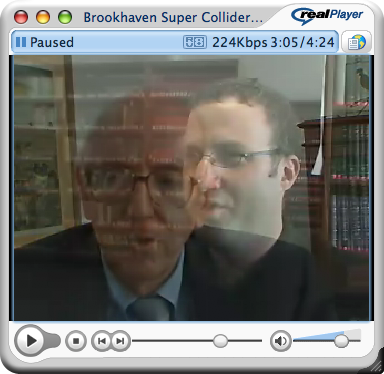
 This has been in the works quite a while, but is only now reaching the web. In October, I did an interview with Carolyn Weaver of Voice of America TV about RHIC, it's science, and the controversies surrounding the various "doomsday" scenarios proposed in the 80's and 90's. It's now posted on the VOA website.
What I hadn't realized when I agreed to give this interview was that Weaver had already spoken to Richard Posner, the eminent federal judge. Posner wrote a book in 2004, "Catastrophe: Risk and Response", which discusses the risks of RHIC, among other disasters, and how we are currently not dealing with various eventualities. And here in the final product (shown to the right), I find myself superimposed on Posner, if only for a brief instant. How many of my lawyer friends can say that?
I've discussed Posner and other critics various times in my previous blog, and I maintain that I find their arguments still less than compelling in their particulars. But I never imagined I'd get a chance to say so in public. I still believe that while we should take risks seriously, and in general scientists should be held accountable for the risks they take, and discuss them openly. However, we must constantly be updating the level of risk based on incoming information. Posner (and Rees, for that matter) are basing everything on several papers written in 1999 and before, well before the RHIC data came in. Since that time, we have found that the matter we create at RHIC essentially blows apart as soon as it is made. And more importantly, this matter is not baryon rich, as it was at the AGS. This suggests to me that we're even less likely to make stable strange matter than ever before. That said, I should not be construed to be a real expert on this subject. But that said, no expert I know has suggested that the risk level has increased. There have even been searches for strangelets at RHIC (in the baryon-rich forward region) which have (as always) come up empty!
So until my colleagues A) actually isolate even a hint of a strangelet signal, and B) start to believe (based on experimental data) that RHIC is really a better enviroment for their production than previous facilities (which have established stringent upper limits), I think it's premature to start any serious discussions of the risk of RHIC to humanity as a whole. But I'm sure someone out there already disagrees with me.






 That was fast: Director Chaudhari just announced that James Simons, along with partners, has committed to raising $13M for the RHIC run. This is great. I know that I and all of my colleagues are really excited about this. More later.





 Fun season so far, but pretty busy overall. That said, an amusing issue popped up at lunch, yesterday. Chatting with a friend of mine, a plant biologist at BNL, we both realized that we both were Lego-obsessed kids. Then it turns out that he was part of a group of three friends growing up in England on the same street, who were all obsessed with those multicolored plastic blocks, and they all became scientists. Adding me to the sample, that's 4 for 4: anyone else out there?
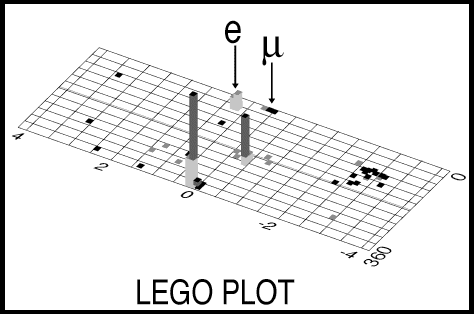 It's always amused me that high-energy physicist have been using "Lego plots" for years, but it never occurred to me that it could be part of a larger trend.


 OK, this has made me mad. John Horgan, author of the much-debated (and unread-by-me) "The End of Science", has managed to secure himself the last page of this week's New York Times Book Review on which to tell us that "
