 This is the greatest thing I've seen in a while. A group of 7th graders visited Fermilab and made before-and-after descriptions and drawings of their image of scientists.
This is real progress, folks.
(Thanks, Betsy!)
 This is the greatest thing I've seen in a while. A group of 7th graders visited Fermilab and made before-and-after descriptions and drawings of their image of scientists.
 This has been in the works quite a while, but is only now reaching the web. In October, I did an interview with Carolyn Weaver of Voice of America TV about RHIC, it's science, and the controversies surrounding the various "doomsday" scenarios proposed in the 80's and 90's. It's now posted on the VOA website.
The Department of Energy (DOE) would enjoy substantial increases for its energy and science R&D portfolios in 2007, an unusual turn of events for a department that has mostly seen flat budgets in recent years (see Figure 6). The DOE Office of Science (OS) would emerge as the clear winner in the 2007 budget with a 14 percent increase to $3.8 billion for its R&D portfolio centered around the physical sciences. The largest OS programs would all receive increases of 8 percent or more, including a dramatic 24 percent boost for Nuclear Physics after a decade of stagnant funding, a 36 percent increase for computing research, a 25 percent increase for Basic Energy Sciences centered around several large-scale facilities, and a 31 percent increase for the core life sciences research portfolio. Although these increases would help BES, computing research, and nuclear physics reach new highs, high-energy physics, fusion, and biological and environmental research would remain below previous years’ funding levels because of years of eroding budgets.What a rollercoaster, from the World Year of Physics presenting us with the worst budget in a while, with many gloom-and-doom predictions for the future, to an enormous "bounce" (hope not a "dead-cat" bounce...) and a rosy outlook. But people should keep in mind that a 24% increase relative to 2006 doesn't translate into a huge increase if one averages over the last few years: it's only 15% above the 2005 budget, and inflation depreciates all funding by 3-4% a year, so it's really equivalent to a real 8% increase -- not peanuts to be sure, but it certainly does not sound as whopping as 24%!
 So after all of the struggles last year (remember the 65% solution?), things are certainly looking up this year. Newsday (and never the New York Times, it seems!) has a piece (and a photo of STAR, with my colleague Gene Van Buren in front!) which seems to have run twice in the last couple of days: "Proposal lets collider run a full schedule".
The relativistic heavy ion collider received $121.5 million for 32 weeks of operation in fiscal 2005, but this year had its budget cut to $110 million. After a $13 million private donation, the collider is scheduled for 20 weeks of operation this year. The proposed 2007 budget includes $138 million for a full schedule of 30 weeks of operation.This sounds a little awkward, getting more money for less running, but people should realize that we have massive R&D needs, and major upgrades are underway, both for the big detectors (STAR and PHENIX) and for the accelerator (Uranium, anyone?)
The collider is a superconductor that accelerates ions to nearly the speed of light, allowing scientists to explore the smallest known pieces of matterIt's an accelerator, not a superconductor! Yes, there are superconducting magnets everywhere, but ultimately the particles are accelerated in vacuum and just guided by the magnets. Yes it sounds niggly, but I don't think our material science friends would appreciate the confusion either.
 Just a short follow-up to that last post. I arrived for day 2 of Jury Duty at 10am, and essentially did nothing for the rest of the day, only to be fully discharged by 3:30pm, after a two hour lunch break. I was happy to do my duty, in principle, but it still makes me a bit sad that having an overly-developed sense of the objective, and thus a high standard for evidence, makes me a liability to the legal system as it is.
 After the mayhem of last week, spending 8+ hours a day with ATLAS software, this week has taken on a whole new character: Jury Duty. After holding off the New York Supreme Court for a few months back in the autumn, I was finally compelled to drop by the courthouse this morning. I can't give much in the way of details, but I can report a few things that surprised me.
Jury duty takes a lot less time than it used to: apparently it was two weeks, only a few years ago, but it's certainly never going to end after a day. Minimum is two days, and it's looking like typical cases can take days. Consider that next time you pick your next postponement date. The orientation is cheesy, the time lost from work is a little excessive, but after a while you really start to get into it. While it really looks like a hardship in the abstract, seeing a few details of how the legal system works is pretty neat. Heck, I'm a physicist: I like to know how things work, and the law is supposed to be a machine of sorts, right? Based on laws, just like physics, right?
Well maybe, but they certainly don't seem to value the scientific outlook. While I really can't say much about what went on the courtroom, I can say that I was in the first (large) group of people to be brought down to be considered for a jury. I can also say that I was in the first group of 12 to be considered out of the larger group. So for a few minutes I felt kind of proud of myself, that I could serve my civic duty. Then the questions began, as we cycled through our renditions of the "Voir Dire", a set of questions related to our ability to serve impartially on the jury. Have you ever been a victim of a crime? Do you know anyone in law enforcement? And so on. Most of us didn't set off any alarms in this way, as few people are so scarred by their experiences with courts or law enforcement that they can't consider a situation objectively.
Then they asked us what we did for a living and where we went to school. At first I didn't understand why, although it was fascinating to see the wide cross section of people they had selected, from a wide range of backgrounds and occupations. But a funny thing happened as soon as I said: "Physicist, PhD, MIT". "So you want to be an astronaut?" asked the New York Supreme Court Judge. That started to make me suspicious. Then the prosecuting DA asked: "Mr. Steinberg, scientists typically want objective means to verify facts. Do you think you will be able to believe testimony given by witnesses in the case?" I had to think about this one: "I would feel responsible to my duty to the court, but I really prefer to have some objective verification of facts I am given." I thought this seemed reasonable, to express a high standard for evidence. But the judge lit into me: "You scientists want all the answers! One has to be able to find a defendant guilty on the testimony of a single witness. It's not about the quantity, but the quality!" I realize that this has to be the case, for the system to convict anyone, but I've always been taught to verify everything, since even the smartest, most reliable, people can make mistakes in their perceptions or interpretations.
The defense attorney picked up on my response, however, in a way that made me very suspicious. After he asked me a few questions of what kind of physics I do ("nuclear physics? that's my favorite!" said the judge), he extended this issue of questioning testimony: "I hope all of you will be able to consider that a story given by a witness could be a lie." Always a possibility, but at that point I started to wonder if I was a goner. And after a short recess I was a goner, along with six others in my group, sent back to the pool of potential jurors. Although it wasn't the only reason to cut someone from a jury, the very training I was so proud of, the one that made me so sensitive to various issues in how we know what we know, made me essentially unqualified to serve in one of our most important civic institutions.
So while there are clearly laws of physics, there doesn't seem to be much room for physics in the law. Hasn't anyone seen Minority Report? Better luck tomorrow!
 As usual, blogging slows down as life speeds up. And things have been quite intense recently, as attention shifts almost completely to my new projects. I'm finally making headway with my longer-term project for the PHENIX experiment (a little database, that should grow pretty big over time...) and we just finished an extensive week-long software workshop for ATLAS. This was really the big one for me, when I finally felt "over the hump" in terms of being able to actually use the ATLAS software, which is apparently quite powerful: but with great power comes great...complexity? Anyway, more later as I get my thoughts together (and finish a 15 page writeup of my lectures from Erice last summer, by Wednesday [gulp]).
When Brookhaven National Laboratory managed to save one of its key nuclear physics experiments last week by using private financing to fill in federal budget gaps, the effect wasn't limited to the lab itself.
In broader terms, the lab's economic impact statewide is far more significant. Between 1993 and 2003, it added up to 79,000 jobs, $9.2 billion and a host of new technologies that cannot be entirely quantified, according to a report released Thursday by Long Island Association chief economist Pearl Kamer.
The report, which has been two years in the making, shows that the lab is one of the top five high-technology employers on the Island, with 2,750 employees. But what with visiting scientists, the development and marketing of new inventions, and the ripple effect of new technology created in the lab, it's really responsible for tens of thousands of additional, secondary jobs for the state, in industries such as construction, retail and business services, the report said.
And in the future the lab's economic effects could be even greater, with another $5.6 billion and 91,000 jobs statewide by 2014, Kamer's report predicts. Much of the trickle-down effect occurs on the Island, she said, as workers spend money and the economy grows.
 Sorry to have been silent these last 6 days. A bunch of us went skiing in Vermont for the long weekend (and most of us returned OK...) and since then it's been chaos for me getting retooled for my post-PHOBOS life. We had an internal review of the heavy ion efforts for ATLAS, and since then I've been down with a minor cold, which gave me my only chance to work on my long-overdue PHENIX tasks. That's three acronyms in two sentences, folks. No wonder I'm having trouble keeping up.
 There's a lot of ground to cover in the issues surrounding the recent announcement of private funding for RHIC. But as a nice way to start these discussions, it seems apropos to start with a telling quote (at least in retrospect) from the New York Times Business section on November 19, 2005, from an interview by Joseph Nocera with Simons in his Manhattan office:
What interested me most of all was: why? At an age when most men are contemplating retirement, with more money than he can count, why was Mr. Simons still at it? "I enjoy the challenge," he replied.Hear, hear. I've reposted the STAR image just to show what Simon was referring to.
He then began describing a demonstration he saw recently of a new nuclear accelerator at the Brookhaven National Laboratory, where he is on the board. Two atoms hurtled toward each other, colliding with great force. "A huge number of particles are thrown out," he said, "and the job is to analyze everything that results from the collision."
"Watching the spray of particles on the screen made me think of the stock market," he continued. Every trade, even of a hundred shares of a company, affects every other trade. And every day there are thousands upon thousands of such trades, all of them affecting the rest of the market. His work, as he sees it, is to analyze that incredibly complex mosaic and try to figure out how it all fits together.
"The subject may not be the most important in the world," he concluded, "but the dynamics of the market are really interesting. It's a serious question."
I suddenly understood the motivation behind Mr. Simons's new fund. He's doing it because he wants to see if it can be done. Once a scientist, always a scientist.
 That was fast: Director Chaudhari just announced that James Simons, along with partners, has committed to raising $13M for the RHIC run. This is great. I know that I and all of my colleagues are really excited about this. More later.
 little of it amenable to the blog. That said, it has been fairly exciting to be Apple-watching of late. New CPUs, Tiger upgrade, the MacBook (everyone seems to want one... including me) and... Google Earth. Google Earth. So now I can look for my very own apple (or MacBook) in the Garden of Eden. But given the choices Google Earth gives me, even just in the NYC area, I don't even know where to start...
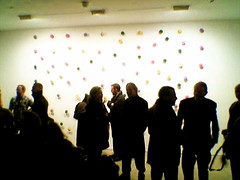


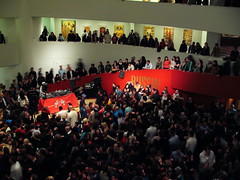
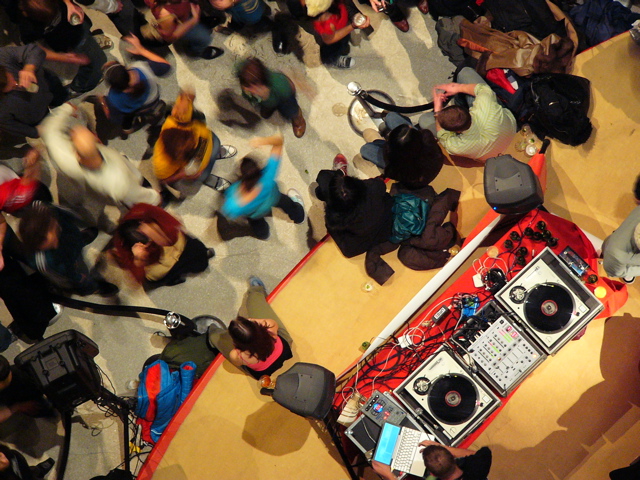 Little did I know that I was just in time for one of the more fun events I've ever attended in NYC: the First Fridays event celebrating the close of RUSSIA! with Diplo running DJ set until 1am. The line ran around the block even at 10pm, but membership has its privileges (totally kidding, folks, but this was my good luck for the evening having become a member for a totally unrelated reason...) Really neat seeing all of the art (amazing) with a huge crowd on the ground floor, and lots of others hanging over the walls of the ascending spiral. And the DJ set was excellent, especially seen from directly above (see the photos...)
 Fun season so far, but pretty busy overall. That said, an amusing issue popped up at lunch, yesterday. Chatting with a friend of mine, a plant biologist at BNL, we both realized that we both were Lego-obsessed kids. Then it turns out that he was part of a group of three friends growing up in England on the same street, who were all obsessed with those multicolored plastic blocks, and they all became scientists. Adding me to the sample, that's 4 for 4: anyone else out there?
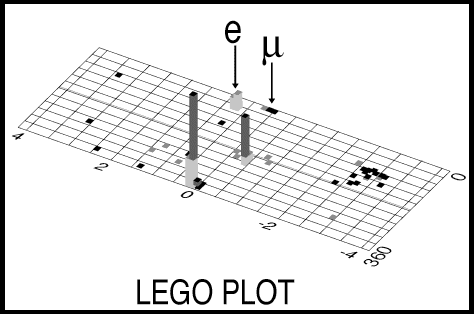 It's always amused me that high-energy physicist have been using "Lego plots" for years, but it never occurred to me that it could be part of a larger trend.
 At last the loop is closed. It began as a mild-mannered post on Quantum Diaries last March, made a pit stop during a photo-shoot at BNL in late August, and has finally culminated in a bona-fide article in Symmetry Magazine (which I somehow didn't get in my mailbox!). Check out the PDF version with the full-page photo!
 OK, this has made me mad. John Horgan, author of the much-debated (and unread-by-me) "The End of Science", has managed to secure himself the last page of this week's New York Times Book Review on which to tell us that "Einstein Has Left the Building."