Monday, July 30, 2007

On Target


So we went to see Sonic Youth at McCarren Pool in Brooklyn over the weekend. Pretty great to hear Daydream Nation played front-to-back. I'll leave the infinite regress of bellyaching about supporting nostalgia trips outside in yesterday's rain -- the music, issues, topics, etc. still sound wildly futuristic even now. The only thing that might date it is the fascination with 70's and 80's icons like Philip K. Dick (oops, people are still making movies of his books, and Blade Runner is being re-released again) and William Gibson (no more movies, but cyberspace anyone?) And maybe the song about the Preppie Murderer ("Eliminator, Jr."), whom I could find namechecked in only one online review -- how quickly things move into the past.

But I knew I recognized Lee Ranaldo's amps from somewhere: Jasper Johns: An Allegory of Painting, 1955-1965. Very sly sneaking in the modern art for the kids. Almost as sly as that huge Gerhard Richter candle...

Monday, July 23, 2007

Shapes of Things

Yow, the conservation of (blogging + life) holds true. I'm just back from a week in Montreal + Vermont, 5 days of which were spent attending the "ETD-HIC" (Early Time Dynamics in Heavy Ion Collisions) workshop at McGill. The workshop was mainly concerned with various approaches to modeling and measuring the microscopic dynamics of the very early stages of a nucleus-nucleus collision. Of course, many people think that this is easy: nuclei are made of hadrons, hadrons are made of quarks (and gluons), and we know the rules by which quarks and gluons interact. Sad part is, it's not: the stuff we make at RHIC acts far too much like a fluid to be merely composed of particulate quarks and gluons bouncing around via pair-wise interactions. So it was a lot of discussion of Color Glass Condensates, Color Fields (w/ Wiebel instabilities), Lattice QCD, etc., and various ways of probing these dynamics experimentally (especially "hard probes" like QCD jets and heavy quarks.)

Naturally, I was there pushing my favorite worldview: that most of the data points us to considering a very rapid equilibration of the system. So rapid that it might as well be immediate, or on size scales comparable to that of the Lorentz contracted nucleus (i.e. a size that decreases linearly with energy). Regardless of that precise time, it seems to thermalize so fast that the initial configuration of the nucleons themselves are "frozen" in time (e.g. as shown above, with the green circles representing the "participating" nuclei), and serve to initialize the spatial distribution of the matter. This then evolves hydrodynamically (ideal or otherwise) until it freezes out into the particles that hit our detectors. At the very least, one seems to need to consider this lumpy, fluctuating initial state to capture various systematics of the data (e.g. how it varies with system size, shape, etc.) Neat stuff (which is why I like to talk about it!)

Wednesday, July 11, 2007

2 Out of 3 Ain't Bad

As Gram Parsons once sang, "and they called me a man because I couldn't keep my great big mouth shut." I guess I'm a man now: my 3rd lecture is finally over (and posted on my feed). Lots of fun (and great questions from the students) but my throat is sore.

Anyway, I'll be leaving Tallahassee and FSU tomorrow. But for the absurd heat and humidity, it's been an interesting trip -- and it's back to the grind tomorrow.

Tuesday, July 10, 2007

Lecture One in the Sunshine State

This week I'm hanging out in Tallahassee, FL (staying only a few blocks from the governor's mansion, it seems -- too bad Jeb is gone now...) at the National Nuclear Physics Summer School, presenting a set of 3 lectures on RHIC physics. I'm also learning quite a bit about the state of modern nuclear physics, which actually becomes more interesting as I dig deeper into RHIC physics. People generally think that RHIC physics is somehow growing away from "normal" nuclear physics, e.g. nuclear structure, but the more we look, the more we realize that our results really "see" the nuclear wave function in some form or another -- although we see "snapshots" rather than steady state configurations. So why am I sitting in Ian Thompson's nice leactures, blogging about them rather than listening? Go figure.

Anyway, here's the first lecture given yesterday -- an extended version of my RHIC colloquium, with a few more details on centrality determination than i usually allow. More to come.

Thursday, July 05, 2007

Murray & Lev

What is Landau telling Gell-Mann? I'm not kidding -- I'm dying to know. If any readers know Gell-Mann personally, can you ask him? Interestingly, this photo (which I stumbled on after digging up my talks from 10 years ago in a forgotten directory...) sums up a lot of my interest in how QCD works.

Barring any real answer (but who knows?...) any ideas for captions would be welcome in the comments!

Friday, June 29, 2007

Me Feed

I've been asked to keep a list of recent talks, papers, etc. online and I've been wondering how to do this in a relatively-dynamic way that avoids just editing lots of HTML pages. Et voila, I can edit *XML*! At least it looks slick in an RSS reader, or on iGoogle. I'll be keeping a list of my available talks on this, in somewhat chronological order, and papers will come soon. Always feel free to drop me a line if any of this strikes you.

What's New with "What's New?"

What gives?
1. 1984: WHAT'S NEW WAS BORN ON THIS DAY, 23 YEARS AGO.
WN was in Orwellian peril from the start. My wife asked how long I planned to keep writing this thing. "Not long," I said, "if I tell it like I see it, they'll end it in a year." After I became director of the new Washington Office, the APS Council asked me to make my weekly report public - but not advertise it. Some wanted Big Brother to approve each issue before it went out. If so, someone else would have to write it. Much later I agreed to add a disclaimer - not everyone liked that either. After more than 1,200 issues and growth from 112 subscribers to 15,617, APS finally ended WN. My department chair, however, asked that I continue writing WN, but with the University of Maryland as sponsor. He made it my principal teaching assignment.
...
4. 2007: WN LIVES, BUT THIS IS MY LAST DAY WITH THE APS.
I am truly grateful to the APS for allowing me to speak my mind, not just in WN, but to the media and in congressional testimony. In a university like Maryland it's expected, but it's unusual in Washington. For those who hope for a gentler WN, I refer you to H.L. Mencken's epitaph: "As he grew older, he grew worse."
Who offed Bob Park at the APS? Who will whats-new "What's New?"?

[Update: In looking for a photo of Park, I found this...“I’m not really going anywhere,” Park advises friend and foe alike, “I just won’t have the title anymore.” So it goes.]

Wednesday, June 27, 2007

Citations: Dyonic Black Holes, Landau's Hydrodynamics

A few months ago I posted a proceedings from the GHP06 meeting in Nashville, called "Hotter, Denser, Faster, Smaller...and Nearly-Perfect: What's the matter at RHIC?" In general, people don't cite proceedings much, since they often just summarize results from other papers, maybe combining a few things here and there that hadn't been done before, or making some useful (if not exactly rigorous) commentary. Now why the authors of "Hall conductivity from dyonic black holes" (Hartnoll and Kovtun) chose my proceedings to cite in their paper -- beyond the fact that I cite and show a figure from Kovtun's seminal work with Starinets and Son -- I don't know, but I think it's really neat to be introduced to a new physics topic via my own citation-searching vanity. RHIC physics is starting to make its presence known to more and more communities, since it is now finding itself friends with many different kinds of strongly-coupled systems -- and it's really bracing to watch it happening in real time (vs. summarized in textbooks years after the fun is over).

And speaking of citations, I also just noticed a recent paper "Unified description of Bjorken and Landau 1+1 hydrodynamics" citing my old proceedings on "Landau Hydrodynamics and RHIC Phenomena". I'm still trying to figure out exactly when the switch in my brain flipped in this direction, but I've been arguing (only semi-successfully) for about four years now that people should be taking Landau's hydrodynamical model (full stopping of the nuclear matter in the overlap volume) seriously, following the clear lead of Peter Carruthers in the 1970's. It's been known for a while that some RHIC data clearly supports it, and I've argued that a wide range of phenomena are also consistent with it, but very few people have done theoretical work to see how it behaves in the geometries we might expect from nuclear collisions.

Thus, this new paper is encouraging to see, since it at least revisits and starts to clarify how the Landau solution "works". It's also neat to see more and more people exploring the connections between hydrodynamic behavior and dual gravity theories. One of the authors of "Unified" proposed boost-invariant (Bjorken) flow as being dual to a black hole moving in the "5th dimension" of the AdS theory, which begs the interesting question of what the equivalent analogy is for Landau's fully 3D flow (which is a much more interesting scenario than boost-invariance since it provides causal connections between most of the final state by rapid thermalization in the initial state -- a lot like the inflationary model of the universe!). I hope these guys figure this out, and soon.

Maarteenies and Pseudoparticles

Gee, this is neat: The New Yorker's Roz Chast did the cover of the latest Symmetry magazine. I only found this in my mailbox just today, despite it being the May issue. How did I miss this?

Sunday, June 24, 2007

Coney Island Mermaid Parade


It's summer in the city again (although the weather certainly won't tell you that) and last night was most people's yearly pilgrimage to Coney Island for the Mermaid Parade. As usual, fantastic time. Great costumes, music, etc and just a great reminder of the oft-forgotten treasures of NYC. And we rode the Wonder Wheel, in a "swinging" car. Fantastic.

Unfortunately, there were overwhelming shadows over the parade this year from twin looming threats of the continuing war in Iraq, and the more recent fear of over-development along the shore near Coney. The boardwalk and amusement park are fantastic resources and are basically free to wander around. It'll be hard to imagine them surrounded by gated communities and the businesses that will inevitably attend to them. Have a look at my photos and others and keep fingers crossed we'll all be able to take more similar ones in the future.

Friday, June 22, 2007

New CERN Schedule

Look what's in on the tubes:
Geneva, 22 June 2006. Speaking at the 142nd session of the CERN1 Council today, the Organization’s Director General Robert Aymar announced that the Large Hadron Collider (LHC) will start up in May 2008, taking the first steps towards studying physics at a new high-energy frontier. A low-energy run originally scheduled for this year has been dropped as the result of a number of minor delays accumulated over the final months of LHC installation and commissioning, coupled with the failure in March of a pressure test in one of the machine’s components.
Useful information for the next couple of years of travel planning...But should we be concerned that the CERN press office doesn't know it's 2007?

Wednesday, June 20, 2007

Cats in Collision

I was as baffled as you were when this whole LOLCATS thing appeared. I'm even more baffled by this.

I mean, how do we know it's a liquid, and not a plasma? Jeez.

Monday, June 11, 2007

Birds of a Feather

What better way to get over the lackluster Jobs keynote (yes I'm an Apple fan -- so what?) than to stumble on this article in New York Mag on Edward Tufte? While I never took his class at Yale (although friends did), I did see him give his seminar at BNL, where we paid a grand total of $25 for the full-day of his time and his (at the time) full set of three books (worth $100+ on Amazon, and almost $400 if you do the seminar+books today). And while I don't have rimless glasses (I went back to thick plastic recently), I too have Minard's graphic of Napoleon's march on Moscow on my office door. So consider me a fan.

It's hard to express just how influential Tufte has been on the way I look at, and present, scientific data. I can really see the difference in my talks and plots before and after that summer day in 2000, and I've tried my best to evangelize (with occasional success) to my colleagues as we put together useful figures to represent the interesting things we've learned at RHIC.

And it's also neat to hear him express his admiration for Apple, and to read how they paid him back in that iPhone ad. What they don't mention is that Google analytics (which I use to track readership of this website) already uses "sparklines" everywhere, and they do exactly what he says they do. Neat stuff, both the short article and his books, and worth a look by scientists and non-scientists alike.

Tuesday, May 29, 2007

The Physics of Art Business

Sometimes one wonders why physicists tend to be prime candidates for banks and consulting firms. Then one sees a case like Paul So, a prof at George Mason University, outside of Washington DC.
So, currently on a sabbatical, bought the building at 1353 U Street NW, next to the Republic Gardens, last year for $1.3 million. It is his dream to provide a space and program for art students so they can learn the business side of art, like how to write grants and how to market their work. Those selected would get two-year fellowships that would also include lectures and seminars by local educators, gallery owners and artists, So said. He likens his idea to getting a post-doc in art...He will add office space for rent upstairs, and a couple of condos. That way, he said, he can afford to run the gallery and nonprofit group.
A physicist wants to show his paintings and support local artists. So he buys a building to create a self-sustaining nonprofit gallery. That's why. Awesome.

Wednesday, May 23, 2007

The Quark Matter Tapes (1983)


Speaking about how certain things become "invisible" in the online world, and thus nearly cease to exist, what about "audible" things which don't naturally interface to digital realities? Try and wrap your mind around what I'm holding up to my iMac: an audio tape of talks from one of the first Quark Matter conferences, held at BNL in 1983. These are perhaps the most important conferences in the field (although clearly the QM2002 organizers didn't think so...), and have been running since 1982.

My colleague, and BNL physicist, Carla found these in her office where they'd been sitting for 24 years -- in a box on the shelf. I spoke to graduate students yesterday who weren't even born when this happened. They might not have even known what to do with these things, although they might not be able to afford a car without something that can play them. Fortunately my car (a trusty Golf IV) still has one too (good for my iPod, natch), meaning I could drive home listening to the late David Schramm speak about the importance of heavy ion physics to Big Bang physics (via its help in forming Jupiter-mass black holes) and Piet Hut on "Disturbing the Vacuum" -- yes, the ur-RHIC-as-Doomsday story.

We are where we are now at RHIC because of what went on in the room when this tape was made. Even more, it's simply gripping hearing the past speak to you so directly (there's a lot that doesn't make it into the written proceedings, and memory is fleeting) and profoundly moving (didn't I mention the memory thing already?). I'm hoping these things can be made digital ASAP.

Monday, May 21, 2007

The Invisible Visual Web

Hm, where does the time go? Last week it went to a trip to Toronto and a trip to California, where I gave a colloquium at UC Riverside (posted soon!). This week it's catching up time, and I have a lot to do.

But through my PHENIX channels (aka Bill Zajc, whom some readers may have met through his guest blog on Backreaction), I was alerted to this article from the Institute for Nuclear Theory on "The strongly interacting quark gluon plasma in a new light: photons at RHIC", written by my BNL colleague Raju Venugopalan. Now, it seems that no-one knew about this article through the usual means. But the usual means, of course, means Google. And how could Google miss anything, when at the rate it's going it'll have all of our baby pictures indexed visually in a couple of years. Or not -- it's still pretty mediocre at indexing images, and that's why this article didn't show up on my usual RHIC searches, despite it being full of RHIC-related keywords. All of the text and captions are images, rendered from LaTeX (our standard typesetting package) into PNG (a standard image format):

It's funny how the obviously visual becomes completely invisible to current technologies. Maybe someone should print it out, scan it, OCR it, and re-post it as text. Then I'm sure Google will get cracking on it pronto.

Or someone, e.g. I, could just post it as postscript (which Google will read...thanks, Raju!)

Tuesday, May 15, 2007

Nuclear Physics: Not Just for Men

Just a follow up to the story which ran in the Times last week. As Paul pointed out in the comment to my post, it was an unfortunate example of the perception of physics as ultimately a boy's game. In this case, the story made working at RHIC sound literally like "grown men gathering around wide-screen TVs to watch collisions" -- or Star Trek -- despite showing several women in the photograph. Two of my colleagues at BNL and Stony Brook -- Sally Dawson (the chair of the physics department) and Barbara Jacak (recently-elected Spokesperson of PHENIX) -- have justly objected to this somewhat-skewed portrayal, in a letter to the Times:
Nuclear physics experiments at Brookhaven Lab’s Relativistic Heavy Ion Collider involve a lot more than men viewing wide-screen monitors in a control room rooting for collisions.

The Phenix and STAR collaborations at RHIC are large teams that run these experiments. They include about a thousand scientists — women and men, young and old — from around the globe. And though exploration of the moment just after the Big Bang may sound like science fiction, house-sized detectors, fast electronics and large-scale computers are in use here and now, revealing that the early universe was a dense liquid of quarks and gluons.

Women earn 21 percent of bachelor’s degrees in physics and are as excited as men about looking so far back in time. The science, and the technology needed to do that science, will make them — and Long Island — future economic leaders.

Barbara Jacak
Stony Brook
Sally Dawson
Upton
The writers are, respectively, Phenix Collaboration spokeswoman and chairwoman of the physics department at Brookhaven National Laboratory.
While we still have a way to go before we reach the numbers of women one finds in countries like Italy or Spain (which were striking during my student days at CERN, after spending my life to that point in the US), the trends are clearly headed in the right direction.

Monday, May 14, 2007

The Grey Lady, at CERN


Just a quick post from the Buffalo airport, on the way back from Toronto (family visit - lots to plan, lots to plan...). It seems the NY Times Science Times has the LHC story to end all LHC stories, a huge Dennis Overbye piece about his visit to CERN, chatting with many of the usual suspects from CMS and ATLAS, several satellite stories (the magnet diaster, the string theory connection), an interactive graphic about the machine and detectors (snazzy), and a video. A video. That's a wrinkle that I haven't seen yet from the other news and newsy outlets.

But I have to say, I'm a little frustrated by CMS stealing all the photo spotlight. Then again, I was told by colleagues recently that CERN orchestrated a major media event recently while they were lowering a section of the detector into the pit, so maybe it's just all about access. That said, there's quite a few images of ATLAS in the video. Even better, there's also a brief flash of a simulation of a heavy ion collision (the usual colorful billiard balls).

But look (reading and writing in real-time -- jetBlue calls!): there's the espresso drinking thing again (as seen in the New Yorker piece) although drunk this time in print by Michelangelo Mangano. Of course Nima Arkani-Hamed makes his appearance just before, talking about the sleeplessness induced by the prospect of new data. Considering his several-shot-an-hour habit he revealed Kolbert, maybe it's not just the science.

Wednesday, May 09, 2007

RHIC Alert: New Yorker (what, no ATLAS?)

I keep forgetting to actually pick up the New Yorker and read it sometimes. Good thing I remembered this week, to catch the (now de rigeur these days, it seems) article on the LHC - rigorously rendered as "L.H.C." throughout Elizabeth Kolbert's article. So far so good, and even a mention of the old RHIC doomsday debate:
Worries about the end of the planet have shadowed nearly every high-energy experiment. Such concerns were given a boost by Scientific American—presumably inadvertently—in 1999. That summer, the magazine ran a letter to the editor about Brookhaven’s Relativistic Heavy Ion Collider, then nearing completion. The letter suggested that the Brookhaven collider might produce a “mini black hole” that would be drawn toward the center of the earth, thus “devouring the entire planet within minutes.” Frank Wilczek, a physicist who would later win a Nobel Prize, wrote a response for the magazine. Wilczek dismissed the idea of mini black holes devouring the earth, but went on to raise a new possibility: the collider could produce strangelets, a form of matter that some think might exist at the center of neutron stars. In that case, he observed, “one might be concerned about an ‘ice-9’-type transition,” wherein all surrounding matter could be converted into strangelets and the world as we know it would vanish. Wilczek labelled his own suggestion “not plausible,” but the damage had been done. “BIG BANG MACHINE COULD DESTROY EARTH” ran the headline in the London Times. Brookhaven was forced to appoint a committee to look into this and other disaster scenarios. (The committee concluded that “we are safe from a strangelet initiated catastrophe.”)

“I know Frank Wilczek,” Engelen told me. “He is an order of magnitude smarter than I am. But he was perhaps a bit naïve.” Engelen said that CERN officials are now instructed, with respect to the L.H.C.’s world-destroying potential, “not to say that the probability is very small but that the probability is zero.”
Now that's an amusingly, um, American way of handling the problem.

But how did someone forget to show ATLAS to the New Yorker people. This is the LHC experiment which not only has involvement from several major New York universities and institutions (Columbia, NYU, BNL, Stony Brook, but not Rockefeller - hmmm....) but whose very logo is sitting in front of Rockefeller Center - holding the whole universe on his shoulders, to boot.

Tuesday, May 08, 2007

Nuclear Fallout

Some people know it, some don't, but there was just an important meeting in Galveston, TX last week, in order to develop the priorities for the nuclear physics Long Range Plan. These priorities are crucial for all of us nuclear physicists since they determine the priorities of the community -- in order -- for the Department of Energy to use to make the hard choices in lean budget years. I've just been sent a powerpoint of the final recommendations, which are officially public and open for discussion. Let's make discuss.

Without further ado, here are the recommendations -- in order:
  1. We recommend completion of the 12 GeV Upgrade at Jefferson Lab. The Upgrade will enable new insights into the structure of the nucleon, the transition between the hadronic and quark/gluon descriptions of nuclei, and the nature of confinement.
  2. We recommend construction of the Facility for Rare Isotope Beams, FRIB, a world-leading facility for the study of nuclear structure, reactions and astrophysics. Experiments with the new isotopes produced at FRIB will lead to a comprehensive description of nuclei, elucidate the origin of the elements in the cosmos, provide an understanding of matter in the crust of neutron stars, and establish the scientific foundation for innovative applications of nuclear science to society.
  3. We recommend a targeted program of experiments to investigate neutrino properties and fundamental symmetries. These experiments aim to discover the nature of the neutrino, yet unseen violations of time-reversal symmetry, and other key ingredients of the new standard model of fundamental interactions. Construction of a Deep Underground Science and Engineering Laboratory is vital to US leadership in core aspects of this initiative.
  4. The experiments at the Relativistic Heavy Ion Collider have discovered a new state of matter at extreme temperature and density—a quark-gluon plasma that exhibits unexpected, almost perfect liquid dynamical behavior. We recommend implementation of the RHIC II luminosity upgrade, together with detector improvements, to determine the properties of this new state of matter.
Number 4. Ouch. More on this to come.

(cue Jimmy Webb's "Galveston"...)

Monday, May 07, 2007

Voyage to the 3rd Dimension

Speaking of the NYTimes, and Star Trek, there's also this fantastic article on three dimensional printers: "Beam It Down From the Web, Scotty"
Sometimes a particular piece of plastic is just what you need. You have lost the battery cover to your cellphone, perhaps. Or your daughter needs to have the golden princess doll she saw on television. Now.

In a few years, it will be possible to make these items yourself. You will be able to download three-dimensional plans online, then push Print. Hours later, a solid object will be ready to remove from your printer.
Really makes you wonder if the sci-fi actually drives the development of certain technologies by planting those seeds in our childhood minds.

STAR Shift Troopers

More like Star Trek. A day the life in the STAR Control room during RHIC Run 7, but as covered by the New York Times (regional). Holy moly:
Thomas A. Trainor, 62, a physics professor from the University of Washington, who was at the control panel, invoked another metaphor, likening the control room to the bridge of the Enterprise in “Star Trek.”

“That’s Captain Kirk over there,” said Dr. Trainor, pointing to the shift leader, a spry 81-year-old physics professor from U.C.L.A., George Igo. He was accumulating collision data from the experimental run and amassing an impressive pile of pistachio shells on his desk. “I’m just the bookkeeper,” Dr. Igo said.

Dr. Trainor continued, “You could say I’m Sulu, at the controls, but when the captain tells me, ‘I want things run this way,’ I do it.”

“He’s Chekov,” Dr. Trainor said, pointing to Jan Kapitan, 26, a doctoral student in nuclear physics from the Czech Republic. Then he turned to a tall man monitoring the alarm systems, Peter Filip, who works for a research group from Moscow.

“He’s Scotty,” Dr. Trainor said, “because if something goes wrong, he has to respond.”

...

“The ‘Star Trek’ metaphor is very appropriate,” Dr. Trainor said. “Did you know the idea for the show was actually based on the voyages of Captain Cook? It is evocative of what we do here. The detector is not actually moving, but this is a voyage.”
But seriously, not all of us watch Star Trek. Some of us watch...Battlestar Galactica. You know, the new series. So different than the older one, and so much better.

Sunday, May 06, 2007

N-1

The score has been settled, as of yesterday (look way down at the bottom). History: N, Time Fact Checkers: N-1 (to their obvious credit, N is presumably a very large number):
Editorials/Op-Ed

From Thomas L. Friedman’s column on April 27: Albert Einstein won the Nobel Prize for his “services to theoretical physics and especially for his discovery of the law of the photoelectric effect,” not specifically for relativity. (Go to Article)

Unfortunately, you now have to pay to read the article (damn TimesSelect) but it's there. Of course, I'm sure my complaint was echoed by quite a few others, as it's one of the most bizarre examples of neglect in the modern history of the field (and to be kind, who wouldn't assume that he got the prize for E=mc2?). But it's nice to see that loop closed.

Friday, May 04, 2007

The Nano Soda Bottle

Bizarre follow up to my post yesterday about the BNL scientists who have submitted a spintronics patent: This morning just before 9am, I (Steinberg) received this email:
Dear Mr Zalizyak

I have just read an article about your nano electron and the spin like double magnetic field.

I have already applied for patent on such technology and further I have used the concept and the technology for production of electricity.

I think you will find a very great areas of collaboration and conflict of patent.

My application for overall claim has been published , so I am sure we will create conflict of interest.

I produce nano materials in layers in SP3 multiplayer in a cola bottle in room temperature and atmospheric condition.

I am sure if you provided us with your patent claim number we will have covered this.

My claim goes back to October 2005.

Please contact me, that we can rectify the matter otherwise we have to take steps that you can not issue licences.

Best regards

M T Keshe
from someone whose address reads "c de roose (fb855828@******.be)" (I'll block out part of the email so as to not attract the robot again...). So "Mr. de Roose" sends a mail for "Mr. Keshe" (Ms.?)? Spin-like double magnetic field to produce electricity in a soda bottle? Looks/sounds like a scam to me. Anyone seen this kind of thing before?

Thursday, May 03, 2007

Rocks, Trees, Strings

I'm a little slow to catch this sooner, but Google news just dug up this new release from the Princeton press office, regarding a relatively new PRL from Igor Klebanov and collaborators (OK, a month ago, but this is Physics, folks, not political news). Believe it or not, "A Test of the AdS/CFT correspondence using high-spin operators" may well be about more quotidien objects than quarks, gluons, or strings. From the press release:
"These problems include describing the interactions among the quarks within everyday atomic nuclei," said Igor Klebanov, the Thomas D. Jones Professor of Mathematical Physics at Princeton and an author of a recent paper on the subject. "We have previously been able to study these interactions in detail only at the high-energy conditions within particle accelerators, but with these findings we may be able to describe what's happening inside the atoms that make up rocks and trees. We cannot do so yet, but it appears that the math of string theory could be what we need to bridge this gap."
I must admit that both this paper, and the Beisert et al work (in the Journal of Statistical Mechanics) on which it was based, are a bit beyond me due to the hard-core field theory, but times change: can anyone boil this down and explain the consequences for someone in the trenches? Here's one attempt, in the press release, explaining how these results bridge the weak coupling regime (the domain of perturbation theory) and strong coupling (the domain of string theory techniques):
"Beisert and his collaborators made an inspired guess based on sophisticated notions of gauge theory behavior," said Curtis Callan, the James S. McDonnell Distinguished University Professor of Physics at Princeton. "Their equation allowed Igor and his colleagues to work out the 'transition' between the two regimes. They demonstrated that it exactly matched string theory's predictions at the strong interaction limit. That was the hard part."

GMMs, QGPs, and BNL (at the USPTO?)

I'm a little slow on the uptake this week, with all the interesting things to write about (and photos to take, etc. -- i have a fantastic new 50mm fixed lens for my Nikon...). But I didn't want to let this one pass me (and thus you all) by, since it involves one of those bizarre-but-true synergies you could only get at a place like BNL:
An interdisciplinary group of scientists at the U.S. Department of Energy’s Brookhaven National Laboratory has devised methods to make a new class of electronic devices based on a property of electrons known as “spin,” rather than merely their electric charge. This approach, dubbed spintronics, could open the way to increasing dramatically the productivity of electronic devices operating at the nanoscale — on the order of billionths of a meter. The Brookhaven scientists have filed a U.S. provisional patent application for their invention, which is now available for licensing.
The topic is doing spintronics (making logic gates, etc.) using "graphene-magnet multilayers" (GMMs), a 2 dimensional layer of graphite in a hexagonal pattern which can propagate spin excitations:

“Graphene is quite unique,” Zaliznyak says, “in that an ideally balanced sheet is neither a conductor nor an insulator. Related to this is the fact that electrons in graphene behave in such a way that their mass effectively vanishes!” In other words, he explains, they move without inertia, like rays of light or particles accelerated to relativistic speeds — that is, close to the speed of light.

Such relativistic particles are studied at Brookhaven at the Relativistic Heavy Ion Collider (RHIC), a nuclear physics facility where scientists are trying to understand the fundamental properties and forces of matter. RHIC theoretical physicist Dmitri Kharzeev and condensed matter physicist Alexei Tsvelik have collaborated with Zaliznyak to gain a better understanding of the physics of magnetized graphene.

Now if only they'd forget about this patent business, I could actually tell you what they were talking about. But who knew RHIC physics would apply to 2D spin systems?...

Wednesday, May 02, 2007

6-0 on Video

As promised, here is the view from the tower of all of us in "BNL 60" formation. Looks pretty good from up there -- and the time lapse video looks even better. I'm the dude in black who starts on the lower-left, then keeps making scouting runs to take photos...

In any case, I hope the lab gets this posted on YouTube sometime soon, so I can post the video right here!

Tuesday, May 01, 2007

BNL 60 Photo

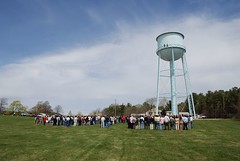
A whole lot of us gathered in the huge field near the BNL center today to commemorate BNL's 60th anniversary by spelling out "BNL 60" in huge letters. Roger, one of the long-time BNL photographers, perched himself on the huge blue water tower, looking down at us, and shouted down orders which some followed (and some didn't...)

Anyway, I hope we get to see one of the top-down photos soon. In the meantime, here are some of my bottom-up shots - in a Flickr set.

Monday, April 30, 2007

Response to the Response (Smolin vs. Polchinski)

Wow, I'm on fire today: 4 posts. Maybe it's that May 1 deadline, but maybe it's because there's just a lot of fun debate about physics going on, and a lot of it references the physics I do and love. Case in point: Lee Smolin has posted a reply to Joe Polchinski's online (Cosmic Variance guest blog) review of Smolin's The Trouble With Physics (something which I always meant to review online, but somehow lost my way...). I have no idea how I would have found this, except for randomly bumping into it on Peter Woit's webpage.

Anyway, I feel no particular authority to comment on most of Smolin's comments on Polchinski's comments, but just wanted to point out Smolin's comments on the applicability to heavy ion physics:
With regard to heavy ion physics, yes the applications of the AdS/CFT duality to this are interesting and important. But they should not be exaggerated. Polchinski does so when he says, “And so the quantum gravity that is manifesting itself in dual form at Brookhaven is likely to be the same one that operates everywhere else in the universe.” First because there is no quantum gravity here, in this particular application only the correspondence with classical supergravity arises. Second, what is the basis for the “likely” here? I can imagine an aether theorist making the same argument: aether theory must be right because after a lot of work the principle of relativity of inertial frames was shown to be a consequence of the dynamics of the aether, therefore since nature “uses a small number of principles in diverse ways”, the aether must be the right explanation for why this principle is observed in nature. Further, it remains the case that the calculations behind these claims are done with an extended super-symmetric theory, when real QCD has no super-symmetries at all. It may be that they get some things approximately right for reasons that have nothing to do with string theory, such as the use of a scale invariant theory to provide a rough approximation of a non-scale invariant theory, in an experimental regime which has approximate scaling.
I might want to comment that for any approach to "get something approximately right", if it's "merely" scale invariance, this is somewhat of a cause for celebration in heavy ions, considering the non-perturbative regime we seem to have found ourselves. Even if string theory was a mere excuse to get to the "right" ingredients for a useful theory, then it's worth the (continually fascinating) endeavors of the string community.

That said, even I have been somewhat confused about the "ontological" status of AdS/CFT as it related to RHIC physics. I asked Polchinski about this in early 2004 (when he spoke at Quark Matter 2004 in Oakland, CA), trying to see if the applicability of AdS/CFT meant that string theory was somehow "in" the physics we do at RHIC, unification and all. I remember him having no particular difficulty in saying yes to this, as reflected in the sentence Smolin quotes. Would that it were true, but I'm still more comfortable saying that it's a "mathematical" connection between RHIC physics and black holes, leaving the more subtle (i.e. physical) connections for the experts!

LHC Update: No Test Run

What a disaster. I missed this Scientific American piece last Thursday about "Magnet Trouble Likely to Complicate Start of Large Hadron Collider". The disaster isn't missing the article, but what it means for the machine, people, detectors, and even some physics. Naturally, any and every delay creates logistical issues for the machine installation, which is already enormously complicated even when things stick to the plan. But it's also somewhat tricky for all of the people who have already started trying to plan their lives around the potential machine schedules, i.e. when they and their postdocs and students should be at CERN. The detectors will suffer a bit since they won't get to take "test" data while the machine is ramping up. But finally, the physics community will be missing a chance to improve the "energy scan" of collider data. The original test run was supposed to be at "injection energy" (900 GeV), without any acceleration in the LHC itself. While there exists a huge volume of useful collider data from UA1/2/etc on particle multiplicities, spectra, jets, etc, this is all around 20 years old by now. Many measurements at RHIC and the Tevatron have already pointed towards wanting to measure these things much more precisely and in greater experimental detail.

I know this was a major reason for me wanting to get to the LHC early, so I admit that I'm pretty disappointed, but life goes on...

Robot Wars, Geneva - Solved

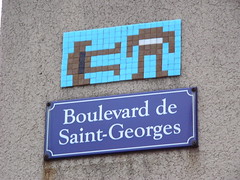
I blogged about this a bit over a year ago, somewhat baffled by the appearance of this videogame-inspired mosaic above a street sign in downtown geneva. Now today K pointed me to this post on nymag.com about "space invader in D.U.M.B.O. area", which links to a Paris-based art site that has this interactive map of Geneva. Apparently the invasion has already taken place, and evidence is all over the city. Now I know what I should be doing next time I have a free afternoon on a sunny day during my next trip to CERN...

Light Through a Lens

For those colleagues of mine who don't keep up with the science blogs, even one as enjoyable as Backreaction, be sure to check out Sabine's recent guest blogger in her "Inspirations" series: former spokesman of the PHENIX experiment at RHIC, Bill Zajc. Bill is one of heavy ion physics' more eloquent spokespeople in general (e.g. see the story on RHIC physics he co-wrote for Scientific American last spring), and this latest example is no exception. And only one typo -- pretty good for a long blog piece (sorry, Bill!).

(shameless self-promotion of the day #1: Pertaining to this post, I did a piece for this way back in February.)

(shameless self-promotion #2: I'm going to be getting some official sponsorship starting tomorrow, when I'll be blogging as part of BNL's 60th aniverssary. Nice to have some pressure once in a while!)

UPDATE: Brant suggested I mention Bill's Wikipedia entry, for no other reason than the fact that he has one.

Friday, April 27, 2007

Fact-check of the week: Friedman vs. Einstein vs. Friedman

Nice to see a meditation on Einstein and intellectual freedom discussed in Friedman's op-ed today (OK, so it's Walter Isaacson's meditation -- couldn't a few more non-cliched Einstein quotes have made it in there?) but the Gray Lady's top man and editorial staff has let down its man it seems:

Tom Friedman says:
"If Einstein were alive today and learned science the boring way it is taught in so many U.S. schools, wouldn’t he have ended up at a Wall Street hedge fund rather than developing theories of relativity for a Nobel Prize?"
Nobelprize.org says:
"Albert Einstein: 'for his services to Theoretical Physics, and especially for his discovery of the law of the photoelectric effect'"
I know I sound like splitting hairs here, but this didn't take more than a quick Google check. More importantly, it's always been very noticeable that he didn't get his prize for relativity, which everyone knows is his most important historical achievement (despite the photoelectric effect, requiring quanta of light, being his most self-admittedly "radical"). It's not hard to dig a little, e.g. this Discover piece from this year, based on research from Robert Marc Friedman (ironic -- wonder if he's a relative?) to get the story that the Nobel Committee actively didn't want him to get a prize for relativity, in a cultural context where "his theories were dismissed as 'world-bluffing Jewish physics' by some prominent German physicists, who claimed to practice "true" German science based on observations of the natural world and hypotheses that could be tested in a laboratory." And while his star was rising in the US, and the physics community pressed for him to get the prize, especially after Eddington confirming general relativity,
1921 was not the year, thanks to one stubborn senior member of the prize committee, ophthalmologist Allvar Gullstrand. "Einstein must never receive a Nobel Prize, even if the whole world demands it," said Gullstrand, according to a Swedish mathematician's diary dug up by Friedman. Gullstrand's arguments, however biased, convinced the rest of the committee. In 1921, the Swedish Academy of Sciences awarded no physics prize.
You get the picture. This is a great story about how a politicized culture worked against Einstein at his peak, such that an opthamologist could hold him back. At least one Friedman picked up on this.

Thursday, April 26, 2007

And You May Ask Yourself

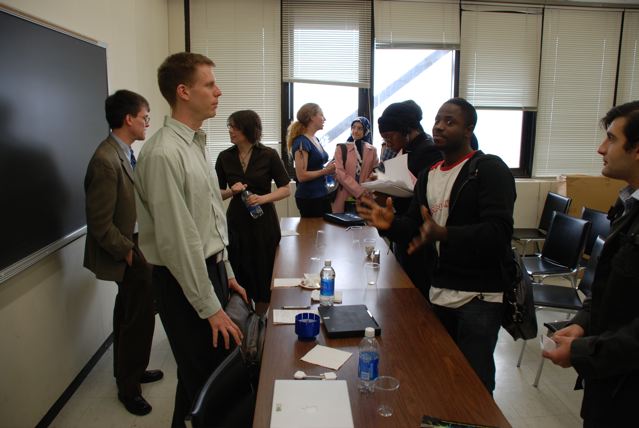
How did I get here? Today I had a chance to try and explain my random walk to physics at a Career Panel held at CCNY. I was one of four speakers, the others being Rachel Connolly, Manager of Astrophysics Education at the Rose Center for Earth and Space, American Museum of Natural History, Joshua Spodek, Entrepreneurial Physicist (of linear zoetrope fame -- dig his news coverage), and Christina Tosti, Biomedical Engineer at Columbia. We had a great audience of about 40-50 CCNY students and staff, and about 90 minutes to share our stories, which had more than a few surprising wrinkles (major changes, aborted degrees, stints in the navy...). But I think it was fun for everyone there to see how our various choices got us to places we liked, and jobs we enjoyed.

My slides are online, posted here.

Thursday, April 19, 2007

Circus in the Mist

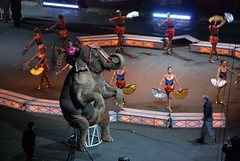
As New York suffered torrential rainfall, K and I managed to score a few cheap seats for the Ringling Bros. Barnum & Bailey circus down the street at Madison Square Garden. We had hoped to take some younger relatives but we still had an excellent time with just us adults. Clowns, elephants, acrobats, tigers - all there. You can find a few of my photos in a Flickr set.

Pop Quiz

Just poking around Cosmic Variance this morning (as if I have time, given my trip to Chicago this evening for a PHOBOS collaboration meeting...) and stumbled upon this: a cocktail party primer about string theory. Now, love it or hate it, string theory has captured most of the available mindshare for theoretical physics (kind of like the LHC in experimental physics), so it's great to see my people (i.e. RHIC) namechecked at the bottom:
Still, particle physics experiments being performed with collisions of very heavy ions at Brookhaven National Laboratory and with proton collisions at CERN could connect string theory with reality.
And we're already running. Now.

OK, so things aren't so easy when trying to connect experimental data with a theory that doesn't really predict anything yet. But as I've tried to point out where possible, people are clearly trying -- and it's interesting how even something which might be "wrong" (in the ontological sense) might nudge people intellectually in directions they hadn't considered, which may well lead us to something that is "right" (same sense). My money is that a similar story will play out at the LHC. No matter what will be observed, people will certainly try to say 1) it's nothing (e.g. DuRujula, below) 2) it's something out of the standard model so boring, or 3) it's exotic -- soit's proof of string theory! Of course there are worlds of exotica which people don't talk about anymore, and worlds to be discovered until the data is solidified (cf. LSND/MiniBoone).

All of this will prove (once again) that data rarely speaks by itself, and even if it tries, it tends to speak quite slowly...Ok, I really have to finish a few things now.

Tuesday, April 10, 2007

ATLAS in RHIC News

A few weeks ago, I mentioned the new "RHIC News" which
is already on its third issue. And this one is special, since yours truly has contributed a piece on the BNL involvement in the ATLAS heavy ion program. I was hoping to make the case that the LHC will be a natural, and essential, next step for the science we have been doing at RHIC (and at lower-energy facilities at CERN and BNL). Even better, all of the LHC detectors will be able to make contributions to this scientific effort, when the machine collides ions sometime in the next few years.

Now if only they could get those magnets sorted out...

Monday, April 09, 2007

On The Radio

It's becoming clear that the LHC, even with the setbacks of two weeks ago, is starting to gain a lot of mindshare in the media. To keep up with the one-article-per-week-it-seems, NPR's David Kestenbaum (a former physicist himself) has reported a piece from CERN. rapping with Alvaro de Rujula (who I heard give a great set of lectures on gamma ray bursts in Erice a few years back). While I'm not a big fan of the "nothing is interesting" (i.e. finding no Higgs might be more important than finding one) scenario, de Rujula clearly feels no need to hold back. Have a listen!

Friday, March 23, 2007

Oh, Lordi (I'm in Finland)

Another quiescent period, but I've been at CERN all week (ATLAS trigger/physics week) and now in the land of Lordi (Finland for those who don't pay attention to Eurovision winners, or read articles in the Times about them...). Actually, I'm at a workshop in Jyvaskyla, a few hundred kilometers north of Helsinki, staying in a gleaming, white hotel on an frozen lake. And there's a suspension bridge just in front that leads to the gleaming, white Physics Department here at the University of Jyvaskyla.

It's looking like a rough week, with a student lecture to deliver on Monday ("Introduction to Hydrodynamics" - and I don't even do hydro) and a talk to give on Tuesday morning ("Consequences of Early Thermalization" etc., so once again, with feeling -- and more details). But no pain, no gain, I suppose.

Friday, March 16, 2007

Extra Extra

If you have a fixin' for RHIC news, and find yourself scouring the arxiv after Quark Matter conferences, you need look no further than the just released "RHIC News". It's planning to be a bi-weekly release, with new content from RHIC scientists and updates from the machine and experiments. For more on the philosophy, and even how to contribute (that means you, RHIC scientist!), you can read John and Susan's introduction.

Wednesday, March 14, 2007

String Debate '07

The String Wars of 2006 continue, but are kicking it up a notch in 2007 with the first (that I've heard) String Debate. And not just debate as in "let's argue in journals or magazines or newspapers" but debate as in:
String Theory: Brian Greene and Lawrence Krauss Debate Co-sponsored with the Department of Energy’s Office of Science
It comes down to this: Are all things in nature actually super-tiny bits of strings that are vibrating strands of energy? If so, string theory would merge general relativity and quantum mechanics, and would explain the origin of space, time, and the universe itself. Or is the theory, as some critics claim, just extraordinarily complex mathematics which may have nothing to do with physics and a theory of nothing, not everything? If so, physicists are back to the drawing board in their quest for the Holy Grail of physics—an ultimate theory of everything.
For those of you in DC in a couple of weeks, this will be happening at the National Museum of Natural History at the Smithsonian, moderated by Michael Turner.

But seriously folks, who benefits from these kinds of debates, besides the obvious rock-star experience seeing two charismatic speaker/performer/scientists argue in real life? Then again, who wants to imagine Greene and Krauss snapping fingers at each other, going "Bring it!"? In sum, I'm not sure (as it's mildly fun to watch smart people argue, despite the inevitable vacuousness of any result from this particular debate...kind of like the WWE, right?). All I know is
Greene is a professor of physics and professor of mathematics at Columbia University; Krauss is Ambrose Swasey professor of physics and a professor of astronomy at Case Western Reserve University; and Turner is the Rauner Distinguished Service professor in the Kavli Institute for Cosmological Physics at the University of Chicago.
so Greene, lacking a titled chair, which even the moderator has, is already racing to catch up.

(Thanks, Burt!)

Tuesday, March 13, 2007

Mistakes Were Made

I generally try and avoid politics in my blogging, but the political firing of federal prosecutors really irks me, reeking of the anti-democratic odors one has picked up emanating from this administration for years. That said, how often does a national figure (i.e. AG Gonzales) quote Matt Groening's Life in Hell: "I accept that mistakes were made"? OK, seriously, Groening was was quoting Reagan but was Gonzales (who gets mixed style points for combining active and passive voice in the same sentence)?

In trying to remember where that phrase came from, I found a blog post by Caterina "Flickr" Fake on the subject, and she found a great excerpt from Charles Baxter on the subject. Totally relevant now, and totally excellent.
What difference does it make to writers of stories if public figures are denying their responsibility for their own actions? So what if they are, in effect, refusing to tell their own stories accurately? ... Well, to make an obvious point, they create a climate in which social narratives are designed to be deliberately incoherent and misleading. Such narratives humiliate the act of storytelling. You can argue that only a coherent narrative can manage to explain public events, and you can reconstruct a story if someone says, "I made a mistake," or "We did that." You can't reconstruct a story — you can't even know what the story is— if everyone is saying, "Mistakes were made." Who made them? Everybody made them and no one did, and it's history anyway, so let's forget about it. Every story is a history, however, and when there is no comprehensible story, there is no history. The past, under these circumstances, becomes an unreadable mess.
(Please don't ask me where I got a copy of LiH, since more people should be allowed to see them online! Google will reveal all.)

UPDATE: Gee those New York Times reporters know lots of stuff about mistakes.

Tuesday, March 06, 2007

Freeman (Dyson) in New York

Why do I ever leave the apartment without a camera? K and I left the house on Sunday afternoon with a few errands and some work to do, but knew that our final destination was the Guggenheim Museum. The goal was to see "El Greco to Picasso" (at least for 15-20 minutes after bumping into one of my oldest college friends who lives in Turkey, etc. -- can anyone reading this quantify the effective area of the entire planet, once network effects are taken into account?), find somewhere to eat on the Upper East Side (Cafe Alsace, found by accident given Saigon Grill's unexpected renovations, was pretty great), and then to see Freeman Dyson talk about "How We Might Have Gone To Mars in 1965."

Freeman Dyson. I nearly jumped when I got the email announcing this late last week. Here's a guy who has made a mark in real science (QED, Schwinger-Dyson equations etc.), real science & military policy (JASON, test-ban treaties), and even science "fiction" (Dyson spheres, Dyson trees -- on comets no less) and written more than a few books for general consumption. And he's 84, so no time to waste. Then again, K and I saw him being guided through the main exhibition and he looked pretty spry, regardless of age.

Anyway, no time today to go into how great his talk was, or to explain the context in detail. Bottom line: Project Orion - a spaceship to explore the solar system (carrying real scientists in addition to astronauts, even, a la the Beagle) powered by several thousand 1-kiloton nuclear bombs, deployed via what was planned to be essentially a Coke-bottle dispenser (General Atomic even consulted with Coca-Cola about this!). The powerpoint (prepared by his son George, one famous child among six, who wrote the definitive history about Orion several years ago) was incredible, simple and full of 1) archival images, many declassified for George Dyson's book, and 2) honest-to-God information, which he would let us read. And finally, he answered questions, lots of them, and even the ones which were completely off topic. After we left the theater (downstairs at the Guggenheim and clearly unaltered Frank Lloyd Wright -- itself worth the price of admission) and the post-talk reception (an extremely gracious touch, but where K noticed that no-one seemed to be getting Dyson a glass of water -- so she brought him one!) we basically flew home. It was a really well-executed Sunday event by Dyson and the Guggenheim, and we'll be back.

So back to that camera. I normally post my own images from these kind of things (e.g. the theater, Dyson, his slides, etc) But no luck this time, having left said camera at home. But frustratingly, I can't find any images online of Orion as it was shown in Dyson's talk. All one finds are images from the NASA-influenced "final" design, which was ultimately cut. Dyson didn't have many nice things to say about it, so I will just show something based on Jules Verne's "From the Earth to the Moon", which was, according to Dyson, literally how they imagined the Orion spaceship for most of its project lifetime.

Friday, March 02, 2007

Two Minutes or Less

In a group meeting yesterday, my colleagues pointed me to this interesting, um, contest, from Discover Magazine.
The Challenge
Just over a century ago, Albert Einstein published three groundbreaking scientific papers in one year, any one of which could have won him the Nobel Prize.

Taking a cue from The Great One, Discover.com is now challenging armchair theorists to produce a similar feat of inspired - and speedy - brilliance.

Your goal is to create a video that quickly and clearly explains perhaps the most baffling idea in the history of the world: string theory.

And the best part is that you have just two minutes.

The Opportunity
The winning video will be selected by Columbia University physicist Brian Greene, best-selling author of The Elegant Universe and The Fabric of the Cosmos, and broadcast via a prominent spot on the homepage of Discover.com.

The individual or team who submits the best video will be featured in an upcoming issue of Discover Magazine.

The Rules
The video should present an accurate, basic understanding of string theory that will stick in the brains of relatively intelligent non-scientists.

You can use any teaching aides you like (props, animation, etc.)

Submissions will be accepted from individuals and teams (subject to the terms and conditions).

Don't go over the time limit.
I wish I could explain anything in two minutes. My only question is why you wouldn't just go straight to YouTube...

Tuesday, February 27, 2007

Going and Coming Home

Sorry for the unintended break. It's not that I have a maximum number of words per week, but I had to finish up a few things before a 5 day trip to Ireland for a wedding. My first time, and highly recommended (for me to go back, that is -- I don't normally try and give travel advice).

Anyway here's the first thing I come back to, in the new issue of Physics News Update (It's a broken link for now -- I get this via email):
STRING THEORY EXPLAINS RHIC JET SUPPRESSION. String theory argues that all matter is composed of string-like shreds in a 10-dimensional hyperspace assembled in various forms. It has won acclaim from many who appreciate the theory’s elegant mathematics and ambition to unite quantum mechanics and general relativity, and skepticism from others who cite the theory’s lack of a practical track record. String theory, the doubters say, makes no testable predictions. But this isn’t exactly true. Indeed, the theory has not yet been experimentally vindicated in the realm of quantum gravity, but has been put into play in the realm of high-energy ion collisions, the kind carried out at Brookhaven’s Relativistic Heavy Ion Collider (RHIC). A few years ago string practitioners attempted to establish a relationship between the 10-dimensional string world and the 4-dimensional (3 spatial dimensions plus time) world in which we observe interactions among quark-filled particles like protons (for background, see Physics Today, May 2005). This duality between string theory and the theory of the strong nuclear force, quantum chromodynamics (QCD), was recently used to interpret puzzling early results from RHIC, namely the suppression of energetic quark jets that should have emerged from the fireball formed when two heavy nuclei (such as gold) collide head on. The thinking was thatperhaps the plasma of quarks and gluons (quarks bursting free from their customary proton and meson groupings) wasn’t a gas of weakly interacting particles (as was originally thought) but a gas of strongly interacting particles, so strong that any energetic quarks that might have escaped the fireball (initiating a secondary avalanche, or jet, or quarks) would quickly be slowed and stripped of energy on its way through the tumultuous quark-gluon plasma (QGP) environment. Two new papers by Hong Liu and Krishna Rajagopal of (MIT) and Urs Wiedemann (CERN) address this problem. The first paper calculates a specific quark-suppression parameter (namely, how much the quarks, each attached to a string dangling "downward" into a fifth dimension, are pushed around as they traverse the quark-gluon plasma) that agrees closely with the experimentally observed value. Rajagopal (krishna@ctp.mit.edu, 617-253-6202) says that in the second paper, the same authors make a specific testable prediction using string theory that bears not just on missing jets of energetic light quarks (up, down, and strange quarks), but on the melting or dissociation temperatures of bound states of heavy quarks (charm-anticharm or bottom-antibottom pairs) moving through the quark-gluon plasma with sufficiently high velocity, as will be produced in future experiments at RHIC and the Large Hadron Collider (LHC) under construction at CERN. (Physical Review Letters: first paper in the 3 November 2006 issue; second paper, upcoming article)
Wow that's a long "blurb". No wonder we have such trouble explaining how this all fits together. You have to explain most of modern physics in the same paragraph. Anyway, so we're done (i.e. String Theory Explains RHIC Physics)? I can go home now?

OK, seriously: Nothing brand new (i.e. I heard all of this in China in November) but interesting to see it bubble up to the level of news. While it is nascent phenomenology for now (at least to my eyes/ears), it bodes well for a fascinating future ahead of us. Follow the references and citations of these papers and you'll find a rapidly-growing community of theorists getting in on the action. What do they usually say about exponential growth?...

Sunday, February 18, 2007

Why I Am A Physicist

Once in a while you get the chance to bare your physicist's soul in the harsh light of the physioblogophere, and today is my chance. Sabine Hossenfelder co-writes a great, funny blog called Backreaction (which I've posted to several times, and which I've seen mentioned in various realms of said ogosphere), and as part of an email thread starting with me asking her to put in a good word for me at the Perimeter Institute (where I'm still interested to give a RHIC seminar someday), she ended up asking me to contribute a few words on "Why I became a physicist". I have to admit that I didn't expect to get into high memoir mode, but I did (and in a bit more than a few words, I now notice), partially inspired by a very moving piece about Ron Mallett I heard on This American Life a few weeks ago. So here it is, bigger hair and all (and thanks to K for taking the photo at Storm King Art Center back in October)

Wednesday, February 14, 2007

Starlings

Speaking of excellent, I'm totally smitten by this photograph: "Migration of starlings, Algeria", a 2nd place prizewinner in the Nature category of the World Press Photo 2007 Winners Gallery.