Sunday, April 30, 2006

Visions in Collisions, Hummingbirds, etc.

So last night I finally had my chance to teach "Physics for Filmmakers" and the results kind of look like this. The whole thing was a real 'hail mary', in that I came up with the title in mid-March before I had any idea, but eventually the actual content somehow nucleated around the title. I first tried to show how physicists image the fleeting traces of particles, which are not visible to the human eye, by means of various detector technologies. Lucky for me that even cursory Google searches yield troves of classic particle physics images. Then I tried to sketch out how we take these images of particles and "run the movie" backwards to understand the primordial event that yielded them. I tried to keep the tone breezy and the focus on the visuals (and make wisecracks whenever possible), and I hope it worked. I had a lot of fun giving the talk to this audience of filmmakers and friends and I think they had fun too. I even got a few questions during the wine & cigarette break (all the smokers took an unplanned exit when we had a few video problems at the start of my talk...).


Other highlights for me were:

  • The Thereminvox performance by Anthony Jay Ptak (who turned out to have gone to high school just down the road from Brookhaven...)
  • An unbelievable archival film of Edgerton's high speed stroboscopic films. Smoke, birds, snakes, insects - one always forgets the richness of physical and biological phenomena when one sees them at "human" speeds. 6000 frames a second can show a lot...
  • Liquid crystals filmed by Jean Painleve
  • Void Ratio by Ray Sweeten - the funniest oscilloscope tutorial I've ever seen. Should be a part of every freshman physics course, including the extended visual freakout in the second half.
  • I also liked Jennifer's The Garden Dissolves into Air, a montage of images from the Brooklyn Botanical Garden processed through the "optical printer" (and a Macintosh, of course...)

A fun evening, all in all. You can find my slides here.

Monday, April 24, 2006

Live!

Please don't take my silence as indications that I'm giving up. It's just been insanely busy, with trips to Chicago and Toronto, and various projects at work coming together asynchronously. And I got tenure. Tenure.

Anyway, one of the projects I've been working on has been a short public talk I'll be giving as part of the show "Aerodynamics of the Hovering Hummingbird: Science, Cinema, and Ways of Seeing". It's on Saturday, April 29, 8 pm at Millennium Film Workshop and is curated by Jennifer MacMillan and Bradley Eros. Please come and check it out -- I saw a previous evening Jennifer curated and it was really fun and interesting.

My talk is called "Visions in Collisions", and will be a few reflections on the ways particle and nuclear physicists see both particles, and the underlying dynamics that created them. Think of us as trying to reconstruct a whole movie when we only have access to the last few frames.

Friday, April 07, 2006

Like Steve

Many people who know me professionally know that I have quite a few, um, obsessions which aren't exactly related to physics. One is that I'm a tireless Apple booster, having gone all-Mac all-the-time in the last year and evangelizing where possible. Another is that I'm a serious nut-case perfectionist about the talks I give at meetings and conferences. Although I'm all too aware that it's not necessary to get everything right both in terms of contents and visuals, I've long felt that it never hurts. (I have a clear memory of reading an article about...well...Eddie Van Halen when I was a teenager. I didn't even like Van Halen that much (that has grown with time), but he explained why they rose to rapid fame in the late-70's: they treated every gig, even in tiny bars, as if they were in Madison Square Garden.)

And when it comes to getting presentations (especially the visuals) right, it's hard to beat the instincts of Steve Jobs, co-founder of Apple (especially, as manifest in Keynote, Apple's homegrown presentation software). And now, you too can know the secrets of Steve Jobs, at least as divined Carmine Gallo in BusinessWeek. But here's the thing: while I am not interested in turning scientists into Powerpoint-wielding corporate drones, it surprises me how often scientists ignore common-sense when preparing and delivering talks. I know I'd enjoy conferences so much more if people could just be a bit more like Steve.

(from TUAW)

Wednesday, April 05, 2006

RHIC on the Radio

Now here was a surprise. I was doing my occasional wanderings through that Internets thing trying to see if there was anything on RHIC out there in the media that I had missed. And lo, while I was poking around the WNYC website, I noticed a link to "Radiolab", a show I've heard advertised but never heard (a problem now solved for me with radioSHARK...), clicked on it, and found myself drawn to this quote:
A Simpler Time
Have you ever wished you could time travel, like in the movies? Artist Terry Wilcox asks us to imagine 1,594 years into the future, when his sculptural clock will chime. A particle accelerator jockey at Brookhaven National Laboratory takes us 45 feet away from the beginning of time. And Swedish producer Marcus Lindeen introduces us to David McDermott, an artist who devotes his life to ignoring the present.
"45 feet from the beginning of time"? Holy incompatible units, Batman (but maybe they just suppressed the "c", like pro physicists do?). Anyway, after a bit of fiddling around to find a link to the show which actually worked, I got to hear about RHIC on the radio.

The piece was unfortunately introduced by means of the aforementioned Terry Wilcox, who was worried about those "scientists at Stony Brook making a universe". OK, he missed hitting Brookhaven by about a 45 minute drive, and was attributing a scientific goal I haven't heard much of since Benford's sci-fi novel Cosm. But there we were, with Robert Krulwich interviewing one of my RHIC colleagues, Todd Satogata, about the collider. OK so a few details were botched (like RHIC colliding nuclei to study the properties of the early universe, and not protons), and some of the verbal imagery and sound effects made it sound like we were doing some serious universe creating around these parts. Still, overall I found the piece to have a surprisingly light touch and conveyed a lot of the enthusiasm we feel about our physics. Let's do some more fact-checking next time, Radiolab!

Wednesday, March 15, 2006

Awakening

Gee has it really been 2 weeks since my last post? I suppose it has, but it's not like I had any time to think about it. Since Geneva, I definitely lost a week both to jet lag and talk writing. Then the next week was probably a trifecta for me: a visit to Ohio State University where I gave both a Departmental Colloquium and a Nuclear Physics Seminar, followed a day later by a PHENIX talk at a workshop at BNL on running RHIC at very low energies. Three talks in three days: makes me drowsy just to remind myself.

The visit to OSU was incredibly interesting, as they have quite a group of nuclear physicists, both experimental and theoretical, who kept me busy for two solid work days, leaving me not as much time to prepare for the workshop as I would have preferred! Then again, I didn't prefer to have two planes, on two different airlines, malfunction on the ground in Ohio just as I was trying to board them. While the second one turned out to require only a quick repair, my return to my apartment in NYC was spoiled by a complete absence of water, due to a broken main on Broadway. Fortunately, I had a backup plan, allowing me to attend the low-E workshop with a minimum of unnecessary odor!

Since then, I've been recovering a bit, seeing friends a bit, seeing art a bit (like this dreamy video installation at Scope New York), seeing Garrison Keillor with the NY Philharmonic a bit (thanks Terry and Rachel!), and trying to wake up for a new round of ATLAS work. But speaking of waking up, I was utterly blown away by the reports that Ambien, the enormously popular sleeping pill, seems to trigger sleep-eating in many people, who gorge themselves at night, and wake up remembering nothing, although they have food in their mouths. Doesn't anyone sleep anymore? Turns out that lots of people think they don't, as they lie awake for an hour or so in the middle of the night (I know I do this!), but some people think that this is the most natural sleep pattern of all. Go figure.

Wednesday, March 01, 2006

John Cale in Geneva


Geneva certainly seems like a nicer place to hang out now than I remember it from 10 years ago. There are lots of excellent new restaurants and bars (e.g. Le Gout des Autres in Eaux Vives), and old standby's like L'Usine have gotten very impressive and ambitious in their offerings.

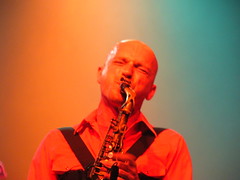
Here's a shot of a John Cale show we caught at L'Usine the night before heading back to the US. Most notable was how excellent the show was, bursting with ideas and energy (incredible especially for a guy the same age as my parents -- I hope I age as gracefully). A close second was the absolute ban on smoking, requested by Cale himself. One of the bouncers mentioned that Cale would flat-out stop if he smelled smoke. That's another serious change from 10 years ago.

Tuesday, February 28, 2006

Robot Wars, Geneva


Robot Wars, Geneva
Originally uploaded by entropybound.
In the midst of an inadvertant pub crawl around Geneva on Friday, we bumped into this little treasure. Apparently, the white robots are winning, at least by the Rhone. Can anyone verify this?

Tuesday, February 21, 2006

ATLAS & Me

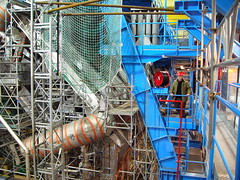
These days, it's not a trip to CERN without a tour in the ATLAS pit. My colleague Pavel snapped this photo of me standing on the scaffolding next to a tiny fraction of the ATLAS detector, which is currently under feverish construction in advance of the LHC start-up, still planned for end-2007.

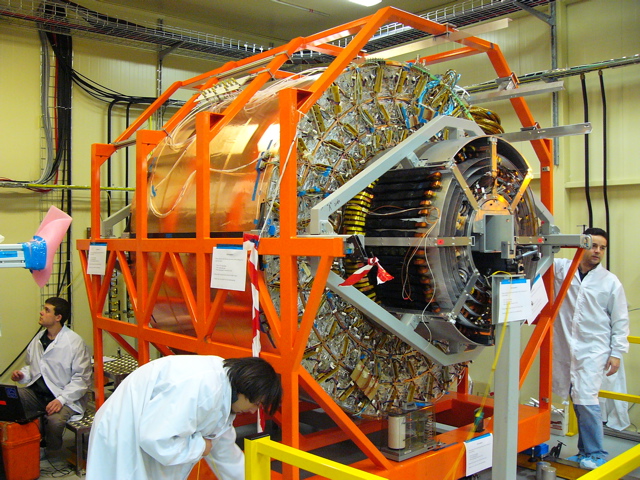
Needless to say, this thing is big. BIG. But what I still find fascinating is that while the muon system is enormous, and the calorimeters are huge, the "inner detector" which tracks particles in a profoundly complicated silicon and straw-tube detector is much more human-sized. My old colleague Heinz took me to their assembly room where they were surveying the recently-assembled "barrel". Much smaller, but a sublime piece of work with the millions of channels we will be using to study nucleus-nucleus collisions at the LHC.

Mont Blanc, Revealed


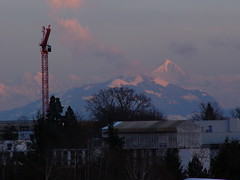
This time I have a good excuse: I'm on another trip to CERN for an ATLAS week. It's been non-stop action since hitting the ground (ok, barring an 8 hour collapse after landing on sunday morning). But as I was finishing a videoconference in my colleague's office, we noticed that the clouds had parted, leaving the French Alps exposed to the sunset. Nothing else to do but run outside to capture it on film, or a memory chip. Whatever.

I should mention, however, that I have not seen Mont Blanc from the CERN site since my student days in the mid 90's. It's usually been cloudy during my short visits here. The only way to really guarantee a good view is to head southeast by car. Give me a few days...

Friday, February 17, 2006

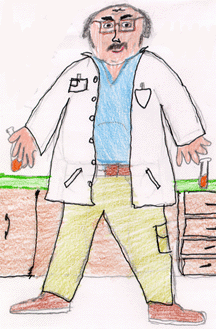
Who's the Scientist?

This is the greatest thing I've seen in a while. A group of 7th graders visited Fermilab and made before-and-after descriptions and drawings of their image of scientists.

This is real progress, folks.

(Thanks, Betsy!)

Wednesday, February 15, 2006

Richard and Me

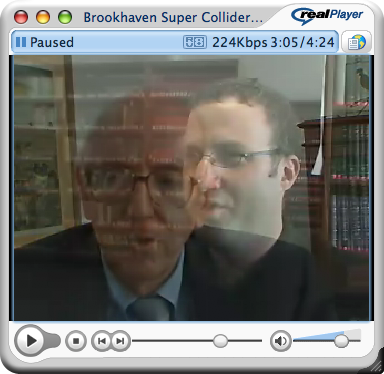
This has been in the works quite a while, but is only now reaching the web. In October, I did an interview with Carolyn Weaver of Voice of America TV about RHIC, it's science, and the controversies surrounding the various "doomsday" scenarios proposed in the 80's and 90's. It's now posted on the VOA website.

What I hadn't realized when I agreed to give this interview was that Weaver had already spoken to Richard Posner, the eminent federal judge. Posner wrote a book in 2004, "Catastrophe: Risk and Response", which discusses the risks of RHIC, among other disasters, and how we are currently not dealing with various eventualities. And here in the final product (shown to the right), I find myself superimposed on Posner, if only for a brief instant. How many of my lawyer friends can say that?

I've discussed Posner and other critics various times in my previous blog, and I maintain that I find their arguments still less than compelling in their particulars. But I never imagined I'd get a chance to say so in public. I still believe that while we should take risks seriously, and in general scientists should be held accountable for the risks they take, and discuss them openly. However, we must constantly be updating the level of risk based on incoming information. Posner (and Rees, for that matter) are basing everything on several papers written in 1999 and before, well before the RHIC data came in. Since that time, we have found that the matter we create at RHIC essentially blows apart as soon as it is made. And more importantly, this matter is not baryon rich, as it was at the AGS. This suggests to me that we're even less likely to make stable strange matter than ever before. That said, I should not be construed to be a real expert on this subject. But that said, no expert I know has suggested that the risk level has increased. There have even been searches for strangelets at RHIC (in the baryon-rich forward region) which have (as always) come up empty!

So until my colleagues A) actually isolate even a hint of a strangelet signal, and B) start to believe (based on experimental data) that RHIC is really a better enviroment for their production than previous facilities (which have established stringent upper limits), I think it's premature to start any serious discussions of the risk of RHIC to humanity as a whole. But I'm sure someone out there already disagrees with me.

Friday, February 10, 2006

Budget Watch, contd., and the Future

Wow, there's a lot of action on science budgets these days. From Bush's State of the Union address, which announced the "American Competitiveness Initiative" (which proposes to double the science budget over the next 10 years) to its manifestation in the 2007 President's budget, which has manifest itself as huge increases to projects near-and-dear to Brookhaven.

The AAAS released an analysis of the budget here, with a choice quote:
The Department of Energy (DOE) would enjoy substantial increases for its energy and science R&D portfolios in 2007, an unusual turn of events for a department that has mostly seen flat budgets in recent years (see Figure 6). The DOE Office of Science (OS) would emerge as the clear winner in the 2007 budget with a 14 percent increase to $3.8 billion for its R&D portfolio centered around the physical sciences. The largest OS programs would all receive increases of 8 percent or more, including a dramatic 24 percent boost for Nuclear Physics after a decade of stagnant funding, a 36 percent increase for computing research, a 25 percent increase for Basic Energy Sciences centered around several large-scale facilities, and a 31 percent increase for the core life sciences research portfolio. Although these increases would help BES, computing research, and nuclear physics reach new highs, high-energy physics, fusion, and biological and environmental research would remain below previous years’ funding levels because of years of eroding budgets.
What a rollercoaster, from the World Year of Physics presenting us with the worst budget in a while, with many gloom-and-doom predictions for the future, to an enormous "bounce" (hope not a "dead-cat" bounce...) and a rosy outlook. But people should keep in mind that a 24% increase relative to 2006 doesn't translate into a huge increase if one averages over the last few years: it's only 15% above the 2005 budget, and inflation depreciates all funding by 3-4% a year, so it's really equivalent to a real 8% increase -- not peanuts to be sure, but it certainly does not sound as whopping as 24%!

This was echoed today by a short presentation by Directory Chaudhari presenting how the budget will directly affect BNL. He reported the robust RHIC budget, promising a 34 week run (not 30 as I mentioned previously), funding for RHIC II-related work (i.e. EBIS, the new ion source), R&D funding for NSLS II (which will be another major facility here, with QCDLab, if it gets sited here) and full funding of the Center for Functional Nanomaterials. All good news, but not nearly as striking as the projections for the lab's future, predicated on these increases. If all goes well, the general shrinking of personnel and near-constant funding levels over the last 5 years will reverse over the next 4-5 years, with the lab's funding increasing by 40% and employment increasing by over 10% over the next five years. Amazing prospects.

Wednesday, February 08, 2006

Justice for RHIC

So after all of the struggles last year (remember the 65% solution?), things are certainly looking up this year. Newsday (and never the New York Times, it seems!) has a piece (and a photo of STAR, with my colleague Gene Van Buren in front!) which seems to have run twice in the last couple of days: "Proposal lets collider run a full schedule".
The relativistic heavy ion collider received $121.5 million for 32 weeks of operation in fiscal 2005, but this year had its budget cut to $110 million. After a $13 million private donation, the collider is scheduled for 20 weeks of operation this year. The proposed 2007 budget includes $138 million for a full schedule of 30 weeks of operation.
This sounds a little awkward, getting more money for less running, but people should realize that we have massive R&D needs, and major upgrades are underway, both for the big detectors (STAR and PHENIX) and for the accelerator (Uranium, anyone?)

But while I appreciate Newsday's interest quite a bit, I wish they would just stop saying this:
The collider is a superconductor that accelerates ions to nearly the speed of light, allowing scientists to explore the smallest known pieces of matter
It's an accelerator, not a superconductor! Yes, there are superconducting magnets everywhere, but ultimately the particles are accelerated in vacuum and just guided by the magnets. Yes it sounds niggly, but I don't think our material science friends would appreciate the confusion either.

Friday, February 03, 2006

Freedom from Justice?

Just a short follow-up to that last post. I arrived for day 2 of Jury Duty at 10am, and essentially did nothing for the rest of the day, only to be fully discharged by 3:30pm, after a two hour lunch break. I was happy to do my duty, in principle, but it still makes me a bit sad that having an overly-developed sense of the objective, and thus a high standard for evidence, makes me a liability to the legal system as it is.

So I guess the scales of justice aren't for me, despite the obvious point that they borrow their defining trope from the scientific method. Clearly, the whole concept of showing the scales of justice is to indicate an objective "measuring" the guilt of the defendant by recourse to brute facts. Go figure: maybe that's why lady justice is portrayed as blind?

Wednesday, February 01, 2006

Law and Physics

After the mayhem of last week, spending 8+ hours a day with ATLAS software, this week has taken on a whole new character: Jury Duty. After holding off the New York Supreme Court for a few months back in the autumn, I was finally compelled to drop by the courthouse this morning. I can't give much in the way of details, but I can report a few things that surprised me.

Jury duty takes a lot less time than it used to: apparently it was two weeks, only a few years ago, but it's certainly never going to end after a day. Minimum is two days, and it's looking like typical cases can take days. Consider that next time you pick your next postponement date. The orientation is cheesy, the time lost from work is a little excessive, but after a while you really start to get into it. While it really looks like a hardship in the abstract, seeing a few details of how the legal system works is pretty neat. Heck, I'm a physicist: I like to know how things work, and the law is supposed to be a machine of sorts, right? Based on laws, just like physics, right?

Well maybe, but they certainly don't seem to value the scientific outlook. While I really can't say much about what went on the courtroom, I can say that I was in the first (large) group of people to be brought down to be considered for a jury. I can also say that I was in the first group of 12 to be considered out of the larger group. So for a few minutes I felt kind of proud of myself, that I could serve my civic duty. Then the questions began, as we cycled through our renditions of the "Voir Dire", a set of questions related to our ability to serve impartially on the jury. Have you ever been a victim of a crime? Do you know anyone in law enforcement? And so on. Most of us didn't set off any alarms in this way, as few people are so scarred by their experiences with courts or law enforcement that they can't consider a situation objectively.

Then they asked us what we did for a living and where we went to school. At first I didn't understand why, although it was fascinating to see the wide cross section of people they had selected, from a wide range of backgrounds and occupations. But a funny thing happened as soon as I said: "Physicist, PhD, MIT". "So you want to be an astronaut?" asked the New York Supreme Court Judge. That started to make me suspicious. Then the prosecuting DA asked: "Mr. Steinberg, scientists typically want objective means to verify facts. Do you think you will be able to believe testimony given by witnesses in the case?" I had to think about this one: "I would feel responsible to my duty to the court, but I really prefer to have some objective verification of facts I am given." I thought this seemed reasonable, to express a high standard for evidence. But the judge lit into me: "You scientists want all the answers! One has to be able to find a defendant guilty on the testimony of a single witness. It's not about the quantity, but the quality!" I realize that this has to be the case, for the system to convict anyone, but I've always been taught to verify everything, since even the smartest, most reliable, people can make mistakes in their perceptions or interpretations.

The defense attorney picked up on my response, however, in a way that made me very suspicious. After he asked me a few questions of what kind of physics I do ("nuclear physics? that's my favorite!" said the judge), he extended this issue of questioning testimony: "I hope all of you will be able to consider that a story given by a witness could be a lie." Always a possibility, but at that point I started to wonder if I was a goner. And after a short recess I was a goner, along with six others in my group, sent back to the pool of potential jurors. Although it wasn't the only reason to cut someone from a jury, the very training I was so proud of, the one that made me so sensitive to various issues in how we know what we know, made me essentially unqualified to serve in one of our most important civic institutions.

So while there are clearly laws of physics, there doesn't seem to be much room for physics in the law. Hasn't anyone seen Minority Report? Better luck tomorrow!

Monday, January 30, 2006

Time of Transition

As usual, blogging slows down as life speeds up. And things have been quite intense recently, as attention shifts almost completely to my new projects. I'm finally making headway with my longer-term project for the PHENIX experiment (a little database, that should grow pretty big over time...) and we just finished an extensive week-long software workshop for ATLAS. This was really the big one for me, when I finally felt "over the hump" in terms of being able to actually use the ATLAS software, which is apparently quite powerful: but with great power comes great...complexity? Anyway, more later as I get my thoughts together (and finish a 15 page writeup of my lectures from Erice last summer, by Wednesday [gulp]).

Sunday, January 22, 2006

Global Fest

No physics connection here (but I've surprised myself before) but this was a pretty neat experience. A friend and I went down to GlobalFest, a smorgasbord of world music at the Public Theater last night. While there were more than a few things to complain about (too many tickets sold, forcing many of us to wait in various lines *after* buying our not-cheap tickets!), it was a good reminder of the worlds beyond our borders, both political and mental. Naturally, there's a flickr set of a few choice photos.

Friday, January 20, 2006

Return of RHIC Round-up

While this story hasn't seemed to reach the national news, via the New York Times (why not, folks?), Newsday has been all over our story recently:
Newsday also has a story about a talk at the lab yesterday that I missed: "BNL's Economic Impact Goes Beyond LI", January 20, 2006. The talk was given by Long Island Association chief economist Pearl Kamer. I can only quote the article since I can't seem to find the report at the moment:
When Brookhaven National Laboratory managed to save one of its key nuclear physics experiments last week by using private financing to fill in federal budget gaps, the effect wasn't limited to the lab itself.

In broader terms, the lab's economic impact statewide is far more significant. Between 1993 and 2003, it added up to 79,000 jobs, $9.2 billion and a host of new technologies that cannot be entirely quantified, according to a report released Thursday by Long Island Association chief economist Pearl Kamer.

The report, which has been two years in the making, shows that the lab is one of the top five high-technology employers on the Island, with 2,750 employees. But what with visiting scientists, the development and marketing of new inventions, and the ripple effect of new technology created in the lab, it's really responsible for tens of thousands of additional, secondary jobs for the state, in industries such as construction, retail and business services, the report said.

And in the future the lab's economic effects could be even greater, with another $5.6 billion and 91,000 jobs statewide by 2014, Kamer's report predicts. Much of the trickle-down effect occurs on the Island, she said, as workers spend money and the economy grows.

Thursday, January 19, 2006

The New World

Sorry to have been silent these last 6 days. A bunch of us went skiing in Vermont for the long weekend (and most of us returned OK...) and since then it's been chaos for me getting retooled for my post-PHOBOS life. We had an internal review of the heavy ion efforts for ATLAS, and since then I've been down with a minor cold, which gave me my only chance to work on my long-overdue PHENIX tasks. That's three acronyms in two sentences, folks. No wonder I'm having trouble keeping up.

And there's a lot to keep up with, especially after last week's blockbuster news of private funding for RHIC. Just as I was returning from lunch today, I overheard a snippet of conversation: "So...we're going back to how science funding used to be...before World War II". It's really true that one just doesn't think about private citizens, or even large foundations, funding science that doesn't offer clear returns on the investment. One is used to thinking of private funding for AIDS, or even for telescopes, but rarely for accelerators (maybe unless they are purposed for radiation therapy...).

Still, this situation asks more questions than it answers: could the emergence of private money inspire the government to make more investments, on the argument that there is clearly interest in the science, or will it just make them cut us further, assuming that we will always find benefactors year-to-year? These are just the first issues that pop to mind, but even this is a brave new world for all of us.

Friday, January 13, 2006

Once a Scientist

There's a lot of ground to cover in the issues surrounding the recent announcement of private funding for RHIC. But as a nice way to start these discussions, it seems apropos to start with a telling quote (at least in retrospect) from the New York Times Business section on November 19, 2005, from an interview by Joseph Nocera with Simons in his Manhattan office:
What interested me most of all was: why? At an age when most men are contemplating retirement, with more money than he can count, why was Mr. Simons still at it? "I enjoy the challenge," he replied.

He then began describing a demonstration he saw recently of a new nuclear accelerator at the Brookhaven National Laboratory, where he is on the board. Two atoms hurtled toward each other, colliding with great force. "A huge number of particles are thrown out," he said, "and the job is to analyze everything that results from the collision."

"Watching the spray of particles on the screen made me think of the stock market," he continued. Every trade, even of a hundred shares of a company, affects every other trade. And every day there are thousands upon thousands of such trades, all of them affecting the rest of the market. His work, as he sees it, is to analyze that incredibly complex mosaic and try to figure out how it all fits together.

"The subject may not be the most important in the world," he concluded, "but the dynamics of the market are really interesting. It's a serious question."

I suddenly understood the motivation behind Mr. Simons's new fund. He's doing it because he wants to see if it can be done. Once a scientist, always a scientist.
Hear, hear. I've reposted the STAR image just to show what Simon was referring to.