
Thursday, February 01, 2007
Congressional Update
So the budget battle wages on, but a major victory happened yesterday, the implications of which are outlined in this Science article. One can find all of the blow-by-blows here on the house web page. This includes real honest-to-god blow-by-blows on the floor and a full roll-call of yeas and nays. Democrats were all-in, but only 30% of the Republicans went for it, 140 of them voting against (and with some prominent abstensions, e.g. Hastert). Are they angry about the earmarks removed so as to free up $130M for the DOE's discretion?


Tuesday, January 30, 2007
Gonna Sit Right Down and Write [Appropriators] A Letter
 As I should have mentioned previously, this year's RHIC run depends crucially on legislative action to get us over the funding "hole" incurred by the inaction of the new Congress to pass a budget. There are several letters going around Congress, where the representatives and senators are being asked to support increases of funding to the DOE Office of Science and the National Science foundation. The current status of the letters is here, as posted on the AIP FYI web site. I and many of my colleagues participated in this process by writing letters to our local Congressmen asking them to sign this.
Apparently, the House will be considering legislation to finish up the 2007 budget process (good thing too, considering we're already 4 months into FY07!). Here's hoping they get the job done this time.
Sunday, January 28, 2007
A Day Off
 There is an iron law of professional physics: for every talk you give, there is some sort of proceedings (be it conference, workshop, meeting) to write. Thus, I've been having lots of trouble blogging, since all of my writing mojo has been used up by the end of each and every working day. And yet, it's a new year, the LHC is looming, my serial deadlines have almost run their course, and there are interesting new things popping up daily.
The last few days have been a brief respite from work, work-related travel, and family-related holiday travel (Woodstock, Vermont, Chicago, etc.) K and I decided to take our lives back for a day and remind ourselves about all the outrageously interesting things one can do in NYC, given one has time to take a deep breath and look around.
 So just in one day we: 1) zipped through the Chelsea galleries (this despite Jed Perl's withering assessment of the current scene in the New Republic, subscription required though...), seeing neat stuff by Kim Keever at Kinz, Tillou + Feigen, Adi Nes' photographs portraying biblical scenes at Jack Shainman, and Marc Newson at Gagosian,
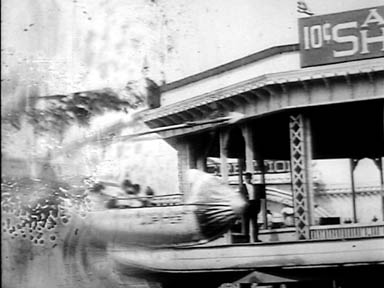
 2) headed down to the Angel Orensanz Center on Norfolk to see Bill Morrison and Michael Gordon's "Decasia" live with at
 least 6 screens (does the decaying altar count as a "screen"?) and 55 musicians tucked into the balconies playing seemingly-asynchronous punctuated polyrhythms, all in the service of a beautiful montage of decaying vintage film stock (David Bowie was there too, seated about 10 feet from us. Dude.) and 3) grabbed dinner at Momofuku Ssam Bar on 2nd and 13th (the burrito -- ssam -- was fine but nothing special, but the urchin was tasty and the grilled mackerel stellar, as were the rice-coated ice cream balls). Not a bad day at all.
Friday, January 26, 2007
Budget Battles, Redux
 As good an update as any. As some of you may have read, RHIC is once again in the news. Not for new discoveries or technical progress, but because, once again, our funding is at peril, just as it was at the end of 2005. And the reason is the same, since the new congress has neglected to pass a 2007 budget at all, instead letting the government coast on a "continuing resolution" that nominally keeps all programs funded at last year's levels. Of course, with the normal rate of inflation, this translates into a 3-4% cut. On top of that, the '06 budget was notoriously stingy to RHIC science, requiring an infusion of $13M from private investors who realized that the return to investment was enormous (i.e. by investing less than 10% of the operating budget, they would be responsible for making good on a full year's operation). Anyway, no-one expects a similar Hollywood Ending this year, so an entire RHIC year remains on the block.
Unless.
Unless the Congress can pass legislation modifying the continuing resolution to allow reallocation of money within the Department of Energy. The money exists (leftover from completed projects) and it's just a matter of Congressional effort now.
Stay tuned.
Sunday, January 07, 2007
The Vanguard
 Maybe Lisa Randall was just paying me back a few karma points for linking my masses of readers to her online interview. Or not. In any case, here she is touting the virtues of science at RHIC in a Seed magazine piece on "The Vanguard of Science":
Also of interest is the recent application of string theory to the physics being done at the Relativistic Heavy Ion Collider (RHIC), where string theory permits some calculations that would otherwise be intractable. The idea at RHIC is to better understand the strong force that binds together the elements of a nucleon, and 2007 may see the theoretical advances of string theory inform the experimental results from RHIC.
Thursday, December 21, 2006
Order in Disorder
 I can't imagine how many times I've told myself to keep a cleaner desk, although I've always prided myself on knowing basically where to find everything I need, even in the midst of overflowing piles. Thus, I've always suspected that it was the sign that I was productive and keeping busy. But now now that I've changed offices, as part of an overall move from Chemistry into the BNL Physics Department, I'm worried that my desk (and office) is cleaner than ever, since I haven't had enough time to really get it messy. Thus, this piece in the times today seems particularly relevant -- Back to work.
Thursday, December 14, 2006
Atoms for Tots
 Atomic experiments for boys, indeed.
For a mere $49.50, the kit came complete with three "very low-level" radioactive sources, a Geiger-Mueller radiation counter, a Wilson Cloud Chamber (to see paths of alpha particles), a Spinthariscope (to see "live" radioactive disintegration), four samples of Uranium-bearing ores, and an Electroscope to measure radioactivity. And what nuclear lab for kids would be complete without an Atomic Energy Manual and Learn How Dagwood Splits the Atom comic book? (The latter was written with the help of General Leslie Groves, director of the Manhattan Project.)From Radar's 10 most dangerous toys.
Wednesday, December 13, 2006
New Year's Resolution?
New fiscal year, no budget. This is the story out of capital hill this week. Problem is, on a continuing resolution RHIC is on the same tight budget as last year, which didn't include nearly enough money for actual running. We were only spared from disaster (layoffs, etc.) by an infusion of money from James Simons and his colleagues at Renaissance Technology. It still boggles my mind that the continuing life and health of Brookhaven rests on relatively small fractions of its total budget. But this is how science is done: lots of fixed costs (especially salaries) and then the so-called "real work" on the margin. Unfortunately, even small shortfalls have dramatic effect (e.g. layoffs, deferred pay-raises) on the people at the lab who have given years of their lives to maintain the level of quality the government and the public (who are the real supporters, via taxes) expect.
It will be a frustrating knock-on effect from what I thought were otherwise satisfying elections if Congress simply leaves the hard decisions to individual recipients of government funding. Let's at least have a budget to argue about.
It will be a frustrating knock-on effect from what I thought were otherwise satisfying elections if Congress simply leaves the hard decisions to individual recipients of government funding. Let's at least have a budget to argue about.
Thursday, December 07, 2006
Both Sides Now (or, Tug of War?)
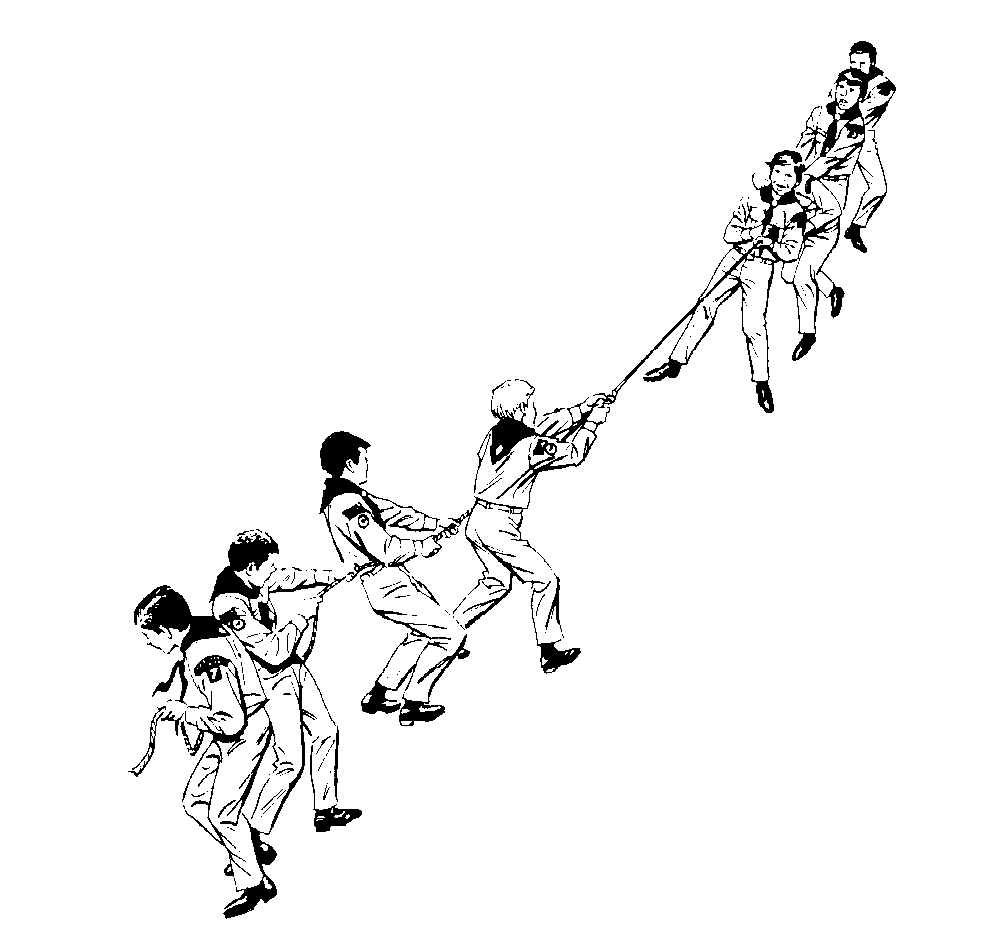 While you may not be able to see this for a few minutes (it's CPU load is too high!), anyone who has been following the great String Theory Debate of 2006, via the action and reaction to the Smolin and Woit books, might want to check out UCSB Professor Joe Polchinski's review of them. This is a 'web-only' enhanced version, with some very candid and informative footnotes. Having read Smolin's book recently, I am trying to apply a more skeptical eye to string theories claims, and especially their media hype. But this is science, folks, and there ain't no science without arguing (and sometimes the down-and-dirty, ad hominem type, but that's not here -- you'll have to poke around Lubos Motl's blog and comments on other blogs for that!)
Sunday, December 03, 2006
Wondering about Wonders (VOTE NOW)
 CNN posted an amusing series of articles last week on "Modern Wonders" of the world, taking stock of the great engineering feats of the last couple of decades. Near the bottom of the page, they give us the humble readers a chance to vote on our "choice", of which they give us seven possibilities. Now while it would have been more interesting for the readership to nominate their own, who can complain: CERN alone accounts for two of them -- the World Wide Web and the LHC itself -- and those are the two that have topped their informal poll on which is the "greatest wonder" of the seven.
It's gratifying that these two projects have been recognized by the public. Instead of just being a big bridge to admire, one of them spawned the largest "world mind" that anyone could have imagined, and the other will hopefully give that collective mind a few new things to rattle around in its collective brain for the next decade. Of course, I really hope the media avoids interesting non-sequiturs like this one in the future:
It is so powerful, it is capable of creating mini-black holes. The hope is that the collisions -- up to one billion per second -- will reproduce the conditions that were in existence immediately after the Big Bang some 10 billion years ago.Really, I appreciate the interest of news outlets like CNN, but would a tiny level of fact-checking hurt anyone?
(Thanks, Howard)
Wednesday, November 29, 2006
Polonium, for Sale?

Never has my career (nuclear physicist) seemed so...timely, as it does now, with this outrageous Litivinenko affair. But pity the poor guys at, yes, United Nuclear, legal salesmen of radioactive sources for the general public. Atomic experiments for boys, indeed.
Thursday, November 09, 2006
Discover String Theorist
 Interestingly, and flatteringly, I've been getting some emails directly from publishers and magazines promoting their products. I hope I have enough readers (but it's quality and not quantity, right?) to warrant this attention!
Anyway, the people at Discover.com have alerted me to an online chat with Lisa Randall, today from 2-3pm. Have a look/listen/read if you can. She's been making serious waves on popular culture this last year.
Of course I've had her book on my to-read list for a year and haven't managed to read more than the acknowledgements. On the other hand, I have been reading Lee Smolin's new book, which is being branded as "anti-string theory", but I've been finding fascinating for many other reasons. Stay tuned for my blog review.
Monday, October 30, 2006
Building Supporting Research
When I first arrived at BNL in the late 1990's I was in some awe of the place, but I was always a little let-down by how run-down many of the buildings were. I appreciate that scientists are practical people, so if the building still stands and people are getting work done, then why worry? But I also am somewhat of a stickler for a well-thought-out environment and so it's nice to see refreshes of ones surroundings here and there. And BNL hasn't really had one since the 1970's as far as I can tell, most of the main office buildings being built between the 40's and 60's (including Chemistry, where I still work for the moment).
Anyway, all of this is to express my appreciation to the DOE for funding a spanking-new addition to BNL architecture (a long neglected field of study): the Research Support Building. This lab is going to be around for quite a while yet, and it deserves structures that send out that message (the nanoscience building is next...).
Only one thing missing: the smell of freshly-brewed coffee in the atrium. Hopefully more on that some other time.
Wednesday, October 25, 2006
Nashville
I'm back from Nashville, at last. It was an interesting trip, and I have a few photos to show for it.

Monday, October 23, 2006
Boy in the Bubble
 Yow, way behind on blogging again. Not that I haven't been up to anything, but it would take me all day just to recap the last couple of weeks. Suffice it to say that I've done a few things I've never done before: bike 60 miles, get engaged, and go to Nashville, where I am now. I can tell you which one was my favorite, and staying here in a bubble is not one of them! I am attending the meeting of the "Topical Group on Hadron Physics", where I gave a talk yesterday, but I'm heading home tomorrow to get back to my real life. It's hard to explain the effect of living inside a huge (63 acre) hotel where you can walk for 15-20 minutes (which I often had to just to change sessions) without ever going outside. It's apparently the closest to a Vegas hotel you can get without actually hitting the casinos (I've never been to Vegas so I have to take the world's word for this).
Anyway, Nashville itself is pretty neat: the honkytonks really look and act like I hoped. Stay tuned for photos.
Friday, October 13, 2006
Google does Units
 Speaking of Google, a colleague pointed out that the search engine knew what a GeV was -- in joules. I wanted to check if it knew how to combine units, and do a bit of quantum mechanics at the same time: check. Freshman physics will never be the same, especially if they can bring their EDGE-enabled cellphones.
Pixelization of the Landscape
 Now that experts have discovered where the deadly E Coli comes from, I wanted to get the big picture. And that comes from Google Maps of course. What blew my mind about this satellite view of the Salinas valley was the stark contrast betwen the green mountainous regions to the northeast and southwest, and the complete parcelling out of the fertile land in the valley. I first thought the satellite image had been tampered with until it became obvious that the pixelization was man-made, on gargantuan scales. Nothing incredibly deep here, but the contrast surprised me.
Wednesday, October 04, 2006
Accelerator in Your Pocket?
 And speaking of GeV, here's a somewhat old article pointed out in Slashdot yesterday: "From Zero to a Billion Electron Volts in 3.3 Centimeters: Highest Energies Yet From Laser-Wakefield Acceleration".
Impressive as this is, "It's the tip of the iceberg," says Leemans. "We are already working on injection" -- inserting an already energetic beam into an accelerating cavity -- "and staging," the handoff of an energetic beam from one capillary to the next and subsequently to others, until very high energy beams are achieved. "Brookhaven physicist Bill Weng has remarked that achieving staging in a laser wakefield accelerator would validate 25 years of DOE investment in this field."Holy crap.
Leemans's group and their collaborators look forward to the challenge with confidence. "In DOE's Office of Science, the High Energy Physics office has asked us to look into what it would take to go to 10GeV. We believe we can do that with an accelerator less than a meter long -- although we'll probably need 30 meters' worth of laser path."
How Jets were Born
 Amidst this interesting article in the science times yesterday on the issues faced by women in science, and physics more specifically, it was pointed out that Gail Hanson of UC Riverside discovered "quark jets". I have to admit that, even after being in my field for 15 years, I had never heard of anyone credited with the discovery of jets. Rather, I had always understood the "discovery" of jets to be the gradual acceptance of the phenomenon by high energy physicsts as the energy increased.
Of course, I was wrong. And I'm probably the last to realize this, since she's already won a Panofsky prize for this work.
Here's the link to the article on "Evidence for Jet Structure in Hadron Production by e+e- Annihilation" from Gail Hanson's website. Not only is this the first time anyone established the "jettiness" of hadrons emerging from the annihilations of electrons and positrons at "high energies" (6-7 GeV in this case), but there's actually a "first author" on this paper (Hanson herself), something which never happens anymore in high energy or nuclear physics anymore!
Tuesday, October 03, 2006
Ready for the Prize?
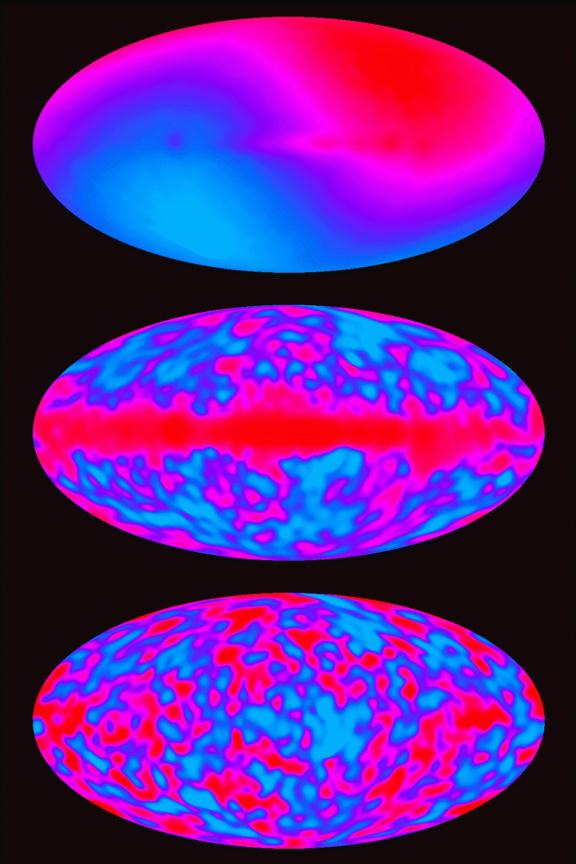 You can feel it in the air in early Autumn: the imminence of the Physics Nobel Prize announcement. I had just arrived at CERN this morning (after a major move from upper Manhattan to Chelsea...long story) when the announcement appeared. The COBE guys have finally gotten their due, and I suppose the huge success of the WMAP program, which is nominally "better", justified the lasting influence of the earlier measurements. However while year-after-year, I am consistently surprised by the choices (both in their content and timing), this year's lucky pair sounded somewhat prepared:
Smoot: ''The discovery was sort of fabulous. It was an incredible milestone. Now this is a great honor and recognition. It's amazing,'' he said.
Mather: "I can't say I was completely surprised, because people have said we should be awarded, but this is just such a rare and special honor,'' Mather said in a telephone interview with the Nobel committee.
Subscribe to:
Posts (Atom)
