
Wednesday, February 14, 2007
2001: Central Park
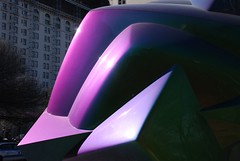
K and I stumbled on this, if one can think it possible to "stumble" on anything sitting on the southeast corner of Central Park, kitty-corner to the Apple Store. It's Liz Larner's "2001", a 12'x12'x12' mashup of a huge sphere and a huge cube, coated with essentially resilient automobile paint that reflects different colors from different angles. Excellent.


Science Creative Quarterly
 My god, a McSweeney's for creative science types. With knots and badges for Science Scouts, no less. I guess I qualify for Badge #6 ("The 'I blog about science' badge") and Badge #32 ("The 'I've done science with no concievable practical application' badge") and maybe
 #23 ("The 'I work with way too much radioactivity, and yet still no discernable superpowers yet' badge"). Do I qualify for Eagle Science Scout yet? Heck, I never even made it to cub scout meetings when I was a kiddo in the 70's. Too bad, as I'd surely invalidate SCQ's recent Valentine's Day Hypothesis #1 "All we need is love".
The project looks neat. Thanks to the intermittently-posting Collision Detection for pointing to it. Clive also points to this outrageous video of a glowing giant squid. Glowing. Giant. Squid. Egads.
Tuesday, February 13, 2007
Forever Blowing Bubbles
 Catching up on ATLAS work today, but while waiting for my Athena (software) to compile I'm catching up on some physics blogs. Bee, from Backreaction (whom I'll be guest-blogging for in the next week or so!) has linked to an older post of hers on "Water in Zero Gravity". Most people who've spoken to me in the last few years know that I've become mildly obsessed with fluid behaviors of all sorts, in the vain hope that I'll collect enough insight to better understand the "near perfect fluid" we think we're making at RHIC.
This one will haunt my dreams for a while. And this one (1930 animation, totally off-topic, downloadable here) will haunt yours (i.e. it's old, weird, fascinating -- and nominally children's entertainment. Go figure!)
Friday, February 09, 2007
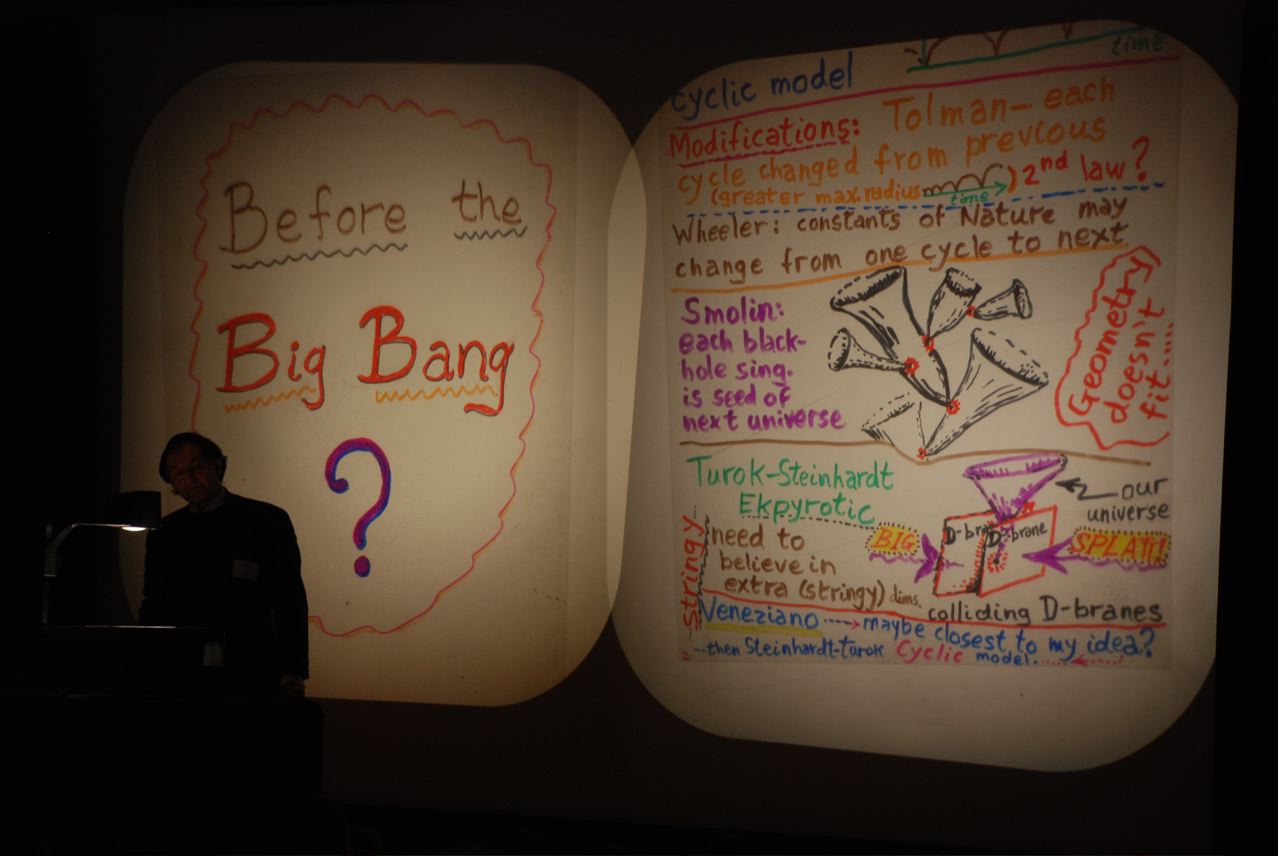
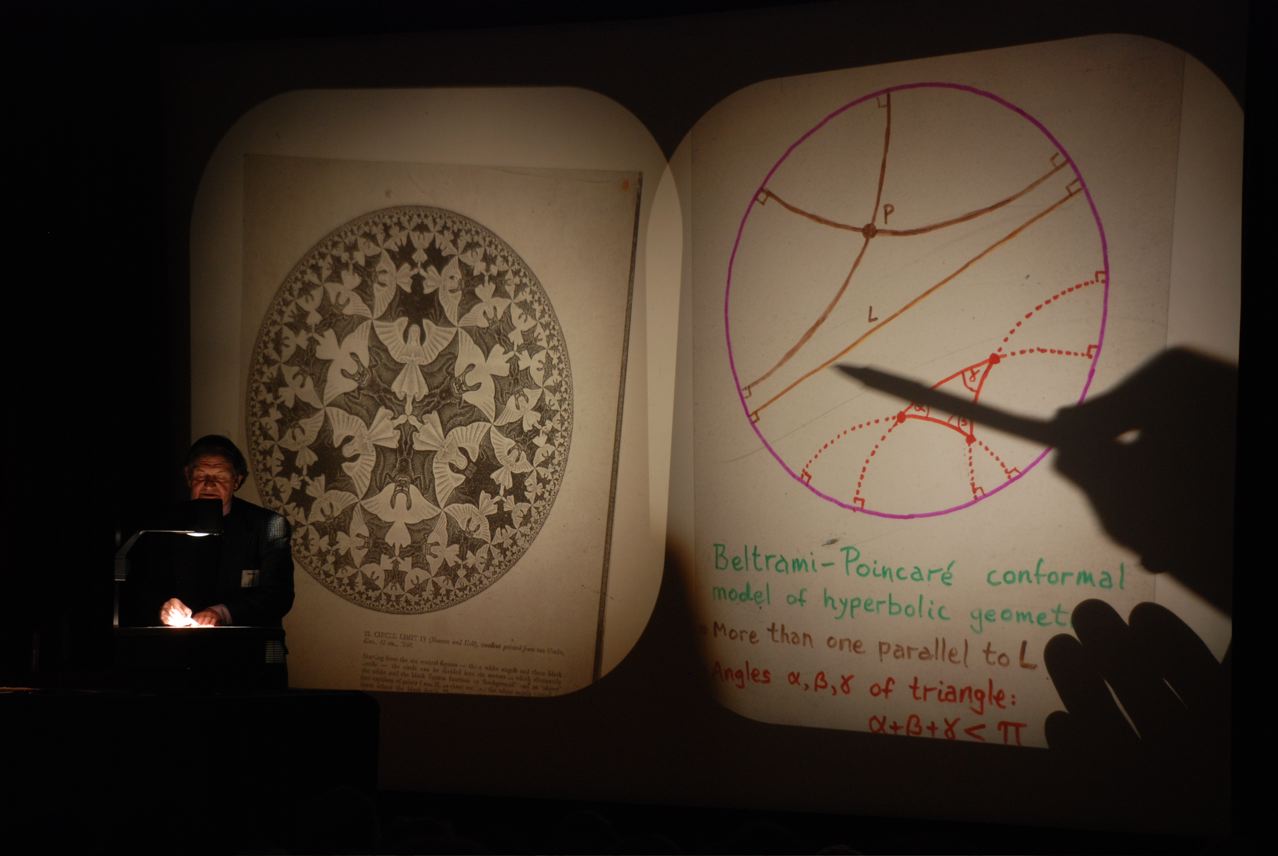
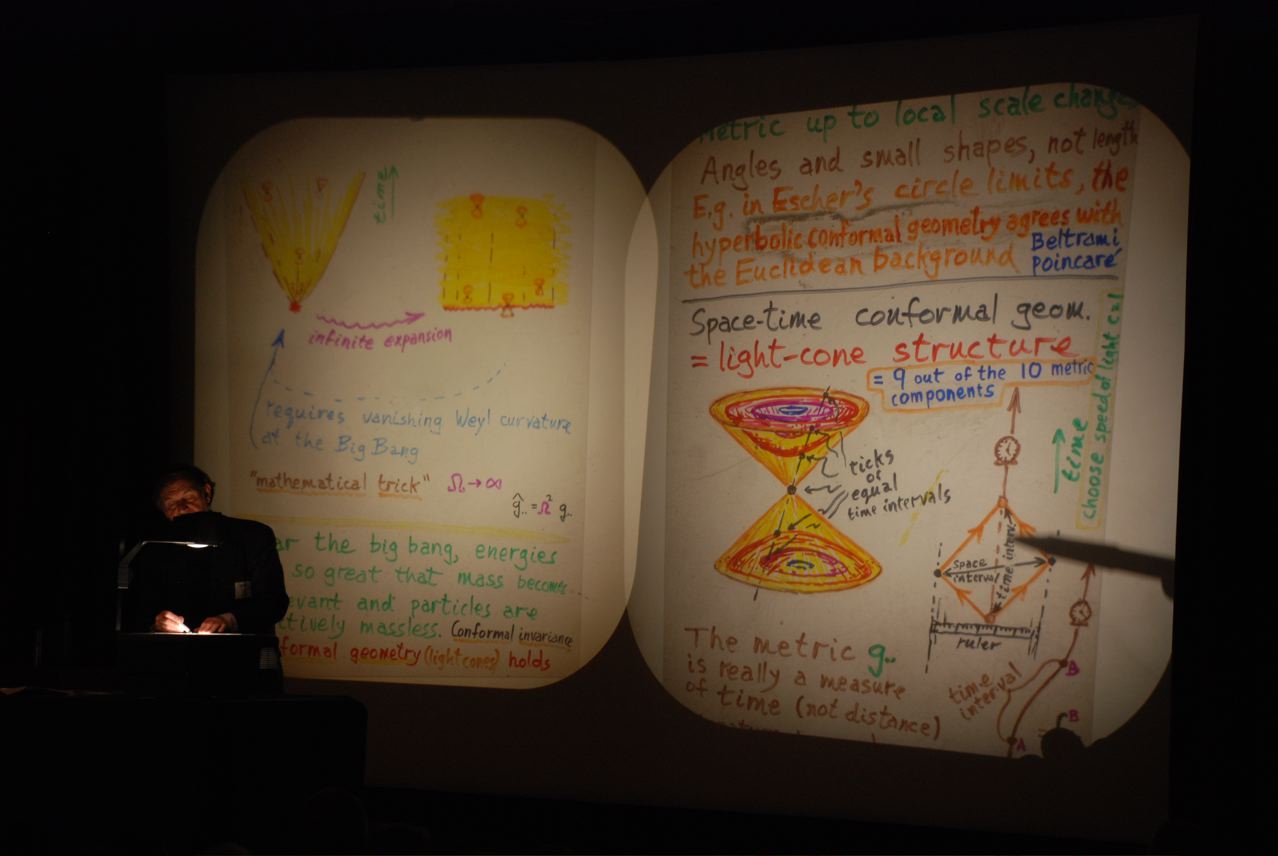
Penrose's Universe (@ BNL 2/6/07)
Roger Penrose stopped by Brookhaven early this week, to discuss his views on the Big Bang...and before. While I'm still working through what he seems to be saying (that the universe somehow serves as the "inflationary" period for the universe which succeeds it...) I found his slides particularly evocative and managed to get a few photographs. Enjoy!
Quantum Computer History
 Not sure how or why I missed this yesterday, but I was really busy. Really. But really, quantum computing is now technology that can be demonstrated? Last I checked, it was still a messy tech on the bench, and thought to be incredibly fragile. Now D-Wave is "ready to make computer history" (but shouldn't that be "computing history"?) with it's Orion system:
The Orion system is a hardware accelerator designed to solve a particular NP-complete problem called the two dimensional Ising model in a magnetic field. It is built around a 16-qubit superconducting adiabatic quantum computer processor. The system is designed to be used in concert with a conventional front end for any application that requires the solution of an NP-complete problem.Of course, the skepticism level is still high:
"This is somewhat like claims of cold fusion," said Professor Andrew Steane of Oxford University's Centre for Quantum Computing. "I doubt that this computing method is substantially easier to achieve than any other."But wait a minute, that D-wave blog post says that:
At the demo, what we’re going to do is run two different applications, live, on an Orion system residing in Burnaby, BC. Orion is designed such that it can be used remotely, and this is the mode we’ll be using for the demos.They're going to run a hardware demo in California on brand-new, highly-anticipated, but widely-doubted technology, and the hardware will be a thousand miles away from the demonstration site? Not the greatest marketing concept I've ever heard, and it won't do much to fend off those skeptics no matter how well it seems to work. We'll check back next week.
But in the meantime, D-wave's blog also points to a paper on arxiv.org on the Orion's architecture. Arxiv? Did I mention that I was really busy yesterday? And this news is burning up the gadget blogs, e.g. check out these images posted to Gizmodo...
Thursday, February 08, 2007
Nuke You Less
 Stumbled on this NYT blog piece by...Dick Cavett?...on a subject near and dear to my heart, and a mainstay of my cocktail party banter: just why W refuses to say "nuclear" correctly. Everyone knows it's "new clear", but even now, more than six years after "winning" the 2000 election, he insistently, deliberately says "nuke you lur" over, and over, and over again. Really, I've learned to accept it as the usual follow-up joke people make when I tell them my profession for the first time. While it instinctively drives me nuts, it's not a matter of personal and professional pride. I certainly agree with Cavett that it's a slight to the English language. But I have also thought that it's his way of being stubborn in the face of criticism from "intellectuals", whom he probably ultimately as effete ineffectuals, worrying about pronunciation when there are more important things to deal with in the post-9/11 world. But of course this is the same stubborn disregard that has gotten him and his colleagues and our country into such trouble in the past -- and which continues unchecked to this day.
Anyway, I heard Andy Rooney riff on this on 60 minutes when I surfed by CBS at the gym last week. And I like Cavett's transliterations, especially "nuke-you-luss". I'll have to sneak that into a talk one of these days. And I'm not going to reflect on "nuke you less" in the light of Seymour Hersh's reporting on the Administration's plans for Iran.
(And an interesting footnote: surfing around Google images to find a nice image of a nukeyouless, there are a lot more cells than subatomic clusters of nucleons... A sign of the times?)
Tuesday, February 06, 2007
Steve Jobs vs. DRM

I know this isn't in my official purview, but I've hated DRM on my iPod just like everyone else. But, Lo and behold, Steve Jobs doesn't like DRM either and is willing to speak out against it on the Apple website:
Though the big four music companies require that all their music sold online be protected with DRMs, these same music companies continue to sell billions of CDs a year which contain completely unprotected music. That’s right! No DRM system was ever developed for the CD, so all the music distributed on CDs can be easily uploaded to the Internet, then (illegally) downloaded and played on any computer or player.It's way too fun to imagine Steve actually reading this outloud, in his inimitable (well, highly imitable, but you know what I mean) style. Right on, Brother. Next, Bill Gates has to make Windows free, or at least cheap, to keep those Russian schoolteachers out of Siberian prison.
In 2006, under 2 billion DRM-protected songs were sold worldwide by online stores, while over 20 billion songs were sold completely DRM-free and unprotected on CDs by the music companies themselves. The music companies sell the vast majority of their music DRM-free, and show no signs of changing this behavior, since the overwhelming majority of their revenues depend on selling CDs which must play in CD players that support no DRM system.
So if the music companies are selling over 90 percent of their music DRM-free, what benefits do they get from selling the remaining small percentage of their music encumbered with a DRM system? There appear to be none. If anything, the technical expertise and overhead required to create, operate and update a DRM system has limited the number of participants selling DRM protected music. If such requirements were removed, the music industry might experience an influx of new companies willing to invest in innovative new stores and players. This can only be seen as a positive by the music companies.
Much of the concern over DRM systems has arisen in European countries. Perhaps those unhappy with the current situation should redirect their energies towards persuading the music companies to sell their music DRM-free. For Europeans, two and a half of the big four music companies are located right in their backyard. The largest, Universal, is 100% owned by Vivendi, a French company. EMI is a British company, and Sony BMG is 50% owned by Bertelsmann, a German company. Convincing them to license their music to Apple and others DRM-free will create a truly interoperable music marketplace. Apple will embrace this wholeheartedly.
Entertaining Science vs. the Super Bowl
 Yes, despite being a longtime Chicagoan, I missed more than half of the Superbowl by attending Roald Hoffman's "Entertaining Science" series on Sunday evening at the Cornelia Street Cafe down in Greenwich Village. And while I felt more than a little twinge of traitorious guilt, I really enjoyed the talk (on organic chemistry, no less) by Karl Anker Jørgensen of Aarhus. The theme of the last couple of programs has been the role of "mirror molecules", and I never cease to be surprised by the wildly different functions of chiral molecules (e.g. peppermint vs. caraway) and their benign and malign effects on biological processes (e.g. sugar substitutes vs. thalodomide). Next program is Sunday, March 4 -- see you there.
Monday, February 05, 2007
What is the, ahem, LHC?
 Just stumbled on this, in the "Big Questions" piece in the recent Wired magazine. John Hodgman (full disclosure: whom I went to school with years ago...) reports:
What is the Large Hadron Collider?I've never heard this joke before. I swear.
The Large Hardon Collider is a giant particle accelerator: a 17-mile-long tunnel beneath Switzerland and France. With it, scientists hope to isolate the Higgs boson, the particle that could explain mass. Some worry that the Hardon Collider is too big and could create a black hole that, while awesome, would destroy Earth. Is such a huge Hardon Collider worth it? Why are you laughing? Oh. Oh. I see. My mistake. I meant to say “Large Erection Collider.”
Friday, February 02, 2007
Not Exactly a Hollywood Ending, 2007 Edition (i.e. RHIC funded in 2007)
 Sometimes we get incredible surprises, like the Renaissance Technology intervention at the end of 2005, but this time we get, well, surprises...like the 2007 budget as it was promised to us last year. No small thing, given the huge transitions in the Congress. Anyway, In the email box this morning (Thanks, Susan!):
"Energy Dept. Assures Delegation It Will Fully Fund Brookhaven's RHIC Program, Significantly Fund NSLS-IIHere's more of the press release hosted by the BNL press office. This is really great news -- and now we can go back to our regular programming. Lots of entropy to bound out there.
...
Editor's Note: The following is a joint statement released from the offices of Senator Charles Schumer, Senator Hillary Clinton and Congressman Tim Bishop.
...
Following this week’s announcement that the Department of Energy’s Office of Science will receive a $200 million increase for the FY 2007 from its FY 2006 funding level, yesterday, DOE Office of Science Director Raymond Orbach assured Senators Schumer and Clinton and Congressman Bishop that the Relativistic Heavy Ion Collider (RHIC) program will be fully funded for FY 2007 and the National Synchotron Light Source II (NSLS II) program will be significantly funded for FY 2007. Orbach’s assurance is a huge victory for Brookhaven National Labs which was girding itself for devastating budget cuts.
On Tuesday, Senator Schumer sent a letter to the Office of Science urging it to use its increased budget to fully fund RHIC and NSLS II. Yesterday, Schumer followed-up with a phone call to Director Orbach and secured assurances that RHIC would be fully funded and NSLS II would be significantly funded for FY 2007.
“I’m thrilled that Director Orbach responded so quickly to our request, and that he understands the huge impact Brookhaven’s programs have on our nation’s scientific research and Long Island’s high-tech job market,” said Senator Schumer. “Continued funding for these two cutting-edge programs will help ensure that American science remains a global leader.”
Thursday, February 01, 2007
Silence
 Sometimes you just gotta go. While I'm totally knuckled under with papers papers papers (catching up from last year's conferences this year...) K's friend was showing a piece in an opening of "[silence]". I somehow managed to survive the mild traffic home (although the LIE is generally quiescent in winter for the most part) by nearly finishing up my listen to David Foster Wallace's excellent (if ridiculously-abridged) audiobook of "Consider the Lobster" and wound my way from the Midtown Tunnel to Franklin Street in Tribeca to Gigantic Artspace. There I walked into a maelstrom of, well, sound. Not exactly silent at all, as one of the pieces consisted of transmitters and various radios. K's friend Michelle
 Rosenberg had a lovely piece: a necklace made of headphone speakers, delicately connected by wires that conducted the signal being delivered by a pen-size Sony radio. Couldn't hear it above the din (silence, indeed) but it looked great.
In the way back was another fun piece, this one by Douglas Repetto. This one was a room-sized array of wooden blocks (show
 n on that web page), densely packed, suspended from the ceiling by thin wires. A switch was placed at head-level with "puff" on a slat of plywood. Blowing on it tripped the switch, which activated a small gadget near the ceiling that jostled one of the blocks hard enough to induce some "sound waves" in the "liquid" of blocks. I see physics everywhere, but this one wasn't trying to hide it at all.
Congressional Update
So the budget battle wages on, but a major victory happened yesterday, the implications of which are outlined in this Science article. One can find all of the blow-by-blows here on the house web page. This includes real honest-to-god blow-by-blows on the floor and a full roll-call of yeas and nays. Democrats were all-in, but only 30% of the Republicans went for it, 140 of them voting against (and with some prominent abstensions, e.g. Hastert). Are they angry about the earmarks removed so as to free up $130M for the DOE's discretion?
Tuesday, January 30, 2007
Gonna Sit Right Down and Write [Appropriators] A Letter
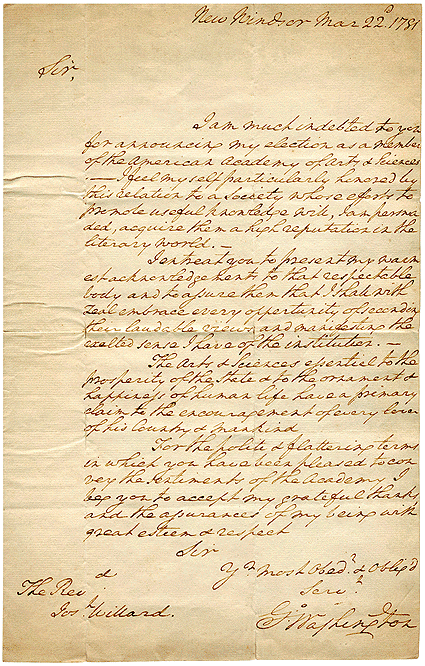 As I should have mentioned previously, this year's RHIC run depends crucially on legislative action to get us over the funding "hole" incurred by the inaction of the new Congress to pass a budget. There are several letters going around Congress, where the representatives and senators are being asked to support increases of funding to the DOE Office of Science and the National Science foundation. The current status of the letters is here, as posted on the AIP FYI web site. I and many of my colleagues participated in this process by writing letters to our local Congressmen asking them to sign this.
Apparently, the House will be considering legislation to finish up the 2007 budget process (good thing too, considering we're already 4 months into FY07!). Here's hoping they get the job done this time.
Sunday, January 28, 2007
A Day Off
 There is an iron law of professional physics: for every talk you give, there is some sort of proceedings (be it conference, workshop, meeting) to write. Thus, I've been having lots of trouble blogging, since all of my writing mojo has been used up by the end of each and every working day. And yet, it's a new year, the LHC is looming, my serial deadlines have almost run their course, and there are interesting new things popping up daily.
The last few days have been a brief respite from work, work-related travel, and family-related holiday travel (Woodstock, Vermont, Chicago, etc.) K and I decided to take our lives back for a day and remind ourselves about all the outrageously interesting things one can do in NYC, given one has time to take a deep breath and look around.
 So just in one day we: 1) zipped through the Chelsea galleries (this despite Jed Perl's withering assessment of the current scene in the New Republic, subscription required though...), seeing neat stuff by Kim Keever at Kinz, Tillou + Feigen, Adi Nes' photographs portraying biblical scenes at Jack Shainman, and Marc Newson at Gagosian,
 2) headed down to the Angel Orensanz Center on Norfolk to see Bill Morrison and Michael Gordon's "Decasia" live with at
 least 6 screens (does the decaying altar count as a "screen"?) and 55 musicians tucked into the balconies playing seemingly-asynchronous punctuated polyrhythms, all in the service of a beautiful montage of decaying vintage film stock (David Bowie was there too, seated about 10 feet from us. Dude.) and 3) grabbed dinner at Momofuku Ssam Bar on 2nd and 13th (the burrito -- ssam -- was fine but nothing special, but the urchin was tasty and the grilled mackerel stellar, as were the rice-coated ice cream balls). Not a bad day at all.
Friday, January 26, 2007
Budget Battles, Redux
 As good an update as any. As some of you may have read, RHIC is once again in the news. Not for new discoveries or technical progress, but because, once again, our funding is at peril, just as it was at the end of 2005. And the reason is the same, since the new congress has neglected to pass a 2007 budget at all, instead letting the government coast on a "continuing resolution" that nominally keeps all programs funded at last year's levels. Of course, with the normal rate of inflation, this translates into a 3-4% cut. On top of that, the '06 budget was notoriously stingy to RHIC science, requiring an infusion of $13M from private investors who realized that the return to investment was enormous (i.e. by investing less than 10% of the operating budget, they would be responsible for making good on a full year's operation). Anyway, no-one expects a similar Hollywood Ending this year, so an entire RHIC year remains on the block.
Unless.
Unless the Congress can pass legislation modifying the continuing resolution to allow reallocation of money within the Department of Energy. The money exists (leftover from completed projects) and it's just a matter of Congressional effort now.
Stay tuned.
Sunday, January 07, 2007
The Vanguard
 Maybe Lisa Randall was just paying me back a few karma points for linking my masses of readers to her online interview. Or not. In any case, here she is touting the virtues of science at RHIC in a Seed magazine piece on "The Vanguard of Science":
Also of interest is the recent application of string theory to the physics being done at the Relativistic Heavy Ion Collider (RHIC), where string theory permits some calculations that would otherwise be intractable. The idea at RHIC is to better understand the strong force that binds together the elements of a nucleon, and 2007 may see the theoretical advances of string theory inform the experimental results from RHIC.
Thursday, December 21, 2006
Order in Disorder
 I can't imagine how many times I've told myself to keep a cleaner desk, although I've always prided myself on knowing basically where to find everything I need, even in the midst of overflowing piles. Thus, I've always suspected that it was the sign that I was productive and keeping busy. But now now that I've changed offices, as part of an overall move from Chemistry into the BNL Physics Department, I'm worried that my desk (and office) is cleaner than ever, since I haven't had enough time to really get it messy. Thus, this piece in the times today seems particularly relevant -- Back to work.
Thursday, December 14, 2006
Atoms for Tots
 Atomic experiments for boys, indeed.
For a mere $49.50, the kit came complete with three "very low-level" radioactive sources, a Geiger-Mueller radiation counter, a Wilson Cloud Chamber (to see paths of alpha particles), a Spinthariscope (to see "live" radioactive disintegration), four samples of Uranium-bearing ores, and an Electroscope to measure radioactivity. And what nuclear lab for kids would be complete without an Atomic Energy Manual and Learn How Dagwood Splits the Atom comic book? (The latter was written with the help of General Leslie Groves, director of the Manhattan Project.)From Radar's 10 most dangerous toys.
Wednesday, December 13, 2006
New Year's Resolution?
New fiscal year, no budget. This is the story out of capital hill this week. Problem is, on a continuing resolution RHIC is on the same tight budget as last year, which didn't include nearly enough money for actual running. We were only spared from disaster (layoffs, etc.) by an infusion of money from James Simons and his colleagues at Renaissance Technology. It still boggles my mind that the continuing life and health of Brookhaven rests on relatively small fractions of its total budget. But this is how science is done: lots of fixed costs (especially salaries) and then the so-called "real work" on the margin. Unfortunately, even small shortfalls have dramatic effect (e.g. layoffs, deferred pay-raises) on the people at the lab who have given years of their lives to maintain the level of quality the government and the public (who are the real supporters, via taxes) expect.
It will be a frustrating knock-on effect from what I thought were otherwise satisfying elections if Congress simply leaves the hard decisions to individual recipients of government funding. Let's at least have a budget to argue about.
It will be a frustrating knock-on effect from what I thought were otherwise satisfying elections if Congress simply leaves the hard decisions to individual recipients of government funding. Let's at least have a budget to argue about.
Thursday, December 07, 2006
Both Sides Now (or, Tug of War?)
 While you may not be able to see this for a few minutes (it's CPU load is too high!), anyone who has been following the great String Theory Debate of 2006, via the action and reaction to the Smolin and Woit books, might want to check out UCSB Professor Joe Polchinski's review of them. This is a 'web-only' enhanced version, with some very candid and informative footnotes. Having read Smolin's book recently, I am trying to apply a more skeptical eye to string theories claims, and especially their media hype. But this is science, folks, and there ain't no science without arguing (and sometimes the down-and-dirty, ad hominem type, but that's not here -- you'll have to poke around Lubos Motl's blog and comments on other blogs for that!)
Sunday, December 03, 2006
Wondering about Wonders (VOTE NOW)
 CNN posted an amusing series of articles last week on "Modern Wonders" of the world, taking stock of the great engineering feats of the last couple of decades. Near the bottom of the page, they give us the humble readers a chance to vote on our "choice", of which they give us seven possibilities. Now while it would have been more interesting for the readership to nominate their own, who can complain: CERN alone accounts for two of them -- the World Wide Web and the LHC itself -- and those are the two that have topped their informal poll on which is the "greatest wonder" of the seven.
It's gratifying that these two projects have been recognized by the public. Instead of just being a big bridge to admire, one of them spawned the largest "world mind" that anyone could have imagined, and the other will hopefully give that collective mind a few new things to rattle around in its collective brain for the next decade. Of course, I really hope the media avoids interesting non-sequiturs like this one in the future:
It is so powerful, it is capable of creating mini-black holes. The hope is that the collisions -- up to one billion per second -- will reproduce the conditions that were in existence immediately after the Big Bang some 10 billion years ago.Really, I appreciate the interest of news outlets like CNN, but would a tiny level of fact-checking hurt anyone?
(Thanks, Howard)
Wednesday, November 29, 2006
Polonium, for Sale?

Never has my career (nuclear physicist) seemed so...timely, as it does now, with this outrageous Litivinenko affair. But pity the poor guys at, yes, United Nuclear, legal salesmen of radioactive sources for the general public. Atomic experiments for boys, indeed.
Thursday, November 09, 2006
Discover String Theorist
 Interestingly, and flatteringly, I've been getting some emails directly from publishers and magazines promoting their products. I hope I have enough readers (but it's quality and not quantity, right?) to warrant this attention!
Anyway, the people at Discover.com have alerted me to an online chat with Lisa Randall, today from 2-3pm. Have a look/listen/read if you can. She's been making serious waves on popular culture this last year.
Of course I've had her book on my to-read list for a year and haven't managed to read more than the acknowledgements. On the other hand, I have been reading Lee Smolin's new book, which is being branded as "anti-string theory", but I've been finding fascinating for many other reasons. Stay tuned for my blog review.
Monday, October 30, 2006
Building Supporting Research
When I first arrived at BNL in the late 1990's I was in some awe of the place, but I was always a little let-down by how run-down many of the buildings were. I appreciate that scientists are practical people, so if the building still stands and people are getting work done, then why worry? But I also am somewhat of a stickler for a well-thought-out environment and so it's nice to see refreshes of ones surroundings here and there. And BNL hasn't really had one since the 1970's as far as I can tell, most of the main office buildings being built between the 40's and 60's (including Chemistry, where I still work for the moment).
Anyway, all of this is to express my appreciation to the DOE for funding a spanking-new addition to BNL architecture (a long neglected field of study): the Research Support Building. This lab is going to be around for quite a while yet, and it deserves structures that send out that message (the nanoscience building is next...).
Only one thing missing: the smell of freshly-brewed coffee in the atrium. Hopefully more on that some other time.
Wednesday, October 25, 2006
Nashville
I'm back from Nashville, at last. It was an interesting trip, and I have a few photos to show for it.

Monday, October 23, 2006
Boy in the Bubble
 Yow, way behind on blogging again. Not that I haven't been up to anything, but it would take me all day just to recap the last couple of weeks. Suffice it to say that I've done a few things I've never done before: bike 60 miles, get engaged, and go to Nashville, where I am now. I can tell you which one was my favorite, and staying here in a bubble is not one of them! I am attending the meeting of the "Topical Group on Hadron Physics", where I gave a talk yesterday, but I'm heading home tomorrow to get back to my real life. It's hard to explain the effect of living inside a huge (63 acre) hotel where you can walk for 15-20 minutes (which I often had to just to change sessions) without ever going outside. It's apparently the closest to a Vegas hotel you can get without actually hitting the casinos (I've never been to Vegas so I have to take the world's word for this).
Anyway, Nashville itself is pretty neat: the honkytonks really look and act like I hoped. Stay tuned for photos.
Friday, October 13, 2006
Google does Units
 Speaking of Google, a colleague pointed out that the search engine knew what a GeV was -- in joules. I wanted to check if it knew how to combine units, and do a bit of quantum mechanics at the same time: check. Freshman physics will never be the same, especially if they can bring their EDGE-enabled cellphones.
Pixelization of the Landscape
 Now that experts have discovered where the deadly E Coli comes from, I wanted to get the big picture. And that comes from Google Maps of course. What blew my mind about this satellite view of the Salinas valley was the stark contrast betwen the green mountainous regions to the northeast and southwest, and the complete parcelling out of the fertile land in the valley. I first thought the satellite image had been tampered with until it became obvious that the pixelization was man-made, on gargantuan scales. Nothing incredibly deep here, but the contrast surprised me.
Wednesday, October 04, 2006
Accelerator in Your Pocket?
 And speaking of GeV, here's a somewhat old article pointed out in Slashdot yesterday: "From Zero to a Billion Electron Volts in 3.3 Centimeters: Highest Energies Yet From Laser-Wakefield Acceleration".
Impressive as this is, "It's the tip of the iceberg," says Leemans. "We are already working on injection" -- inserting an already energetic beam into an accelerating cavity -- "and staging," the handoff of an energetic beam from one capillary to the next and subsequently to others, until very high energy beams are achieved. "Brookhaven physicist Bill Weng has remarked that achieving staging in a laser wakefield accelerator would validate 25 years of DOE investment in this field."Holy crap.
Leemans's group and their collaborators look forward to the challenge with confidence. "In DOE's Office of Science, the High Energy Physics office has asked us to look into what it would take to go to 10GeV. We believe we can do that with an accelerator less than a meter long -- although we'll probably need 30 meters' worth of laser path."
How Jets were Born
 Amidst this interesting article in the science times yesterday on the issues faced by women in science, and physics more specifically, it was pointed out that Gail Hanson of UC Riverside discovered "quark jets". I have to admit that, even after being in my field for 15 years, I had never heard of anyone credited with the discovery of jets. Rather, I had always understood the "discovery" of jets to be the gradual acceptance of the phenomenon by high energy physicsts as the energy increased.
Of course, I was wrong. And I'm probably the last to realize this, since she's already won a Panofsky prize for this work.
Here's the link to the article on "Evidence for Jet Structure in Hadron Production by e+e- Annihilation" from Gail Hanson's website. Not only is this the first time anyone established the "jettiness" of hadrons emerging from the annihilations of electrons and positrons at "high energies" (6-7 GeV in this case), but there's actually a "first author" on this paper (Hanson herself), something which never happens anymore in high energy or nuclear physics anymore!
Tuesday, October 03, 2006
Ready for the Prize?
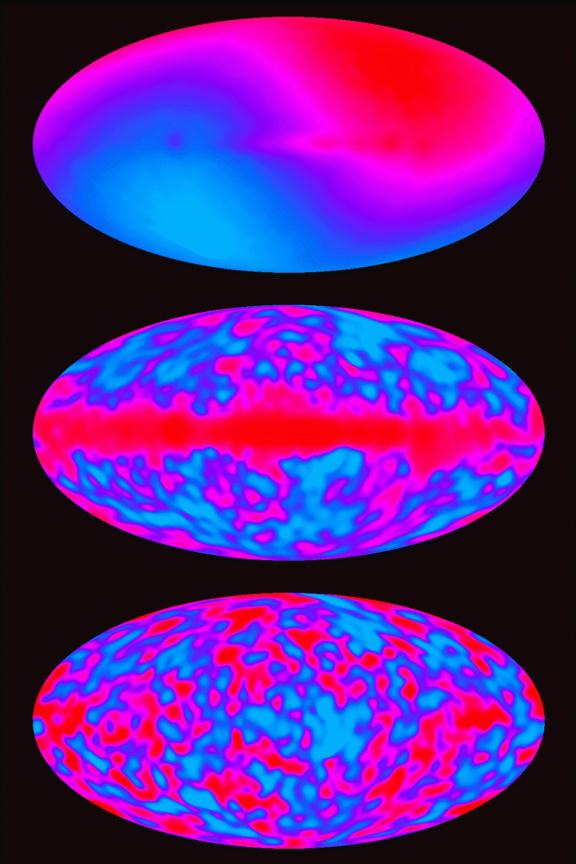 You can feel it in the air in early Autumn: the imminence of the Physics Nobel Prize announcement. I had just arrived at CERN this morning (after a major move from upper Manhattan to Chelsea...long story) when the announcement appeared. The COBE guys have finally gotten their due, and I suppose the huge success of the WMAP program, which is nominally "better", justified the lasting influence of the earlier measurements. However while year-after-year, I am consistently surprised by the choices (both in their content and timing), this year's lucky pair sounded somewhat prepared:
Smoot: ''The discovery was sort of fabulous. It was an incredible milestone. Now this is a great honor and recognition. It's amazing,'' he said.
Mather: "I can't say I was completely surprised, because people have said we should be awarded, but this is just such a rare and special honor,'' Mather said in a telephone interview with the Nobel committee.
Thursday, September 28, 2006
Artifact
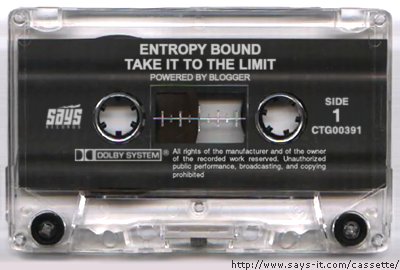 Look what I dug up. I didn't realize that I was audio blogging back in the early 90's. Ok ok, I found this here, via Gizmodo via Boing Boing.
Saturday, September 23, 2006
Quarks Swim Free
 Not sure how I missed this, but Elliot Sharp has a piece floating around town these days that I really should check out: "Quarks Swim Free":
Quarks Swim Free is E#'s latest algorithmic piece for Orchestra Carbon. For 11 or more musicians and based on prime numbers, Quarks Swim Free creates a dense primordial soup filled with high-energy collisions, gnashing grooves, and warped melodies. Quarks Swim Free premiered at the Venice Biennale in 2003. This performance will be captured by noted documentarian Bert Shapiro for his film on E#'s work.Sounds neat, but I was intrigued where the title came from. Best I could come up with was Kenneth Chang's NYT piece (archived by Brookhaven here):
For this concert the ensemble includes Kinan Azmeh, Curtis Fowlkes, Rachel Golub, Brad Jones, Ron Lawrence, Jenny Lin, Chris McIntyre, Rudresh Mahanthappa, Kevin Ray, Danny Tunick, Alex Waterman and more
An atomic nucleus consists of protons and neutrons, which, in turn, consist of smaller particles, quarks. Quarks are held together by still another type of particle, gluons. In ordinary matter, it is impossible to pull out an individual quark or gluon.I saw Sharp play at a benefit last year, accompanying a Jenn Reeves film (thanx Jen!), and I definitely would have swung by last night (if one can swing by Carroll Gardens from the Upper West Side...), but it's Rosh Hashanah folks and Kate and I had a service to attend. Happy new years everyone!
But with hot temperatures and high pressures, physicists theorize, the gluon bindings loosen, and the quarks can swim free, melting protons and neutrons into a new state of matter, a quark-gluon plasma.
Thursday, September 21, 2006
Blow-Up
 Uh-oh, trouble in cosmologyland: Type Ia supernovae, the objects responsible for the post-1998 consensus that the universe is not just expanding, but accelerating, aren't such standard candles after all:
Now, astronomers led by Andrew Howell of the University of Toronto in Canada have found a type Ia supernova that is 2.2 times as bright as others of its class. Called SNLS-03D3bb, it lies about 3 billion light years away, a distance that was independently verified by studying the light spectrum of its host galaxy.As a student, I found it amazing that you could use brightness to measure distance. One always suspects that it's harder than it looks, but it's quite impressive that they have sufficient precision to detect outliers. Unfortunately, once everyone trying to image the dynamics of a younger universe gets on board, they're probably going to have a fun time agreeing on just who the "rogues" really are.
That brightness, along with other clues from the supernova's spectrum, suggests the white dwarf exploded with 2.1 solar masses of material – significantly above the Chandrasekhar mass. "It wasn't a little bit over – it was way over," Howell told New Scientist. "We're forced to say it's not a measurement error."
These young galaxies are found more often in the early universe, which corresponds to greater distances from Earth. "This might actually improve our precision in future studies if we identify this little subset of supernovae," says Howell.In my kind of physics, we sometimes call such things "pentaquarks". Ouch.
(Thanks to slashdot, apologies to Brian de Palma for post title...)
Monday, September 11, 2006
The Rising
Hard to believe it's been 5 years, isn't it? Long story, but I spent most of yesterday in Valhalla, NY, out in Westchester County, watching the dedication of "The Rising". This 80-foot high steel structure, designed by architect Frederick Schwartz, commemorates the 109 Westchester residents who died in the 9/11 attacks. A beautiful work, poignant and soaring -- and not absurdly expensive.
The dam itself is a beautiful object in itself, massive beyond words. All of this, plus candids of Hillary Clinton, Chuck Schumer, and a Bruce Springsteen tribute band, here in my Flickr set.
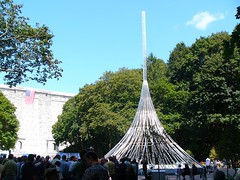
The dam itself is a beautiful object in itself, massive beyond words. All of this, plus candids of Hillary Clinton, Chuck Schumer, and a Bruce Springsteen tribute band, here in my Flickr set.
Friday, September 08, 2006
The Chelsea Particle Zoo
 As one of the seemingly-few unofficial nuclear physicists about town, I can't resist chiming in when the culture industry starts to wander into scientific territory. Kate and I cut out of work a little early yesterday to check out the endless array of Chelsea art openings. I wasn't expecting much (not following the art scene too closely, I admit) but I wasn't expecting The Particle Zoo at the Mike Weiss Gallery.
Don't get me wrong, there is enormous potential in mining scientific concepts and images. Nature throws us many things we could never have imagined until we actually look (with eyes or detectors or telescopes or models, etc.). That said, rainbows and glassy shapes don't really do it for me.
Monday, September 04, 2006
Follow the Bouncing Ball
Summer's over, folks, as is my recent vacation (to the North Fork of Long Island, Southwest Florida, and finally back to NYC). But what better way to acknowledge this fact than to sit my ass down for 6 hours to watch a lot of great tennis at the US Open. Some friends were already going and it didn't take much to get Kate and me on board. Have a look at my Flickr set!
Clearly I didn't get to see Agassi's final game, but given the sold-out General Admission tickets I'm glad I got to see anything at all. Then again, who can complain about seeing greats such as Safin and Davenport without too much fuss? I even learned how to run my camera (Panasonic FZ10 -- beautiful machine, that) in "sports mode" and capture wild serve poses that I would never notice with just my eyes. There's a lot more richness to the game than just the elastics and ballistics of balls hitting rackets.

Clearly I didn't get to see Agassi's final game, but given the sold-out General Admission tickets I'm glad I got to see anything at all. Then again, who can complain about seeing greats such as Safin and Davenport without too much fuss? I even learned how to run my camera (Panasonic FZ10 -- beautiful machine, that) in "sports mode" and capture wild serve poses that I would never notice with just my eyes. There's a lot more richness to the game than just the elastics and ballistics of balls hitting rackets.
Wednesday, August 30, 2006
Melvin Schwartz Dies at 73
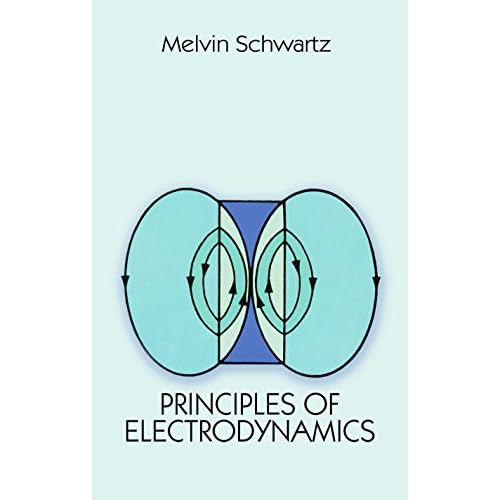 Terrible day, the world losing both Naguib Mahfouz and Melvin Schwartz. Schwartz was many things, a professor at Columbia, Nobel-prize winner in 1988 for the discovery of the muon neutrino, and a major figure in the history of Brookhaven. He was both a scientist there (i.e. the neutrino work) as well as an administrator (overseeing the RHIC project in its early stages!).
Just a point left out of the obituaries: I never met him (he had left the field again by the time I got my PhD), but I always enjoyed his book on electrodynamics. It was one of the more elegant descriptions of the physics and mathematics that I had seen up to that time (1991). And it was cheap -- god bless Dover.
Tuesday, August 29, 2006
Wired, Tired
 When did Wired magazine become merely glib?
Despite the demagoguery (and apparent laziness) of those who keep making these kind of claims (i.e. they haven't read anything about the subject since 1999 *before* the machine turned on, or they only read people who have written about it since, who themselves have been asleep since last century...), RHIC has produced hundreds of interesting papers, many new scientists, and several really fascinating results about high density matter. And no black holes.
(Thanks Rick!)
But if you check the next page, then things are more like it. In the "Wired, Tired, Expired" list for the week: "Wired: scientist blogs". Still can't say Wired is, well, required, but my vanity can't keep from giving it a few points.
Tuesday, August 22, 2006
Who's Gonna Live Forever?


Not to overdo NYTimes mining, but I'm still trying to figure this one out. Do the best of us truly become fame-obsessed, or run for the hills when the pressure gets too great?
Einstein, Mao,and Me
 How can someone resist procrastinating when stumbling on an article like this? Dennis Overbye's profile of Xu Liangying, the foremost translator of Einstein's works in China, and a communist revolutionary turned dissident. From humble beginnings:
The love affair between Dr. Xu, who was born in Linhai, Zhejiang, in 1920, and Einstein began when Dr. Xu was in secondary school and read a collection of Einstein’s essays called “The World as I See It.” The book had as much politics as science. In one passage that the young Xu underlined, Einstein wrote: “The state is made for man, not man for the state. I regard the chief duty of the state to protect the individual and give him the opportunity to develop into a creative personality.”
Dr. Xu said, “I wanted to be such a person.”
Einstein's outlook on intellectual freedom developed into a source of political philosophy that got Xu into more trouble than not. Definitely worth a few wasted minutes at work.
Monday, August 21, 2006
A Matter Darkly
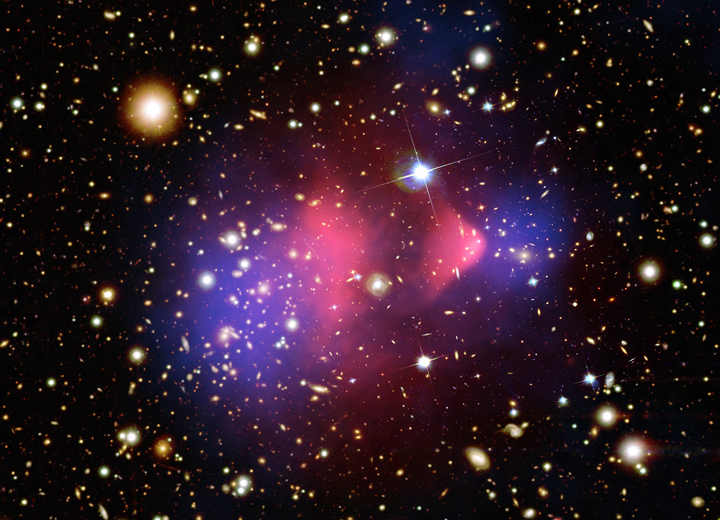 Go freaking figure, just a day after ranting on about RHIC physics to a whole group of friends who trekked out to BNL from NYC, those damn astronomers have got to get some cheap media attention by doing something easy: like finding dark matter. What I find somehow pleasing, though, is how conceptually familiar it all feels. Hereby begins a novice's description
The image shows a collision of two galaxy clusters, but imaged in three different ways. The optical image shows flashes of white galaxies, something we are used to seeing through telescopes. The pink shows an image of the distribution of hot gas surrounding the cluster, imaged by X-ray astronomy (i.e. by looking at the photons emitted by the gas), which seems to have taken on an oddly "Mach Cone" shape, if I may add. Finally the bluish clumps are the distribution of mass, as imaged by the distorted views of the galaxies behind (i.e. gravitational lensing).
The rub lies in the way the pink and the blue have separated. The general view is that the gas has slowed down as the clusters passed through each other, while the dark matter has continued moving on. But if the gas was somehow the more massive part of the system, one would have also found the mass there as well.
The familiar part is that my colleagues and I have been pondering what happens when clumps of things we like, strongly-interacting nucleons (i.e. nuclei), pass through each other at high speed. We also try and "image" the space time story, but of course using different tools. We can't see spatial distributions directly, but we can infer them from the final velocities. Of course, they can't repeat their collisions, while we do so thousands of times per second. And we're all using theories, like hydrodynamics, which are amazingly applicable at extremely microscopic and extremely macroscopic scales.
Friday, August 18, 2006
School of Rock, Gnarls-style
Hi everyone - I swear I'm getting back to blogging one of these days. But it's been a busy summer, both professionally and non. I shouldn't admit this, but we managed to actually see Gnarls Barkley last night at Summerstage (i.e. I had to duck out of an all-day meeting a little early, driving by a car whose wheel fell off in front of me...). Check out the photos!

Subscribe to:
Posts (Atom)
